The Failing "Dollar" - Inflation and the "BRICS Nations", Is America rushing to another "Great Depression"?


You saw in the jobs report that ... wages for the typical worker were up 3.7%. So if you're running 3.7% wage increases at 1.6% core inflation, then real wages are growing at a rate of about 2 [to] 2.5%. By our estimates right now, blue-collar workers have already seen an almost $2,000 raise this year after inflation, because wages are growing so much faster than prices," Hassett explained.
 
President Trump has managed the economy more effectively and efficiently in a good way than any President in my lifetime. And he is doing it in a way that doesn't kick the cans on down the road as most former Presidents, at least those in the 20th and 21st Centuries, both Democrat and GOP, have done.

There will be some pain for some associated with that as any kind of such changes are invariably inevitable. Mistakes will be made and need to be corrected. But the long range permanent effects will be good.
"President Trump has managed the economy more effectively and efficiently in a good way", "And he is doing it in a way that doesn't kick the cans on down the road"

I Absolutely Disagree Foxfyre,


Trump's tariffs, when he was first POTUS, drastically raised prices in the HVAC/Refrigeration/Plumbing, & Electrical fields. I saw prices for materials raise "across the board", with many costs doubling to quadrupling. I also experienced Massive Shortages on many of those Materials, so bad that instead of using one supply house, we had to use several. Material, &Equipment costs have risen so Astronomically that many Customers are not buying "New Equipment", and they were choosing to keep their older equipment longer.

Everything went up in cost, from Groceries to fuel, to Utility Bills, and there was very little difference in costs, when the Fake POTUS took Office.

Now that Trump is POTUS again, ..... It's the same thing all over again, But On Steroids! There are Contractors in the Cinti., Ohio area that are offering $2000.00 discounts, if not more, on their TV Ads, just to generate Business!
Trump, instead of coming up with a Solid Plan to reduce America's Astronomical Debt, that will soon destroy Our Economy,.... Added to it! And he Vastly enriched the "Military/Industrial Complex" via his so called "Big Beautiful Bill"!!
Aside from the Economy,... Trump is now zealously making Undeclared War, upon alleged drug boats, in International Waters, instead of intercepting them in American Waters! And, Trump is threatening to attack Venezuelan Drug labs, which I Firmly Believe will lead to another "Viet Nam like Undeclared, & Unjustified War".


"There will be some pain",........ There is "Pain" now, for the Middle Class, & The Poor, and if Trump stays on this "Path" It will absolutely grow worse!

And before You, or anyone else goes off on me about being a "Liberal", "Demoncrat", etc.,..... That's Bullcrap! I'm Far more Conservative than the majority of Republicans, and I can "Think Critically", unlike most "Trump Followers".

The "BRICS Nations" are now very close to releasing their Gold & Commodities backed Currency, & when they do, that will be the end of the Dollar, and that 38 Trillion + Debt, will be demanded to be paid!
 
"President Trump has managed the economy more effectively and efficiently in a good way", "And he is doing it in a way that doesn't kick the cans on down the road"

I Absolutely Disagree Foxfyre,


Trump's tariffs, when he was first POTUS, drastically raised prices in the HVAC/Refrigeration/Plumbing, & Electrical fields. I saw prices for materials raise "across the board", with many costs doubling to quadrupling. I also experienced Massive Shortages on many of those Materials, so bad that instead of using one supply house, we had to use several. Material, &Equipment costs have risen so Astronomically that many Customers are not buying "New Equipment", and they were choosing to keep their older equipment longer.

Everything went up in cost, from Groceries to fuel, to Utility Bills, and there was very little difference in costs, when the Fake POTUS took Office.

Now that Trump is POTUS again, ..... It's the same thing all over again, But On Steroids! There are Contractors in the Cinti., Ohio area that are offering $2000.00 discounts, if not more, on their TV Ads, just to generate Business!
Trump, instead of coming up with a Solid Plan to reduce America's Astronomical Debt, that will soon destroy Our Economy,.... Added to it! And he Vastly enriched the "Military/Industrial Complex" via his so called "Big Beautiful Bill"!!
Aside from the Economy,... Trump is now zealously making Undeclared War, upon alleged drug boats, in International Waters, instead of intercepting them in American Waters! And, Trump is threatening to attack Venezuelan Drug labs, which I Firmly Believe will lead to another "Viet Nam like Undeclared, & Unjustified War".


"There will be some pain",........ There is "Pain" now, for the Middle Class, & The Poor, and if Trump stays on this "Path" It will absolutely grow worse!

And before You, or anyone else goes off on me about being a "Liberal", "Demoncrat", etc.,..... That's Bullcrap! I'm Far more Conservative than the majority of Republicans, and I can "Think Critically", unlike most "Trump Followers".

The "BRICS Nations" are now very close to releasing their Gold & Commodities backed Currency, & when they do, that will be the end of the Dollar, and that 38 Trillion + Debt, will be demanded to be paid!
I stand by my post.
 

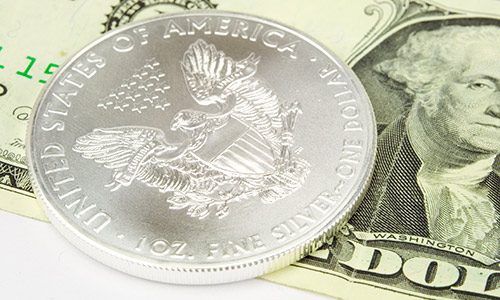
Silver Surges Toward The Magical $100 Mark, Global Debt Levels Are Exploding And The U.S. Dollar Is Dying​

by Contributing Author | Dec 27, 2025 | Precious Metals | 0 comments
silver-usdollar-e1586784471195.jpg

Do you LOVE America?​


Share​

Facebook
X/Twitter
LinkedIn
Email
Copy URL
This article was originally published by Michael Snyder at The Economic Collapse Blog.

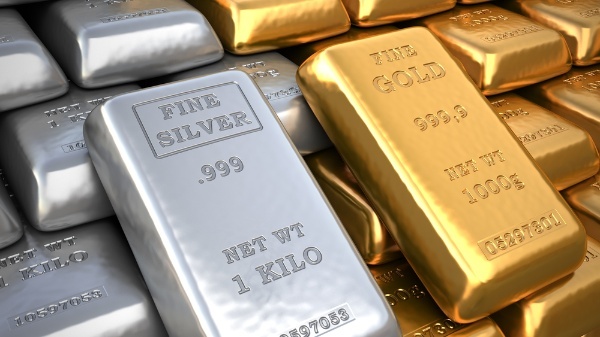
This year, silver has been on the greatest bull run that we have ever seen. It is up an astounding 166 percent since January 1st, and so those who purchased it long ago and stuck with it are really loving life right now. When the price of silver reached the 50 dollar mark earlier this year, I thought that it would be some time before it hit the 60 dollar mark. But of course, the truth is that it didn’t take long at all.

Once the price of silver reached 60 dollars, I thought that it might hit 70 dollars sometime in early 2026. If you check the latest numbers, you will see that we have easily blown past that threshold, and the price of silver has already surpassed 80 dollars in Shanghai. I know that I have been using the word “crazy” a lot lately, but without a doubt, what we are witnessing at this moment is truly “crazy.”

So why is this happening?

In a previous article, I discussed factors such as the AI boom, strong industrial demand, new technologies, and a spike in demand for physical silver in Asia.

But let’s step back for a moment and take a look at the bigger picture.

To me, it is not a coincidence that the price of silver is exploding at the exact same time that we are reaching the terminal phase of the largest global debt super cycle in history

Global debt has climbed to an all-time high of $337.7 trillion by the end of the second quarter of 2025, according to the latest Global Debt Monitor from the Institute of International Finance (IIF). The first half of 2025 alone saw an increase of over $21 trillion, largely driven by accommodative financial conditions, a softer US dollar, and continued government borrowing.

This jump is comparable to the COVID-era debt explosion in 2020, when governments and corporations worldwide dramatically ramped up spending to tackle the pandemic.
This is the first time in world history that all of the major powers are facing a nightmarish debt crisis simultaneously.

As this 337.7 trillion dollar debt bubble bursts, it is going to be so important to have your money somewhere safe.

So it makes all the sense in the world that there is so much demand for silver right now.

Long-term bond yields have been surging all over the globe, and this is even happening in nations that were once considered to be “safe havens” such as Japan and Germany

Long-term yields are rising sharply across many countries, including in Germany and Japan, which in the past used to be safe havens. That puts huge pressure on fiscally distressed countries like Italy and France and incentivizes short-termism. If the EU wants to become a geopolitical player, it can’t allow high-debt countries to dictate foreign policy. This has to stop.
Meanwhile, fiat currencies are rapidly losing value, and that has particularly been true for the U.S. dollar

The U.S. dollar was on the back foot on Wednesday and set for its biggest yearly fall since 2017, possibly with more to come, as investors wagered the Federal Reserve would have room to cut rates further next year even as most of its peers look finished with easing.

Tuesday’s solid U.S. GDP reading failed to move the dial on the rate outlook, leaving investors pricing in roughly two more Fed cuts in 2026.
This has been a horrible year for the U.S. dollar.

That is one of the reasons why the purchasing power of your money doesn’t stretch as far as it once did.

For the year, the U.S. dollar index is down about 10 percent

Against a basket of currencies, the dollar index fell to a 2-1/2-month low of 97.767. It was on track to lose 9.8% for the year, which would mark its steepest annual drop since 2017. Any further weakness in the last week of the year would take its fall to its greatest since 2003.
Please keep in mind that the other currencies that the U.S. dollar is being measured against are rapidly losing value as well.

It is just that the U.S. dollar is losing value even faster.

One of the reasons why the U.S. dollar is losing value so rapidly is that global central banks are becoming less dependent on it

The share of USD-denominated assets held by other central banks dropped to 56.9% of total foreign exchange reserves in Q3, the lowest since 1994, from 57.1% in Q2 and 58.5% in Q1, according to the IMF’s new data on Currency Composition of Official Foreign Exchange Reserves.

USD-denominated foreign exchange reserves include US Treasury securities, US mortgage-backed securities (MBS), US agency securities, US corporate bonds, and other USD-denominated assets held by central banks other than the Fed.
This is not good news at all.

Because, as Wolf Richter has aptly pointed out, having the reserve currency of the world has been a massive advantage for us…

Foreign central banks buying USD-denominated assets, such as Treasury securities, helps push up prices and push down yields of those assets. Being the dominant reserve currency had the effect of helping the US borrow more cheaply to fund its huge twin deficits – the trade deficit and the budget deficit – and thereby has enabled the US to run those huge twin deficits for decades. At some point, this continued decline as a reserve currency, as it reduces demand for USD debt, would make the trade deficit and the budget deficit more difficult to sustain.
People have been talking about the death of the U.S. dollar for a long time.

The U.S. dollar is certainly not dead yet, but the fact that it is in the process of dying should deeply alarm us.

The entire global financial system is shifting, and right now there is a global race to accumulate precious metals. This is particularly true for silver

Silver has been designated critical by the United States. Russia has increased accumulation. India has discouraged selling while encouraging the use of silver as collateral. The Middle East is preparing silver-linked tokenized instruments. Demand is rising across jurisdictions.
At the same time, there have been some things going on behind the scenes that have caused the price of silver to go parabolic over the last couple of months

Here’s the next dot: over the last two months, there has been a massive inflow of silver from Latin America into the United States. Not into China. Into the U.S.

Who is one clearinghouse? JPMorgan.

On Black Friday, JPMorgan effectively pulled silver off the market. That removal of available supply triggered a forced response elsewhere. Someone in China who was structurally short silver had to cover, and cover aggressively. That wasn’t a trade. That was a scramble.
I don’t see how the price of silver can keep going up at this rate.

At some point, it will stabilize.

But of course, silver is not the only precious metal that is in great demand right now.

On Friday, the price of platinum and the price of palladium both went absolutely haywire

Elsewhere, spot platinum rose 8.7% to $2,411.46 per ounce, having earlier hit a record high of $2,448.25, ⁠while palladium climbed nearly 10% to $1,850.76.
For those who have invested in precious metals, what we are witnessing at this moment is such good news.

Conversely, unprecedented volatility in the prices of precious metals is a major red flag for the global financial system.

Bond yields are going nuts, cryptocurrencies have already crashed, and global stock markets are flashing huge warning signs.


Many are anticipating a great deal of financial chaos in 2026, and at this stage it is hard to argue that they are wrong.

Michael’s new book, entitled “10 Prophetic Events That Are Coming Next,” is available in paperback and for the Kindle on Amazon.com, and you can subscribe to his Substack newsletter at michaeltsnyder.substack.com.

About the Author:
Michael Snyder’s new book, entitled “10 Prophetic Events That Are Coming Next,” is available in paperback and for the Kindle on Amazon.com. He has also written nine other books that are available on Amazon.com, including “Chaos”, “End Times”, “7 Year Apocalypse”, “Lost Prophecies Of The Future Of America”, “The Beginning Of The End”, and “Living A Life That Really Matters”. When you purchase any of Michael’s books, you help to support the work that he is doing. You can also get his articles by email as soon as he publishes them by subscribing to his Substack newsletter. Michael has published thousands of articles on The Economic Collapse Blog, End Of The American Dream and The Most Important News, and he always freely and happily allows others to republish those articles on their own websites. These are such troubled times, and people need hope. John 3:16 tells us about the hope that God has given us through Jesus Christ: “For God so loved the world, that he gave his only begotten Son, that whosoever believeth in him should not perish, but have everlasting life.” If you have not already done so, we strongly urge you to invite Jesus Christ to be your Lord and Savior today.


Silver Surges Toward The Magical $100 Mark, Global Debt Levels Are Exploding And The U.S. Dollar Is Dying​

by Contributing Author | Dec 27, 2025 | Precious Metals | 0 comments
silver-usdollar-e1586784471195.jpg

Do you LOVE America?​


Share​

Facebook
X/Twitter
LinkedIn
Email
Copy URL
This article was originally published by Michael Snyder at The Economic Collapse Blog.

This year, silver has been on the greatest bull run that we have ever seen. It is up an astounding 166 percent since January 1st, and so those who purchased it long ago and stuck with it are really loving life right now. When the price of silver reached the 50 dollar mark earlier this year, I thought that it would be some time before it hit the 60 dollar mark. But of course, the truth is that it didn’t take long at all.

Once the price of silver reached 60 dollars, I thought that it might hit 70 dollars sometime in early 2026. If you check the latest numbers, you will see that we have easily blown past that threshold, and the price of silver has already surpassed 80 dollars in Shanghai. I know that I have been using the word “crazy” a lot lately, but without a doubt, what we are witnessing at this moment is truly “crazy.”

So why is this happening?

In a previous article, I discussed factors such as the AI boom, strong industrial demand, new technologies, and a spike in demand for physical silver in Asia.

But let’s step back for a moment and take a look at the bigger picture.

To me, it is not a coincidence that the price of silver is exploding at the exact same time that we are reaching the terminal phase of the largest global debt super cycle in history


This is the first time in world history that all of the major powers are facing a nightmarish debt crisis simultaneously.

As this 337.7 trillion dollar debt bubble bursts, it is going to be so important to have your money somewhere safe.

So it makes all the sense in the world that there is so much demand for silver right now.

Long-term bond yields have been surging all over the globe, and this is even happening in nations that were once considered to be “safe havens” such as Japan and Germany


Meanwhile, fiat currencies are rapidly losing value, and that has particularly been true for the U.S. dollar


This has been a horrible year for the U.S. dollar.

That is one of the reasons why the purchasing power of your money doesn’t stretch as far as it once did.

For the year, the U.S. dollar index is down about 10 percent


Please keep in mind that the other currencies that the U.S. dollar is being measured against are rapidly losing value as well.

It is just that the U.S. dollar is losing value even faster.

One of the reasons why the U.S. dollar is losing value so rapidly is that global central banks are becoming less dependent on it


This is not good news at all.

Because, as Wolf Richter has aptly pointed out, having the reserve currency of the world has been a massive advantage for us…


People have been talking about the death of the U.S. dollar for a long time.

The U.S. dollar is certainly not dead yet, but the fact that it is in the process of dying should deeply alarm us.

The entire global financial system is shifting, and right now there is a global race to accumulate precious metals. This is particularly true for silver


At the same time, there have been some things going on behind the scenes that have caused the price of silver to go parabolic over the last couple of months


I don’t see how the price of silver can keep going up at this rate.

At some point, it will stabilize.

But of course, silver is not the only precious metal that is in great demand right now.

On Friday, the price of platinum and the price of palladium both went absolutely haywire


For those who have invested in precious metals, what we are witnessing at this moment is such good news.

Conversely, unprecedented volatility in the prices of precious metals is a major red flag for the global financial system.

Bond yields are going nuts, cryptocurrencies have already crashed, and global stock markets are flashing huge warning signs.


Many are anticipating a great deal of financial chaos in 2026, and at this stage it is hard to argue that they are wrong.

Michael’s new book, entitled “10 Prophetic Events That Are Coming Next,” is available in paperback and for the Kindle on Amazon.com, and you can subscribe to his Substack newsletter at michaeltsnyder.substack.com.

About the Author:
Michael Snyder’s new book, entitled “10 Prophetic Events That Are Coming Next,” is available in paperback and for the Kindle on Amazon.com. He has also written nine other books that are available on Amazon.com, including “Chaos”, “End Times”, “7 Year Apocalypse”, “Lost Prophecies Of The Future Of America”, “The Beginning Of The End”, and “Living A Life That Really Matters”. When you purchase any of Michael’s books, you help to support the work that he is doing. You can also get his articles by email as soon as he publishes them by subscribing to his Substack newsletter. Michael has published thousands of articles on The Economic Collapse Blog, End Of The American Dream and The Most Important News, and he always freely and happily allows others to republish those articles on their own websites. These are such troubled times, and people need hope. John 3:16 tells us about the hope that God has given us through Jesus Christ: “For God so loved the world, that he gave his only begotten Son, that whosoever believeth in him should not perish, but have everlasting life.” If you have not already done so, we strongly urge you to invite Jesus Christ to be your Lord and Savior today.


Trump will tell you inflation is under control, but then why is the dollar failing? What we’re really seeing is an imbalance in silver supply vs demand. Over a number of years the amount of silver used by industry(EVs, solar panels, rockets, etc.) has dwarfed the amount mined, resulting in dwindling stockpiles and increased price. That would happen regardless of the strength of the dollar and new mines don’t open overnight.
 
Trump will tell you inflation is under control, but then why is the dollar failing? What we’re really seeing is an imbalance in silver supply vs demand. Over a number of years the amount of silver used by industry(EVs, solar panels, rockets, etc.) has dwarfed the amount mined, resulting in dwindling stockpiles and increased price. That would happen regardless of the strength of the dollar and new mines don’t open overnight.
The Dollar has been failing, even before Trump became POTUS the first time, and,.... Trump's, as well as Biden's actions have vastly contributed to accelerating the "Failure of the Dollar".

I agree somewhat about your referring to the lack of available silver, which is causing it's price to rise, but,..... I Believe that the "Full Picture" shows that many Nations are joining with the BRICS Nations, due to their soon to be released Currency, being backed by Gold, & Other Physical Commodities, instead of a "Promise to Pay".

Once that "Currency" is presented to the World, I Believe that America will horrifically suffer an Economic Collapse that will make the "Great Depression" look like a "Mild Recession".
 

Gigantic US Error Or All Part Of A Plan?​

Tyler Durden's Photo

by Tyler Durden
Authored...
Via Rabobank,

Anybody thinking US payrolls, even at -92K, matters much in the current environment is probably at the head of the queue to be replaced by an AI soon. That data series is always volatile and 2.5m undocumented workers are estimated to have left the US since Trump was re-elected: 394K foreign-born workers lost their jobs in the reported month while the native-born series rose 877K, albeit after a shocking 2.5m drop of its own the month before. How can anyone take these numbers seriously even if the underlying signal is deadly serious?

This is eclipsed by Brent oil this morning trading over $110 with WTI at $107: both look to be going exponential, perhaps even opening up the $150 scenario the GCC warn of. Worse, that doesn’t account for more dramatic moves in diesel, jet fuel, fertilizer, key chemicals like sulphur, and gases like helium, without which not a lot moves in the industrial economy, grows in the agricultural economy, or is produced in terms of metals like copper and tech goods like chips.

In short, this is now starting to look like a potential combination of the 1973 post-Yom Kippur War oil shock, the 2022 Russia-Ukraine War commodity shock, and the 2020-21 Covid supply chain shock.


The longer this goes on, the more exponential the damage becomes in a domino effect, which is exactly what oil is now showing to a market that saw some takes last week that ‘things could be a lot worse.’ Well, now they are: and if we are still in the same position this time next week, things could be quite terrifying.

Yet while credible estimates today are that if all fighting were to suddenly cease, it would take two weeks to start to right the ship and a further two months to get back to normal, what we should call Gulf War 3 is showing many signs of widening its geography and escalating within it.

On geography: even if Trump is reportedly now against using the Kurds as a military wedge against Tehran (perhaps due to Turkish opposition), Azerbaijan, which was recently struck by Iran, is another matter. So is Pakistan, which has underlined its mutual defence pact with the Saudis. EU member Cyprus has reported that the drone which struck it was fired by Hezbollah in Lebanon, and was a Russian Shaheed model, not an Iranian one. Russia has also openly said that it isn’t neutral in this conflict, and favours Iran, alongside reports that it’s providing Tehran with data to help it strike its opponents. In Lebanon, Israeli actions are intensifying.

On escalation: after an apology to its neighbours from Iran’s president was rebuffed by the IRGC, the weekend saw strikes on energy facilities against both sides, where Iran came off worse. Moreover, we saw several reports of attacks on desalination plants: if those critical facilities were to go in the region, much of its population would have to as well. Trump is reportedly weighing the introduction of special forces ground troops into Iran, while a third carrier strike group is now on the way. Moreover, Tehran has appointed Mojtaba Khamenei, the son of the former Supreme Leader, to replace him. He is clearly unacceptable to both the US and Israel and reflects the hardest of lines from the regime rather than any possible compromise, Venezuela style.

It’s also time to take a deep breath and note energy expert Anas Alhajji is asking if this is a gigantic US error or part of a plan.

I’d flagged 2026, besides telling 2025 to “hold my beer”, was logically going to see the US use its military to disrupt upstream supply chains heading to China to counterbalance the downstream and rare-earths midstream (i.e., processing) dominance Beijing can coerce it with. The goal was cheap commodities for them and pricey ones for others.

Alhajji takes this further to note that the US is relatively less impacted by the tidal wave of economic and market chaos heading our way:

  • the US (with the Americas) is relatively energy self-sufficient: what if the US were to stop exporting oil, its historic policy norm, to bring WTI down sharply, for example? Could we, as others float, see $200 oil globally and $50 oil State-side?
  • Likewise, US LNG is now the lowest risk global choice: who will trust the Gulf as a secure provider again unless the entire region is brought under a true Pax Americana?
  • The US, with the Americas, is also self-sufficient in many commodities being choked off directly or indirectly via Hormuz. That includes fertilizer, which means US and LatAm food supplies could remain secure when others’ aren’t. It also includes helium, which allows for the manufacture of semiconductors, when others may be about to fall short.
By contrast, Europe is again in a bad position in this looming crisis, as are energy- and commodity-reliant Asian exporters already struggling with US tariffs.

China will have to rely on its stockpiles for a while, then Russia, which greatly strengthens Moscow’s hand in that relationship.

Perhaps this is paranoia or looking for a strategy in a geopolitical miscalculation; or it could have been a plan B if Iran didn’t ‘do a Venezuela’; or it might just be a happy coincidence the US can now take advantage of if it wishes.

Yet the Donroe Doctrine ‘Shield of the Americas’ project launched at the same time as Gulf War 3, the increased likelihood Cuba flips to the US camp, following the pressure on Greenland, and the evident lead set by US economic (and military) statecraft is quite the coincidence if this is all just random.

Indeed, it’s incredibly important to grasp that this might be the Great Game being played, because if it is, assuming “because markets” will bail us out (“Iran/Trump can’t let this happen”) could be false hope.

Oil vey, indeed.

Week ahead​

Tuesday: sees more of Japan Q4 GDP, Aussie NAB business confidence, German trade data, Chinese trade data, and the US NFIB small business survey and existing home sales.

Wednesday: has US CPI. Again, irrelevant right now.

Thursday: it’s US trade data and initial claims, housing starts and building permits.

Friday: sees UK industrial production and trade data, Canadian employment, US personal income and spending and the PCE deflator, durable goods, initial claims, JOLTS data, and Michigan inflation expectations.


Will the Dollar be a Casualty of the Iran War?​

by Ron Paul | Mar 9, 2026
rp-weekly-button-1-1.jpg

President Trump’s unconstitutional and unjust war against Iran is setting back his “affordability” agenda. The war has caused a big rise in gasoline prices. Among the related concerns is the hindering of the movement of oil through the Strait of Hormuz, the only available passage for ships to transport oil from the Persian Gulf.

The increased costs will do more than raise prices at the pump. An increase in gas prices brings increased transportation costs that will be passed along to consumers. Prices of a variety of goods, including food, will increase.


No wonder Energy Secretary Chris Wright, White House Chief of Staff Susan Wiles, and other Trump administration officials are frantically working to develop policies to lower gas prices. One possibility under consideration is deploying US troops to try to ensure ships can pass through the Strait of Hormuz. This could turn into a permanent deployment of US troops.

According to the Center for Strategic and International Studies, the US government is spending about 891.4 million dollars a day on the Iran War. These costs are likely to increase as the war drags on and the US increases its military presence, possibly even putting boots on the ground in Iran.

According to numerous media reports, the Trump administration is preparing a 50 billion dollars “supplemental” funding request for the Iran War. This request will soon be sent to Congress. This funding would be added on top of the defense budget.

The supplemental bill is likely to pass with overwhelming bipartisan support. The Trump administration’s 50 billion dollars price tag is a floor, not a ceiling. Senators and Representatives will seek to add their spending priorities to this “must pass” legislation, while corporate lobbyists are no doubt already preparing “wish lists” to present to lawmakers.

The costs of the Iran War will further increase the already over 38 trillion dollars and rising national debt. The rate of increases will be greater as long as the government is spending almost a billion dollars a day, or more, on a regime change war in Iran.


The costs of this war will put added pressure on the Federal Reserve to keep interest rates low and increase its purchase of Treasury bonds in order to monetize the federal debt. The pressure on the Fed will also increase as other countries reduce their purchase of US debt. These reductions will be motivated by concerns over the economic instability caused by the US government’s out of control spending and by resentment over the US government’s hyperinterventionist foreign policy. These factors could also accelerate the increasing rejection of the dollar’s world reserve currency status. A loss of the reserve currency status will cause a dollar crisis, leading to an economic crash worse than the Great Depression.

This crash will likely result in the end of the welfare-warfare-fiat money system. Whether this system is replaced by an even more authoritarian one or by a system of limited government and much more freedom depends on whether those of us who know the truth do our best to spread the message that the key to peace and prosperity is a system of free markets, limited government, individual liberty, and peaceful relations and free trade with all nations.
Copyright © 2026 The Ron Paul Institute. Permission to reprint in whole or in part is gladly granted, provided full credit and a live link are given.


China's De-Dollarization Push Meets Washington's Defense Of The Dollar​

Tyler Durden's Photo

by Tyler Durden
Authored...
Authored by James Gorrie via The Epoch Times (emphasis ours),

For decades, the U.S. dollar has been the foundation of the global financial system. It dominates trade settlement, anchors central-bank reserves, and underpins international financial networks such as SWIFT. That status has given Washington enormous economic and geopolitical leverage.


But from Beijing’s perspective, that same system is a strategic vulnerability. Because the dollar sits at the center of global finance, the United States can use it to enforce sanctions, control financial flows, and shape geopolitical outcomes.

China’s response has been a long-term strategy known as de-dollarization, which involves a sustained effort to reduce the world’s dependence on the U.S. currency through alternative trade mechanisms, financial institutions, and payment systems.

At the same time, many of Washington’s recent economic and geopolitical actions—such as tariffs, sanctions, and strategic control of global trade infrastructure—are rightly interpreted as efforts to reinforce the power of the dollar-based system and slow the emergence of alternatives.

BRICS and China’s Vision of a Multipolar Financial Order​

One of Beijing’s most important tools for reducing dollar dependence is the BRICS bloc, originally formed by Brazil, Russia, India, China, and South Africa.

Collectively, BRICS countries represent more than 40 percent of the world’s population
and a growing share of global GDP, giving them significant potential influence over the future of international finance.

Within BRICS, China has pushed for trade settlements in national currencies rather than dollars, encouraging bilateral currency swaps and alternative payment systems that bypass Western financial infrastructure.

The bloc has also created new financial institutions—such as the New Development Bank and the Contingent Reserve Arrangement—to provide alternatives to Western institutions like the IMF and World Bank.

For Beijing, these initiatives are the foundation of a multipolar financial system in which the yuan and other currencies gradually reduce the dominance of the U.S. dollar.

Tariffs and Economic Pressure: Reinforcing Dollar-Centered Trade​

From China’s viewpoint, U.S. tariffs demonstrate how Washington uses economic policy to shape global trade in ways that ultimately reinforce the dollar system.

They’re not wrong.

The United States has imposed extensive tariffs on Chinese imports during the ongoing trade conflict between the two countries. The impact has been inconsistent but significant.

Average U.S. tariffs on Chinese goods have at times exceeded 40 percent and have covered virtually all imports from China, dramatically reshaping supply chains and trade flows.

A chart showing the reciprocal tariffs the United States is imposing on other countries is on display in the James Brady Press Briefing Room of the White House in Washington on April 2, 2025. President Donald Trump announced new tariffs targeting goods imported to the United States from most trading partners, including China, Japan, and India. Alex Wong/Getty Images
In response, China has imposed retaliatory tariffs on U.S. goods, escalating the trade conflict and pushing both countries toward partial economic decoupling.

From Beijing’s perspective, such trade policies highlight why reliance on a dollar-centered global economy can be risky.


If access to U.S. markets or financial networks can be restricted through policy decisions in Washington, then building alternative trade systems becomes a strategic necessity.

Energy Politics: Venezuela and the Dollar Oil System​

Energy markets represent another major arena in the competition between dollar dominance and emerging alternatives.

By the time the United States deposed Venezuelan leader Nicolás Maduro, China had invested billions of dollars in Venezuela’s energy sector over the past two decades in order to secure long-term oil supplies through infrastructure investment and financing agreements.

However, U.S. control over Venezuela’s oil industry has dramatically restricted its ability to export crude and access global financial markets.

What’s more, because most global oil transactions are still conducted in dollars, sanctions that restrict dollar-based payments can effectively isolate countries from energy markets.

For China, this reinforces the need for alternative settlement systems that would enable energy trade outside the dollar framework.

US Control of Strategic Trade Routes​

Trade infrastructure is another crucial pillar of the dollar-based global economy. That’s why the Trump administration has increased its focus on limiting Chinese influence in Panama and securing the canal as a strategic asset.

The Panama Canal is one of the most important shipping routes in the world, handling a large share of global maritime commerce, including a significant portion of U.S. container traffic.

Washington has expanded security cooperation with Panama and emphasized that the canal must remain free from Chinese geopolitical influence.

Aerial view of the port of Balboa in Panama City taken on Jan. 30, 2026. Panama is in contact with the Danish company Maersk about temporarily taking over two ports operated by Hong Kong firm CK Hutchison, whose concession was annulled by the courts, Panamanian President Jose Raul Mulino said on Jan. 30. Martin Bernetti/AFP via Getty Images
From Beijing’s perspective, the new Panama policy reinforces the existing global financial order, which is still largely built around dollar-denominated trade.

Sanctions, Iran Attacks, and Financial Power​

The U.S. attacks against the Islamic regime in Iran policy is perhaps the most strident example of how the Trump administration is defending the dollar against China and leveraging its geopolitical advantage. In short, restricting Iran’s energy flows to China helps bolster the dollar and its global infrastructure.

Because global banks and payment systems rely heavily on dollar-clearing networks, countries targeted by U.S. sanctions often find themselves effectively excluded from international finance.


Leveraging power against Iran is a prime example. Even before the ongoing war against Tehran, U.S. sanctions significantly restricted the country’s ability to access global banking systems and export oil through conventional financial channels.

From Beijing’s perspective, such developments are not just geopolitical events but deliberate acts to block its progress toward establishing a financial architecture that can operate independently of Washington’s control.

The Dollar’s Enduring Advantage​

Despite China’s efforts, the dollar remains deeply entrenched in the global economy.

According to international financial data, the U.S. dollar still accounts for roughly 57 percent of global foreign-exchange reserves, far exceeding any competing currency.

That dominance reflects the powerful network effects of global trade contracts, financial markets, and banking systems that are deeply intertwined with the U.S. economy.

But China’s long-term strategy is to build a financial ecosystem that gradually greatly reduces Washington’s ability to shape global economic outcomes.

A Currency Contest for the 21st Century​

In this sense, the struggle between the United States and China is not just a trade war or a geopolitical rivalry; it’s an all-out contest over controlling global finance.

Washington’s tariffs, sanctions regimes, energy policies, and strategic control of trade routes all reinforce the current dollar-centered system
.

Beijing’s tactical response includes expanding BRICS cooperation and adoption, currency diversification, digital yuan experiments, and alternative financial infrastructures to create a world in which U.S. financial dominance is no longer absolute.

Whether that vision succeeds remains uncertain. The dollar’s advantages are immense and deeply embedded in the global economy. The future of global power may increasingly hinge not just on military strength or economic output, but on which currency system the world ultimately trusts to move its money.

Views expressed in this article are opinions of the author and do not necessarily reflect the views of The Epoch Times.


401(k) Hardship Withdrawals Hit Record High​

Tyler Durden's Photo

by Tyler Durden
Authored...
The AI bubble and data center buildout have helped catapult equity markets to new highs (pre-Middle East conflict), minting a record number of 401(k) millionaires. However, beneath the surface, hardship withdrawals from 401(k) plans have also climbed to a record, reinforcing the view that the K-shaped economy is becoming more entrenched.

Vanguard's How America Saves 2025 report shows that hardship withdrawal activity "increased to a new high" of 6% in 2025, up from 4.8% in 2024 and about 2% before the pandemic.

The increase marks the sixth straight annual rise since Congress eased the rules in 2018 by removing the requirement that participants first take a 401(k) loan. Vanguard said the median hardship withdrawal was about $1,900 for avoiding foreclosure or eviction (36%), paying medical expenses (31%), and covering tuition (13%).


"Given that it's now easier to request a hardship withdrawal and that automatic enrollment is helping more workers save for retirement, especially lower-income workers, a modest increase isn't surprising," the Vanguard report said.

The report noted, "For a small subset of workers facing financial stress, hardship withdrawals may serve as a safety net that may not otherwise have been available without plan-implemented automatic solutions."

The report shows the K-shaped economy is continuing with no end in sight as the cost-of-living crisis rages on, forcing those with the weakest financial profiles to tap into 401(k)s and retirement accounts just to stay afloat.

"Withdrawing from your 401(k) has become one of the easiest ways to access excess capital," Shelby Rothman, founder of EnJoy Financial, told CNBC Select.

Rothman said, "Nearly half of Americans don't have $1,000 for unexpected expenses — no emergency fund, no available credit. Nothing."


15th post
Construction Data

Rising Material Costs Signal Potential Headwinds for Contractors​

Escalation in energy and raw material costs—especially oil—may pose challenges, potentially squeezing profit margins in the coming months.
March 18, 2026


2 min read

https://www.contractormag.com/print/content/55364839

Key Highlights​

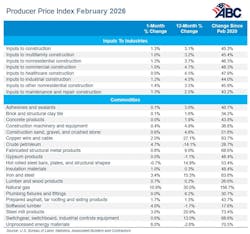
  • Construction input prices increased by 1.3% in February, with nonresidential construction seeing similar gains

  • All three energy categories experienced price increases, notably natural gas and unprocessed energy materials, up 10.9% and 6.0%, respectively

  • Rising oil prices, nearing $100 per barrel, are expected to further raise costs through higher diesel and shipping expenses in the coming weeks and months
ID 2018563 © Michael Flippo | Dreamstime.com

construction site with materials


WASHINGTON, DC — Construction input prices climbed 1.3% in February compared to the previous month, according to Producer Price Index data released today by the US Bureau of Labor Statistics. Nonresidential construction input prices also increased 1.3% for the month.

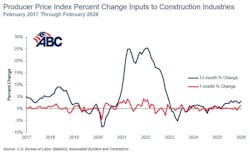
Overall, construction input prices are now 3.1% higher than a year ago, while nonresidential construction input prices are 3.7% higher.

Prices increased in all three energy categories last month. Natural gas and unprocessed energy materials prices were up 10.9% and 6.0%, respectively, while crude petroleum prices were up 4.7% in February.

Rising Oil Prices Not Yet Factored In​

“Construction materials costs surged in February due to significant increases in oil, copper, lumber and steel prices,” said ABC chief economist Anirban Basu. “Notably, this data does not reflect the precipitous increase in oil prices, which are near $100/barrel as of this morning, caused by the conflict in Iran. That will put upward pressure on construction materials prices directly by raising diesel prices and, indirectly, by raising the cost of shipping other inputs.

“While input prices are still up a relatively modest 3.1% since February 2025, they rose at a staggering 12.6% annualized rate during the first two months of 2026,” said Basu. “Which is to say, materials price escalation could serve as a real headwind to construction activity over the next several months. Fewer than 1 in 4 contractors expect their profit margins to shrink over the next six months, according to ABC’s Construction Confidence Index. Those expectations will bear close monitoring if input prices continue their rapid ascent.”
producer price index feb 2026

producer price index percent change


Visit abc.org/economics for the Construction Backlog Indicator and Construction Confidence Index, plus analysis of spending, employment, job openings and the Producer Price Index.


Economic Bad News seems to be "Raining Down" even more, than before.​

=======​

"Going To Cripple Our Economy": Small Businesses Sound Alarm Over Record Diesel Price Spike​

Tyler Durden's Photo

by Tyler Durden
Authored...
The latest AAA fuel data from across America shows that the national average diesel price at the pump has jumped nearly 40% this month, surpassing the 2022 fuel spike that followed Russia's invasion of Ukraine.


Surging diesel prices are already generating a shock across trucking, rail, shipping, farm equipment, construction machinery, generators, and much of industrial logistics, given that the fuel powers the core of the economy.

Seasonality: AAA Daily National Avg. Diesel 2022 vs. 2026


Companies now face three difficult choices if they did not lock in fuel prices before the spike: absorb the impact and accept margin compression, add surcharges, or raise prices.


Last week, Rapidan Energy's Director of Refined Products, Linda Giesecke, told us that, "unlike 2022, the current tightness reflects physical supply disruptions rather than policy risk and trade reshuffling."

Giesecke warned that if the fuel spike proves prolonged, global economic growth could suffer because of diesel's close link to industrial production and freight activity.

BloombergNEF forecast that $5-per-gallon diesel could inflict a weekly $6 billion or more hit on the US economy because these surging fuel costs hurt truckers, construction firms, and farmers the hardest. With prices at $5.2 as of Friday, that weekly hit is set to rise next week.


Readers are already aware of the dire consequences of spiking diesel prices, as we've laid out in recent weeks (see here & here).

Adding more color to the fuel that underpins nearly every stage of production and transport is a Bloomberg report warning that small businesses are sounding the alarm over surging fuel costs.

Here's one example of a small business being financially crushed by surging fuel costs:

Roger Conner sells firewood for a living, but he might know just as much about another energy source: diesel. The fuel powers every step of the supply chain for his company, RC Conner Enterprises: the megatrucks that carry the logs from suppliers to his facility in Exeter, New Hampshire; the machines that offload and process those logs into kiln-dried residential and restaurant-grade firewood; and the trucks that deliver the finished bundles and cords to customers across New England. In a normal year, Conner spends roughly $6,800 a month on diesel. Now it's about $11,000. To absorb some of the cost, he's added a 5% fuel surcharge; when customers saw that, several walked away.

If diesel keeps rising, "we're going to have to keep going up on our pricing, but we probably won't have any sales," says Conner, 50. "This is going to cripple our economy. I don't think people think about how much the economy rides on diesel fuel."
Across the trucking industry, fuel costs are the second-largest expense after driver pay for carriers, according to Bob Costello, the American Trucking Associations' chief economist. He said that even in non-crisis periods, carriers carefully manage fuel consumption because small changes in diesel costs can erode profit margins.

Surging fuel costs are already pushing up freight rates (e.g., barge transport up 27%) across the economy, leading to fuel surcharges from carriers such as UPS, FedEx, and USPS.

Joe Brusuelas, chief economist at tax consulting firm RSM US, told the outlet that a 10% rise in diesel could lift the CPI by .1%, potentially adding .4%, given the nearly 40% spike in diesel prices this month alone.

The Trump administration is doing a delicate balancing act while attempting to neuter IRGC forces while ensuring domestic fuel prices do not spike out of control. The administration has pulled two of what JPMorgan analysts say are six levers to combat triple-digit WTI prices; those two levers pulled so far include an SPR release and a waiver of the Jones Act to ensure that crude flows from emergency stockpiles move more quickly from port to port.

On Friday, President Trump hinted at "winding down" the Iran war, as CENTCOM on Saturday morning announced its biggest move so far to free up the Hormuz chokepoint by degrading IRGC forces with air-delivered munitions. The administration's current goal is to ensure Hormuz reopens to avert what the IEA head warned last week could be the world's largest energy shock on record.


Today's Top Stories​

Contact Information+
Suggested Reading+


Mind the Real Money – Why Gold and Silver are Soaring​

by David Stockman

"These are powerful signals about the future outlook, but self-evidently a Golden Age of prosperity or the S&P 500 at 10,000 is not among them. To the contrary, this has every appearance of a break-out—an overwhelming vote of no confidence in the spend, borrow, and print-a-thons which continue to emanate from Washington, and at an accelerating pace.


As is evident from the chart below, the price of historic money—gold—has entered a new, nearly parabolic phase. Thus, it took nine years for the price to double from $1300 per oz in 2016 to $2,700 by January 2025 under what amounted to UniParty borrow and print policies.


But it has now not only doubled again since the arrival of Trump 2.0, but has actually erupted by 31%—from $3,400 to around $4,440—just since August."

"Needless to say, if the Donald has one signature posture when it comes to economics, it is a relentless demand for lower interest rates and a weaker dollar. The latter, in fact, rises to the level of an obsessive fetish.


The truth is, Donald Trump has never, ever understood the free market or had any respect for it. His basic mentality is that of a plenary commander of all matters economic, and also that of a conspiracy theorist who believes that any condition to his disliking—such as a firmer dollar exchange rate—is owing to the nefarious doings of foreigners rather than the supply and demand forces of the market.


So not surprisingly, another metric heading decisively in the wrong direction during the last 12 months is the FX rate of the dollar."

"But it was not an unhinged war on the dollar driven by the likes of today’s absolute economic moron and know-it-all in the Oval Office. Nor was Ronald Reagan accompanied by an ass-kissing Treasury Secretary like Trump’s, who basically doesn’t know the difference between the utterly fabricated Trumpian Golden Age spin and the real facts and conditions of the economic and financial world.


This latter point became more than evident recently when US Treasury Secretary Scott Bessent ordered a “rate check”—a rare operational move instructing the Federal Reserve Bank of New York to survey banks regarding exchange rates for the USD/JPY currency pair.


Of course, this kind of “rate check” is a heads-up to FX markets that a major currency intervention is coming and that it would be wise not to be caught flat-footed.


That is to say, Washington is fixing to shit-can its own currency in order to rescue the faltering yen. And it appears to be doing so on the cockamamie theory that this will help Uncle Sam sell the massive volume of new bonds, bills and notes that will be needed to finance the Donald’s soaring deficit.


In short, the brown stuff is about to hit the fan in the US Treasury market and we now have in power a gang of absolute financial cowboys who are likely to resort to any and all anti-market expedients to avoid the day of reckoning. But FX intervention on behalf of the yen is surely a reminder that the Trumpian spenders, borrowers, printers, interventionists, and economic statists are fixing to truly veer off the deep end."


They're DONE Funding the U.S.​

ITM Trading's Photo

by ITM Trading
Thursday, Apr 02, 2026 - 23:24


"Foreign central banks just slashed their U.S. Treasury holdings at the New York Fed to the lowest level since 2012. The market has tripled since then. Do the math.

Taylor Kenney breaks down what the mainstream is calling an oil story. It isn't. It's BRIC-aligned nations, India, Thailand, Turkey, quietly executing a dollarization playbook they've been running for years. The war gave them cover. The selloff gave them plausible deniability. And every treasury they dump is a vote of no confidence in the dollar as the world's reserve currency."


New Topics

Back
Top Bottom