The answer, of course, is subjective since "fair" is not an absolute concept and tax data, depending how it's sliced, can tell different stories. Those who say the rich pay their fair share point to the fact that the top 1% of taxpayers end up paying almost as much in federal income tax (and some years even more) as the bottom 95% combined.
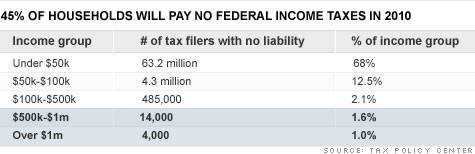
Still, it's unlikely that even the most anti-tax, pro-wealth advocates would find this particularly fair: A very small number of millionaires end up owing no federal income tax at all. They're in good company, of course. Nearly half of all U.S. households, or 69 million, are estimated to have owed no federal income taxes for 2010. The vast majority of them, however, are low income. But 18,000 were households taking in more than $500,000 -- and of those, 4,000 made more than $1 million. How can it be that those with big income streams owed zip to Uncle Sam?
Janice Johnson and Jay Safier, members of the New York State Society of Certified Public Accountants, and Roberton Williams, a senior fellow at the Tax Policy Center, explained the likely reasons. Such tax filers probably have big portfolios and big investment losses from the 2008 financial crisis. They are also more likely to be retired or self-employed, and may be charitably inclined.
What's common to all is that they likely qualify for the many tax breaks in the code that disproportionately benefit high-income households. "A lot of these are people who probably made it very big on Wall Street years ago and who turned around and put it all in tax-exempt bonds," Johnson said.
MORE