Zone1 Tax the Rich! Make them Pay their Fair Share!

So, this is more of along the lines that since you can't take it with you, we (the government) should take what we want, leave you a little, and call it square. What you're doing is what I would call "pocket watching". Envy or jealousy works as well. In life, you have "life's lottery winners". Normal people go about their lives without thinking about what the kids of billionaires & millionaires do. Those who have little going on for themselves or those trying to buy votes think about ways to get money from those who have it.
The American Founders and early Revolutionary-era leaders sought to limit "dead hand control"—the ability of the deceased to control land and wealth in perpetuity—to prevent the emergence of a landed aristocracy and to ensure economic opportunity for the living generation. They believed that the earth belongs to the living and that accumulated wealth should not remain tied up indefinitely by previous generations.


Nah, 2004 Dubya increased it to 56%

View attachment 1243464


Darn, the number didn't increase until 2005 when it went to 52%.

AND removed Clinton rule that didn't allow subprimes with predatory to count
View attachment 1243465


Damn! Look at how much shit HUD was forcing them to buy.


Low- and moderate-income buyers. High-LTV loans.

Lots of subprime loans bought under Clinton's no subprime rules. Weird.

That reminds me, Cuomo talked about it, but I never saw any evidence that Clinton did anything
about "predatory mortgages".

Were you lying, again, or just confused, again?


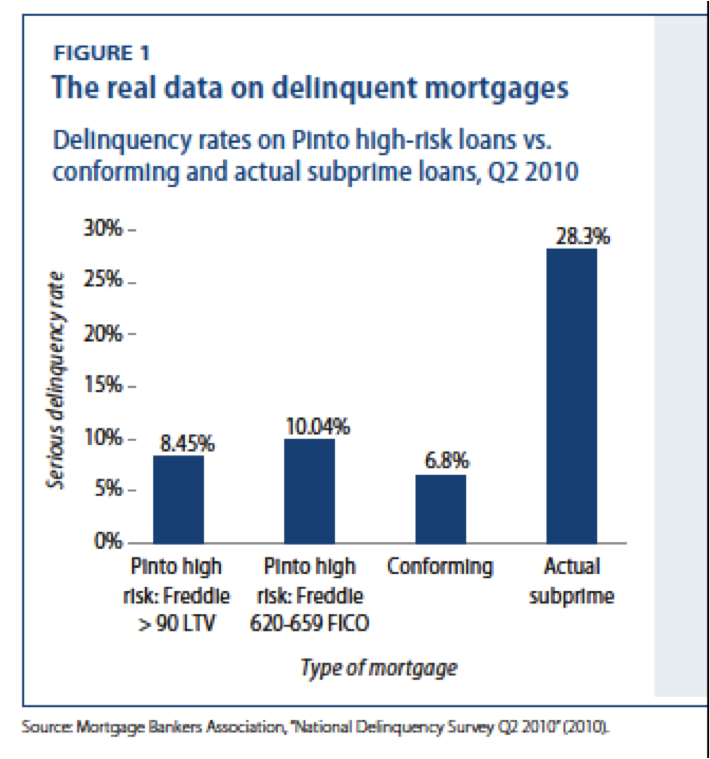
Sorry Cupcake, ED Pinto's and his "math" IS BS


As I point out in “Faulty Conclusions,” Pinto only gets to these numbers (which are radically divergent from all other estimates—for example, the nonpartisan Government Accountability Office estimates that there are only 4.59 million high-risk loans outstanding) by making a series of very problematic and unjustified assumptions.


Case in point: To support his claim that the Community Reinvestment Act, which requires regulated banks and thrifts to provide credit nondiscriminatorily to low- and moderate-income borrowers, caused the origination of 2.24 million outstanding “high-risk” mortgages, Pinto includes many loans originated by lenders who were not even subject to CRA. In fact, most of the “high-risk” loans Pinto attributes to CRA were not eligible for CRA credit.


Similarly, in arguing that Fannie and Freddie’s affordable housing goals caused the origination of 12 million “subprime” and equivalently “high-risk” loans, Pinto includes millions of loans that would not typically qualify for those goals. In fact, the vast majority (65 percent) of the “high-risk” loans Pinto attributes to the affordable housing goals of Fannie and Freddie fall into this category.


You can say the same about VA loans and FHA loans. There was nothing wrong with Bush wanting to help citizens get the sweet taste of homeownership. Bush never set policy for the lenders. Congress later did and the result is many fine lenders did not stay in business.


GAWD

Bush Mortgage Bubble include (but not limited to)

Wanting 5.5 million more minority homeowners
Tells congress there is nothing wrong with GSEs
Pledging to use federal policy to increase home ownership
Routinely taking credit for the housing market
Forcing GSEs to buy more low income home loans by raising their Housing Goals
Lowering Investment bank's capital requirements, Net Capital rule (WALL STREET WENT FROM 12-1 LEVERAGE TO 35+ TO 1, FLOODED THE MARKET WITH CHEAP MONEY IN 2004)
Reversing the Clinton rule that restricted GSEs purchases of subprime loans
Lowering down payment requirements to 0%
Forcing GSEs to spend an additional $440 billion in the secondary markets
Giving away 40,000 free down payments
PREEMPTING ALL STATE LAWS AGAINST PREDATORY LENDING


But the biggest policy was regulators not enforcing lending standards.


Right-wingers Want To Erase How George Bush's "Homeowner Society" Helped Cause The Economic Collapse


2004 Republican Convention:

Another priority for a new term is to build an ownership society, because ownership brings security and dignity and independence.
...

Thanks to our policies, home ownership in America is at an all- time high.

(APPLAUSE)

Tonight we set a new goal: 7 million more affordable homes in the next 10 years, so more American families will be able to open the door and say, "Welcome to my home."


June 17, 2004


Builders to fight Bush's low-income plan


NEW YORK (CNN/Money) - Home builders, realtors and others are preparing to fight a Bush administration plan that would require Fannie Mae and Freddie Mac to increase financing of homes for low-income people, a home builder group said Thursday.


Home builders fight Bush's low-income housing - Jun. 17, 2004


Predatory Lenders' Partner in Crime

Predatory lending was widely understood to present a looming national crisis.

What did the Bush administration do in response? Did it reverse course and decide to take action to halt this burgeoning scourge?

Not only did the Bush administration do nothing to protect consumers, it embarked on an aggressive and unprecedented campaign to prevent states from protecting their residents from the very problems to which the federal government was turning a blind eye

In 2003, during the height of the predatory lending crisis, the OCC invoked a clause from the 1863 National Bank Act to issue formal opinions preempting all state predatory lending laws, thereby rendering them inoperative


Eliot Spitzer - Predatory Lenders' Partner in Crime


Bush drive for home ownership fueled housing bubble


He insisted that Fannie Mae and Freddie Mac meet ambitious new goals for low-income lending.

Concerned that down payments were a barrier, Bush persuaded Congress to spend as much as $200 million a year to help first-time buyers with down payments and closing costs.

And he pushed to allow first-time buyers to qualify for government insured mortgages with no money down
 
True, US health care always near the bottom of outcomes of developed nations
Personal health is more important to them. We have given ourselves over to terrible lifestyles and worse, to the medical industry to "cure" our self-inflicted ills.
 
I informed him, that Fannie Mae and Freddie Mac were the reason for the problems and I believe you and myself proved our case. They were the giants of the loand insustry. They both werre purchassded by the feds due to therir mess.


YET THEY WERE OVERTAKEN BY THE PLS DURING DUBYA'S SUBPRIME BUBBLE. Go figure


Nonbank mortgage underwriting exploded from 2001 to 2007, along with the private label securitization market, which eclipsed Fannie and Freddie during the boom. Check the mortgage origination data: The vast majority of subprime mortgages — the loans at the heart of the global crisis — were underwritten by unregulated private firms. These were lenders who sold the bulk of their mortgages to Wall Street, not to Fannie or Freddie. Indeed, these firms had no deposits, so they were not under the jurisdiction of the Federal Deposit Insurance Corp or the Office of Thrift Supervision. The relative market share of Fannie Mae and Freddie Mac dropped from a high of 57 percent of all new mortgage originations in 2003, down to 37 percent as the bubble was developing in 2005-06.


GOING FROM 57% OF THE MARKET IN 2001 TO 37% OF THE MARKET IN 2005-2006 IS A PRETTY BIG DROP RIGHT?


•Private lenders not subject to congressional regulations collapsed lending standards.
Taking up that extra share were nonbanks selling mortgages elsewhere, not to the GSEs. Conforming mortgages had rules that were less profitable than the newfangled loans. Private securitizers — competitors of Fannie and Freddie — grew from 10 percent of the market in 2002 to nearly 40 percent in 2006. As a percentage of all mortgage-backed securities, private securitization grew from 23 percent in 2003 to 56 percent in 2006


PRIVATE SECURITIZATION, MEANS WALL STREET, NOT FANNIE AND FREDDIE CUPCAKE


At times posters talk about AI and it's impact, but back prior to the housing crisis, we had the dot.com bust. This had a huge impact on housing loans since the loans in many cases were to invest in Dot.coms and when those tumbled, it had a ripple effect on houses where the owners were suddenly upside down.


ok dummie DUBYA'S OWN WORKING GROUP ON THE TIME LINE


From Bush's President's Working Group on Financial Markets October 2008

"The Presidents Working Group's March policy statement acknowledged that turmoil in financial markets clearly was triggered by a dramatic weakening of underwriting standards for U.S. subprime mortgages, beginning in late 2004 and extending into 2007"
 
Bush Mortgage Bubble include (but not limited to)

Wanting 5.5 million more minority homeowners
Bush normally set goals and I have no information on how many he wanted. But the problem was the adjustable loans, the no income loans and other products approved by Freddie Mac and Fannie Mae.

If you ever got a mortgage, pull the papers out and look at the bottom of the forms. They used to say Fannie Mae approved but when they were virtually going bankrupt, and I have not seen the forms in many years, it is possible the current forms no longer say approved by Fannie Mae, and appraisers also have that on their forms, at least when Bush was president.

Here is what is so strange about this conversation.

Maybe you are a clerk at Costco, or a janitor, but my end was as a long-time mortgage lender who loaned funds when Clinton was president and Also when Bush was.

You were asked what your credentials are and you avoided saying what makes you an expert.

Posters here is now he does research. First, he makes his own beliefs part of his question to the internet. Naturally, garbage in, garbage out.
 
Your ego is shoving your arrogance. You can find a zillion posts provided you search for your beliefs. But the truth is more hidden from you than you realize.


Projection there huh? NO WHAT THE FCIC WAS Cupcake?


The Financial Crisis Inquiry Commission (FCIC) final report concluded that the 2008 financial crisis was caused by an explosion of high-risk subprime lending, lax regulatory oversight, and the widespread securitization of these toxic loans. Subprime mortgages were deemed a primary, avoidable catalyst, with $600 billion in such loans originated in 2006 alone, accounting for 23.5% of all mortgages


Key findings regarding subprime loans in the FCIC report:
  • Predatory Lending & Quality: The report highlights that predatory lending practices thrived, with many lenders offering loans to borrowers without verifying income or ability to repay.

  • Securitization & Risk: These high-risk loans were packaged into complex mortgage-backed securities, masking the risk and spreading it throughout the global financial system.

  • Housing Bubble: The boom was fueled by rapidly rising house prices, which masked the poor quality of the loans until the market collapsed.

  • Regulatory Failure: The commission cited a "pervasive permissiveness" in the regulatory environment, where warnings about subprime, ARM (adjustable-rate mortgage), and Alt-A loans were ignored.

  • Market Impact: The collapse of the subprime market led to massive foreclosures and triggered a liquidity crisis when lenders stopped accepting these mortgages as collateral.

According to the Financial Crisis Inquiry Commission (FCIC) report, Fannie Mae and Freddie Mac contributed to the 2008 financial crisis but were not its primary cause. While they held or guaranteed roughly half of all US mortgages, their surge into buying risky, subprime-linked securities peaked late (2006-2007) to regain lost market share


Key Findings on Fannie and Freddie's Role:

  • Late Adoption of Risk: As the housing bubble grew, the GSEs (Government-Sponsored Enterprises) lost market share, causing them to lower underwriting standards and invest in risky Alt-A and subprime loans starting around 2006-2007.

The Financial Crisis Inquiry Commission (FCIC) consisted of 10 members (six Democrats, four Republicans) appointed to investigate the causes of the 2008 financial crisis, including the role of subprime lending. 9 of the 10 agreed with this conclusion, the only one not to was liar, Peter Wallison from AEI, Cupcake

 
Due to Fannie Mae and Freddie Mac changing rules. Their standards were used. Bush had no control over the two firms. They were not then government managed. Now they are.


WHO DO YOU THINK CONTROLLED FANNIE FREDDIE? YOU KNOW EXECUTIVE BRANCH?

Between 2001 and 2007, the Office of Federal Housing Enterprise Oversight (OFHEO) served as the safety and soundness regulator for Fannie Mae and Freddie Mac (GSEs),


  • Regulatory Role: As an independent office within HUD, OFHEO was established in 1992 to monitor the capital adequacy and financial stability of Fannie Mae and Freddie Mac.


The U.S. Department of Housing and Urban Development (HUD) is an executive branch agency directly controlled by the President, who appoints the HUD Secretary, subject to Senate confirmation. The Secretary reports to the President and implements administration policy, including directives on housing supply, funding, and regulatory changes
 
Sorry Cupcake, ED Pinto's and his "math" IS BS


As I point out in “Faulty Conclusions,” Pinto only gets to these numbers (which are radically divergent from all other estimates—for example, the nonpartisan Government Accountability Office estimates that there are only 4.59 million high-risk loans outstanding) by making a series of very problematic and unjustified assumptions.


Case in point: To support his claim that the Community Reinvestment Act, which requires regulated banks and thrifts to provide credit nondiscriminatorily to low- and moderate-income borrowers, caused the origination of 2.24 million outstanding “high-risk” mortgages, Pinto includes many loans originated by lenders who were not even subject to CRA. In fact, most of the “high-risk” loans Pinto attributes to CRA were not eligible for CRA credit.


Similarly, in arguing that Fannie and Freddie’s affordable housing goals caused the origination of 12 million “subprime” and equivalently “high-risk” loans, Pinto includes millions of loans that would not typically qualify for those goals. In fact, the vast majority (65 percent) of the “high-risk” loans Pinto attributes to the affordable housing goals of Fannie and Freddie fall into this category.


Case in point: To support his claim that the Community Reinvestment Act, which requires regulated banks and thrifts to provide credit nondiscriminatorily to low- and moderate-income borrowers, caused the origination of 2.24 million outstanding “high-risk” mortgages,


Not just the CRA, forcing Fannie and Freddie to make half of their mortgage purchases from people with lower credit scores, lower incomes and with lower down payments is what caused over 20 million low quality mortgages to be written.
 
YET THEY WERE OVERTAKEN BY THE PLS DURING DUBYA'S SUBPRIME BUBBLE. Go figure


Nonbank mortgage underwriting exploded from 2001 to 2007, along with the private label securitization market, which eclipsed Fannie and Freddie during the boom. Check the mortgage origination data: The vast majority of subprime mortgages — the loans at the heart of the global crisis — were underwritten by unregulated private firms. These were lenders who sold the bulk of their mortgages to Wall Street, not to Fannie or Freddie. Indeed, these firms had no deposits, so they were not under the jurisdiction of the Federal Deposit Insurance Corp or the Office of Thrift Supervision. The relative market share of Fannie Mae and Freddie Mac dropped from a high of 57 percent of all new mortgage originations in 2003, down to 37 percent as the bubble was developing in 2005-06.


GOING FROM 57% OF THE MARKET IN 2001 TO 37% OF THE MARKET IN 2005-2006 IS A PRETTY BIG DROP RIGHT?


•Private lenders not subject to congressional regulations collapsed lending standards.
Taking up that extra share were nonbanks selling mortgages elsewhere, not to the GSEs. Conforming mortgages had rules that were less profitable than the newfangled loans. Private securitizers — competitors of Fannie and Freddie — grew from 10 percent of the market in 2002 to nearly 40 percent in 2006. As a percentage of all mortgage-backed securities, private securitization grew from 23 percent in 2003 to 56 percent in 2006


PRIVATE SECURITIZATION, MEANS WALL STREET, NOT FANNIE AND FREDDIE CUPCAKE


YET THEY WERE OVERTAKEN BY THE PLS DURING DUBYA'S SUBPRIME BUBBLE. Go figure

Fannie, Freddie and the commercial banks bought those as well.
 
YET THEY WERE OVERTAKEN BY THE PLS DURING DUBYA'S SUBPRIME BUBBLE. Go figure
We offered customers loans that fit their circumstances. I told many of my clients not to accept adjustable-rate loans. The best loans had the most restrictions. Clients got full unbiased from me, information. Law in California demand the brokers, be honest and loyal to clients.
WHO DO YOU THINK CONTROLLED FANNIE FREDDIE? YOU KNOW EXECUTIVE BRANCH?

Between 2001 and 2007, the Office of Federal Housing Enterprise Oversight (OFHEO) served as the safety and soundness regulator for Fannie Mae and Freddie Mac (GSEs),
Thank you for proving Bush exercised no control over Freddie Mac or Fannie Mae.
 
Last edited:
Bush normally set goals and I have no information on how many he wanted. But the problem was the adjustable loans, the no income loans and other products approved by Freddie Mac and Fannie Mae.

If you ever got a mortgage, pull the papers out and look at the bottom of the forms. They used to say Fannie Mae approved but when they were virtually going bankrupt, and I have not seen the forms in many years, it is possible the current forms no longer say approved by Fannie Mae, and appraisers also have that on their forms, at least when Bush was president.

Here is what is so strange about this conversation.

Maybe you are a clerk at Costco, or a janitor, but my end was as a long-time mortgage lender who loaned funds when Clinton was president and Also when Bush was.

You were asked what your credentials are and you avoided saying what makes you an expert.

Posters here is now he does research. First, he makes his own beliefs part of his question to the internet. Naturally, garbage in, garbage out.


Gawd, LEARN READING COMPREHENSION.

There was CONFORMING LOANS (Met Gov't UNDERWRITING standards for HUD, VA, FHA, ETC)

THEN there were GSE UNDERWITING STANDARDS that BILL CLINTON restricted in 2000 that GSE's (FANIE/FREDDIE)


HUD (2000) restricted Freddie and Fannie, saying it would not credit them for loans they purchased that had abusively high costs or that were granted without regard to the borrower's ability to repay. Freddie and Fannie adopted policies not to buy some high-cost loans.


GSE's had the highest standards, UNTIL they started chasing the PLS market (WALL STREET) to th bottom in 2006, AS I'VE linked repeatedly

Fannie /Freddie to get backing from the Gov't had to meet affordability goals, BUT UNTIL Dubya loosened them in 2001-2004, REQUIRED F/F to buy $440 MBS's and CDO's AND upped the goals from 50% to 56%, the GSE's were doing ok.

EVEN DUBYA'S GUY SAID SO IN 2004


March 5, 2004, hearing of the House Committee on Financial Services, titled "The Treasury Department's Views on the Regulation of Government Sponsored Enterprises"


Testimony from W's Treasury Secretary John Snow to the REPUBLICAN CONGRESS concerning the 'regulation of the GSE's (FANNIE/FREDDIE) 2004

Mr. (BARNEY) Frank: ...Are we in a crisis now with these entities?

Secretary Snow. No, that is a fair characterization, Congressman Frank, of our position. We are not putting this proposal before you because of some concern over some imminent danger to the financial system for housing; far from it.


WHAT HAPPENED? READ A GRAPH?


1776111781994.webp
 
15th post
We offered customers loans that fit their circumstances. I told many of my clients not to accept adjustable-rate loans. The best loans had the most restrictions. Clients got full unbiased from me, information. Law in California demand the brokers, be hjonest and loay to clients. --

Thank you for proving Bush exercised no control over Freddie Mac or Fannie Mae.

Between 2001 and 2007, the Office of Federal Housing Enterprise Oversight (OFHEO) served as the safety and soundness regulator for Fannie Mae and Freddie Mac (GSEs)
YEAH, OFHEO WAS ONLY UNDER HUD, THANKS FOR CUTTING THAT PART OUT DOUCHE

THE ONLY REFORM TO MAKE IT OUT OF THE GOP CONTROLLED HOUSE ON GSE REFORM, DUBYA OPPOSED IT, LOL


October 26, 2005

STATEMENT OF ADMINISTRATION POLICY

The Administration strongly believes that the housing GSEs should be focused on their core housing mission, particularly with respect to low-income Americans and first-time homebuyers. Instead, provisions of H.R. 1461 that expand mortgage purchasing authority would lessen the housing GSEs' commitment to low-income homebuyers.

George W. Bush: Statement of Administration Policy: H.R. 1461 - Federal Housing Finance Reform Act of 2005

Yes, he said he was against it because it "would lessen the housing GSEs' commitment to low-income homebuyers"


June 17, 2004

(CNN/Money) - Home builders, realtors and others are preparing to fight a Bush administration plan that would require Fannie Mae and Freddie Mac to increase financing of homes for low-income people, a home builder group said Thursday.


Home builders fight Bush's low-income housing - Jun. 17, 2004


BUT NO, THOUGH BUSH CRUSHED F/F (AS REGULATOR), THE GSE'S DIDN'T CAUSE THE BUSH SUBPRIME CRISIS
 
Yei, THE ONLY BILL TO GET OUT OF THE GOP HOUSE 2001 JAN 2007 WHEN DUBYA CONTROLLED GSE'S WAS THE ONE HE OPPOSED. He also opposed te bipartisan one from the Senate on Freddie and Fannie, BUT he "talked about" reform 17 times, lol
1776112485403.webp
 

Attachments

  • 1776112193156.webp
    1776112193156.webp
    69.6 KB · Views: 4
Last edited:
YET THEY WERE OVERTAKEN BY THE PLS DURING DUBYA'S SUBPRIME BUBBLE. Go figure

Fannie, Freddie and the commercial banks bought those as well.


LEARN WHAT PLS AND GSE WERE. They basically did the same thing, BUT Fannie and Freddie, UNTIL Dubya, had strict underwriting standards, MOST NINJA loans, NOT qualified for Gov't backing, including F/F

Which is why PLS (wall street) bought and bundled the bad mortgages and sold them off UNTIL they couldn't in late 2007 and had to start holding them, THEN we saw what happened


"
Wall Street firms, including Bear Stearns, Lehman Brothers, and Goldman Sachs, aggressively purchased, bundled, and sold subprime mortgages into securities (MBS/CDOs) to meet investor demand. When the housing bubble burst and defaults soared in 2007, the market collapsed, leaving banks holding billions in toxic debt, triggering the subprime mortgage crisis. "


This process created a "vicious cycle" where demand for high-yield securities drove up the creation of risky loans (subprime). Banks often sold these high-risk mortgages to institutional investors, including pension funds, while retaining high-risk tranches that ultimately made them insolvent.

Key developments included:


2006–2007: Housing prices began to fall, leading to high default rates on subprime mortgages.


Early 2007: Major lenders like New Century Financial Corp. went bankrupt.


July 2007: Bear Stearns announced two hedge funds, heavily invested in MBS, had collapsed.


End Result: The inability to sell these bad debts resulted in massive bank losses, a total freeze of credit markets, and the 2008 financial crisis.


As home prices declined, borrowers could not refinance, leading to massive foreclosures and the collapse of the financial derivatives market that had spread the risk globally.
 
Case in point: To support his claim that the Community Reinvestment Act, which requires regulated banks and thrifts to provide credit nondiscriminatorily to low- and moderate-income borrowers, caused the origination of 2.24 million outstanding “high-risk” mortgages,

Not just the CRA, forcing Fannie and Freddie to make half of their mortgage purchases from people with lower credit scores, lower incomes and with lower down payments is what caused over 20 million low quality mortgages to be written.


Another lie from you, I'm shocked, no really I am Cupcake


Government-Sponsored Enterprises (GSEs) like Fannie Mae and Freddie Mac generally maintained better loan quality than Private Label Securities (PLS) subprime loans, particularly in the lead-up to the 2008 housing crisis.


While both markets saw declining standards, studies show that mortgages included in GSE securitizations performed better than those in private-label securities, especially when holding observable risk factors (like borrower credit scores) constant.


Key Reasons for Higher Quality GSE Loans:


  • Conforming Standards: GSEs only purchased "conforming" mortgages, which are required to meet specific underwriting standards regarding borrower FICO scores, debt-to-income (DTI) ratios, and loan-to-value (LTV) ratios.

  • Reduced Risk Factors: Compared to PLS, GSE loans traditionally featured fewer high-risk, "exotic" characteristics such as, low-documentation loans, prepayment penalties, and interest-only features.

  • Performance Differences: During the 2008 crisis, subprime loans, often packaged in PLS, accounted for a disproportionate amount of foreclosure starts (e.g., 48.2% in Q2 2008), while GSE-guaranteed loans generally sustained fewer defaults.

  • Higher Average Credit Scores: Even during the pandemic era, GSE loans have maintained the highest average credit scores of all loan types (around 774) compared to FHA or private-label loans.


Exceptions and Nuance:
  • Rising Risk Tolerance: While better than PLS, the GSEs did increase their own risk-taking in the mid-2000s by buying more ALT-A and higher-risk loans to compete with the expanding private market.

  • Underwriting Differences: Private lenders and issuers that depended on GSEs to purchase their loans often had to adopt the strict guidelines of the GSEs, setting a higher bar for quality than subprime-only lenders


Back
Top Bottom