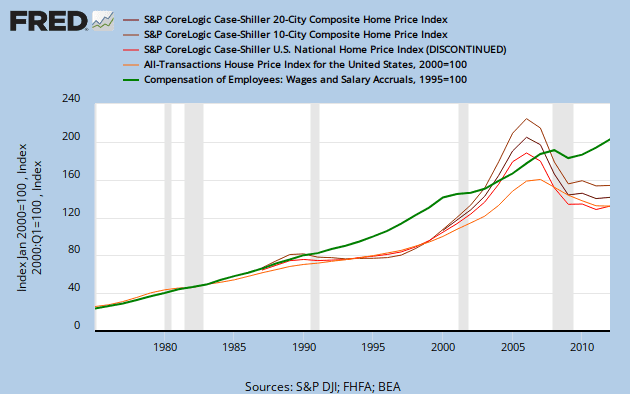
When they stop spending, you lose your job"
if they stop spending and burn the money that is true, but if they stop spending on the movies to make CC payments or home loan payments, for example, the money is merely spent elsewhere to stimulate employment elsewhere
Banks expand the money supply by making loans (money is "created"). When those loans are repaid, money is brought back to the banks, and is "destroyed" (contracting the money supply).
The official supply of "money" includes
currency (cash in public circulation) +
deposits. Bank
reserves (cash in vaults) are
not "money" because they are sequestered in banks, to prop up deposits. When banks make loans, extra cash in their vaults is loaned out to borrowers, and so re-circulated. Currency increases, increasing the money supply. Typically, the borrowed-and-re-circulated cash is
immediately spent -- on cars, boats, houses -- and
quickly re-deposited, back into the bank(s). The cash is de-circulated, back into bank vaults, as
reserves.
Currency decreases, swapped for
deposits. So the total "money" supply (currency + deposits) stays the same. Soon, the cash is re-loaned, back out into the economy, to some other borrower, for some other purpose, repeating the process,
etc..
Typically (?), when loans are repaid, somebody has "money" in a bank deposit account; goes to the bank; and writes a check, transferring "money" out of their deposit account (
deposits decrease) to pay off the loan. That decreases the supply of "money". The money supply contracts. On their balance sheets, the banks erase the loan (bank asset, their accounts-receivable); and the deposit (bank liability, their accounts-payable).
Only if bank loans are repaid with actual hard
cash currency does the "money" supply not contract. Then the banks adjust their balance sheets, entirely on the "assets" side, erasing the loan, and adding the cash. The money supply does not contract. But otherwise, erasing the loan, on the "assets" side, requires erasing some deposit, on the "liabilities" side, of their balance sheets. In practice, how often are home mortgages repaid, with actual suitcases of cash ? Generally, bank lending expands the money supply; re-paying banks contracts the money supply. Thus, the repayment of
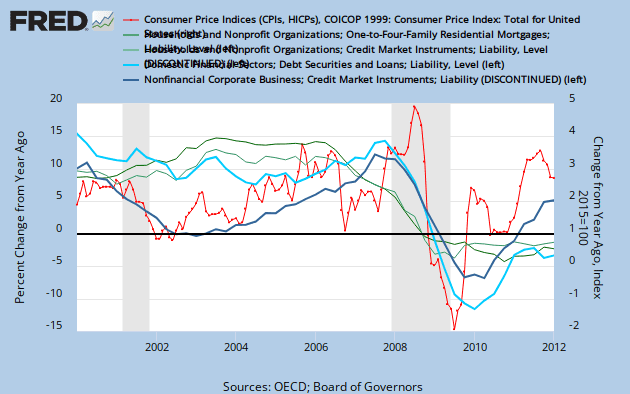
a trillion dollars of mortgage debt, ultimately from banks, over the past
four years, has exerted huge contractionary pressures on the US "money" supply. Instead of borrowing inflating the money supply, debt reduction has deflated the money supply. Instead of spending stimulating the economy, saving to re-pay banks has stalled the economy.
web reference
Economics: Supply of Money