During a speech at the National Narcotics Officers’ Association’s Coalition Drug Enforcement Forum, Sessions said the Centers for Disease Control and Prevention estimated the death toll from drug overdoses last year at approximately 72,000, which he said is the “highest drug death toll in American history by far.” “It is widely estimated that life expectancy has declined in the United States in recent years—largely because of drug abuse,” he said. Sessions said opioids like prescription painkillers, heroin, and synthetic drugs like fentanyl are to blame for the dramatic increase in overdose deaths, and in 2016 alone, 42,000 Americans died from opioid overdoses. “We also have a serious and growing cocaine problem in this country. It’s purer, cheaper, and more available. Cocaine-related deaths have nearly tripled the United States since 2010, and our DEA agents in the West tell us that methamphetamine is their number one problem. The situation is daunting and the challenge is great, but we have a unique opportunity to reverse these trends,” he said.
Sessions noted that in the past drug enforcement agents did not get the support they needed from politicians who tried to “tie” their hands. “I know that sometimes in the past, you haven’t had the support that you deserve. You’ve had politicians that tie your hands, who fail to understand the challenges you face, and who are in denial about the nature and extent of the problem, but not this administration,” he said. “In the face of an unprecedented crisis we have to take unprecedented action, and with President Donald Trump, that is exactly what we are doing. President Trump has a comprehensive plan to end what he has declared to be ‘a national public health emergency.’ The three legs of our plan include prevention, enforcement and treatment,” the attorney general said. Trump has improved prevention efforts, Sessions said, “by launching a national awareness campaign about the dangers of opioid abuse” and has set the goal of reducing opioid prescriptions by one-third in three years. Furthermore, the president ordered Sessions to seek the death penalty for certain drug dealers – “something no president had done before him.” “When we enforce our drug laws, we prevent addiction from spreading. The work that you do helps keep drugs out of our country, reduces their availability, drives up their price, and reduces their purity and addictiveness. That saves lives. Experts tell us supply creates its own demand,” Sessions said.
The attorney general said the Obama administration directed federal prosecutors to omit the full amount of drugs someone is charged with in order to avoid triggering mandatory minimum sentencing for drug cases. “Under the previous administration, in drug cases, the Department of Justice directed federal prosecutors not to include in charging documents the full amount of drugs being dealt if it would trigger certain mandatory minimum sentences. Prosecutors were required to leave out facts in order to achieve sentences lighter than required by law. That is an improper and dangerous policy. It weakens enforcement and reduces cooperation,” Sessions said. As a result, drug prosecutions and the average length of sentences for drug traffickers decreased. “After they put this directive into place, drug prosecutions went down by 17 percent, and the average sentence length for a convicted federal drug trafficking offender decreased 15 percent. Even if everything were going well, that still wouldn’t make sense, but we were suffering from the worst drug crisis in our history,” the attorney general said. “And so, when I became Attorney General, I restored the charging policy of this department to the traditional one that was in place when I was in trying cases and through much of the Obama Administration, and in the districts where drug deaths are the highest, we are now vigorously prosecuting synthetic opioid trafficking cases, even when the amount is small. It’s called Operation Synthetic Opioid Surge—or S.O.S.,” he said.
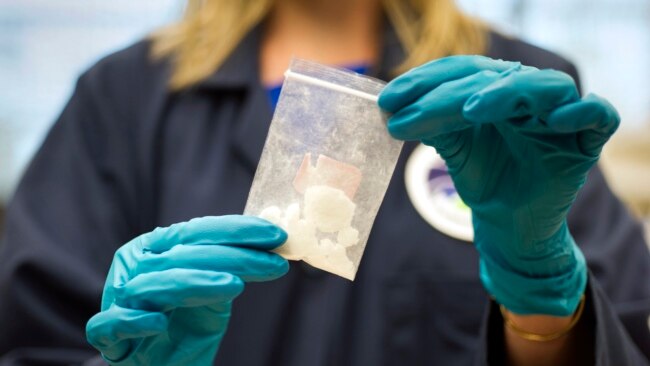
Sessions said it only takes a tiny amount of fentanyl – “a pinch of salt” - to kill someone. “We are in a desperate fight to curtail the availability and spread of this killer drug. Synthetic opioids are so strong that there is no such thing as a small case. Three milligrams of fentanyl can be fatal. That’s equivalent to a pinch of salt. Depending on the purity, you could fit more than 1,000 fatal doses of fentanyl in a teaspoon,” he said. The attorney general said his department targeted synthetic opioid suppliers in one Florida county and reduced the number of overdose calls from an average of 11 calls a day to one a day. “I want to be clear about this: we are not focusing on users, but on those supplying them with deadly drugs. In Manatee County, Florida, in partnership with the sheriff, we tried this strategy, and it worked. This past January, they had half the number of overdose deaths as the previous January. The Manatee County Sheriff’s Office went from responding to 11 overdose calls a day to an average of one a day. Those are promising results,” he said. “We want to replicate those results in the places that have been hardest hit. And so I have also sent 10 more prosecutors to help implement this strategy in ten districts where drug deaths are especially high. And that is in addition to the 12 prosecutors I sent to prosecute opioid fraud in drug ‘hot spot districts.’ To help them do that, I have begun a new data analytics program at the Department called the Opioid Fraud and Abuse Detection Unit to use data to find opioid-related health care fraud,” Sessions said. “This team follows the numbers—like which doctors are writing opioid prescriptions at a rate that far exceeds their peers; how many of a doctor's patients have died within 60 days of an opioid prescription; pharmacies that are dispensing disproportionately large amounts of opioids; and regional hot spots for opioid issues,” he said.
MORE