The change, in the change of the market. I apologize for my error above, it should just say acceleration of the market with no change there. As to why that is important?
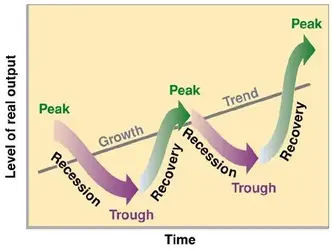
If you've ever managed to stay awake for a college economics course (I know I couldn't, Engineer here) you might have seen a graph depicting the cycles (recession, trough, recovery, peak). The important figure to pay attention to in order to understand where one is at in these cycles is the second derivative of the graph, or acceleration. For example, if the housing market is still decreasing, but at a decreasing rate (meaning each time the decrease is less)
i may conclude that the recession is nearing an end because the trend is positive. A very mathematical explanation I know. Don't hate me, it's just how I think.
View attachment 9141
I actually was assigned to teach an entry-level economics course at a JC when I first started out in my instructor days. "Winging it" would be an understatement for that experience!

I see your point - the rate of decline lessens so the trend is positive, and for the most part I would agree. There have been many green shoots over the last handful of months pointing to a stabilizing economy.
My fear is that all of the
government intervention, and resulting debt burden, will force the head of this recovery back down from where it would otherwise be - and the legs upon which it stands will be far less stable and thus prone to further decline in the near term. I listened to an economist this past weekend explaining how
8% unemployment will be the norm for the next decade and Americans must simply come to terms with that - that in effect, we will be much more like western Europe in the growth and decline of our economy than we have were during much of the 20th Century.
If so, that sucks, because Western Europe often had unemployment rates much higher than our own, and many of those nations suffer under a debt ration even worse than our own...
 Praying for the economy to fail are we?


 Well that seems pretty high! An interesting perspective. I do recall that economics can have many different theories about it. Hopefully that man's belief is just another theory because living at 8% unemployment might drive me to drink. College loans are hard enough to pay off.


