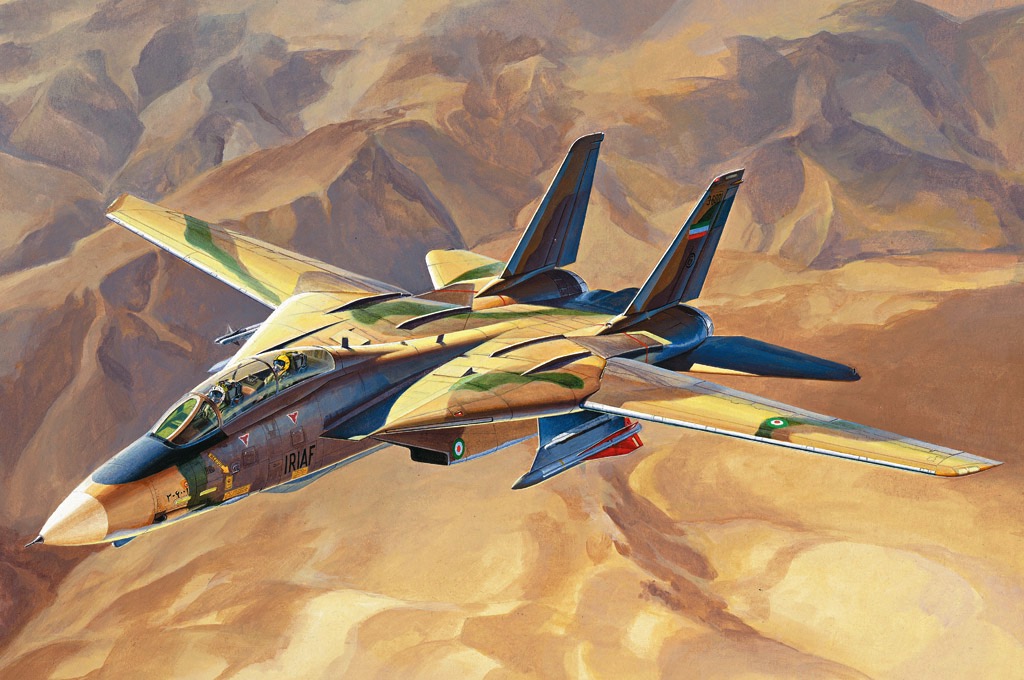
Before the
Islamic Revolution the
Shah of Iran,
Mohammad Reza Pahlavi arranged to arm the
Imperial Iranian Air Force with 80 Grumman F-14A Tomcats and 714
AIM-54 Phoenix missiles in a deal worth US$2 billion, out of which 274 were delivered for US$150 million,<a href="
F-14 Tomcat operational history - Wikipedia"><span>[</span>75<span>]</span></a> 150 embargoed after the revolution and the additional 290 cancelled.<a href="
F-14 Tomcat operational history - Wikipedia"><span>[</span>76<span>]</span></a> In the 1970s
Pahlavi Iran looked for an air superiority fighter to counter
Soviet air incursions of
MiG-25 fighters.<a href="
F-14 Tomcat operational history - Wikipedia"><span>[</span>76<span>]</span></a> In October 1978, two Imperial Iranian Air Force F-14As intercepted a high-and-fast–flying Soviet MiG-25 over the Caspian Sea tracking it for two minutes and forcing it to abort a reconnaissance run over Iran.<a href="
F-14 Tomcat operational history - Wikipedia"><span>[</span>77<span>]</span></a> By the time of the Iranian Revolution 79 of the aircraft had been delivered; the 80th and final was retained by the US.

The first squadron of Islamic Republic of Iran Air Force F-14 Tomcat pilots, at Shiraz Air Base.
By September 1980, the
Islamic Republic of Iran Air Force (IRIAF) managed to make an increasing number of airframes operational, despite immense problems due to repeated purges of its officers. Some of those officers were executed; others were imprisoned, forced into exile, or forced to take early retirement. The IRIAF survived these times, and its Tomcats were to become involved in the war against Iraq, scoring their first kill on 7 September 1980.<a href="
F-14 Tomcat operational history - Wikipedia"><span>[</span>78<span>]</span></a>
There is limited information available about the service of F-14s in the
Iran–Iraq War. Western intelligence indicates that the IRIAF was in decline at the onset of the war in September 1980, and it is rumored that some level of sabotage was committed on the F-14s by either Americans or Iranians loyal to the Shah, during the Iranian Revolution.<a href="
F-14 Tomcat operational history - Wikipedia"><span>[</span>79<span>]</span></a> Following the overthrow of the Shah, most Iranian F-14 pilots and technicians trained in the United States fled from Iran, fearing their association with the Shah's regime, and their time in the United States would endanger them. Only two pilots out of the original flight class chose to remain in Iran. Their fears proved correct, and a number of the original Iranian F-14 crews and technicians who remained were jailed or executed by the new regime. Eventually, several jailed F-14 pilots were released when war broke out with Iraq.<a href="
F-14 Tomcat operational history - Wikipedia"><span>[</span>78<span>]</span></a>
The United States estimated that the IRIAF was able to keep between 15 and 20 F-14s operational by cannibalizing parts from other examples. The IRIAF claims a higher figure, and was able to assemble 25 aircraft for an 11 February 1985 fly-over of
Tehran. Despite the U.S embargo following the Islamic Revolution.
A single F-14 was present during aerial flybys alongside other active combat aircraft by the Islamic Republic of Iran Air Force at the Islamic Republic of Iran Army Day on April 18, 2022.<a href="
F-14 Tomcat operational history - Wikipedia"><span>[</span>84<span>]</span></a><a href="
F-14 Tomcat operational history - Wikipedia"><span>[</span>85<span>]</span></a>
-wiki

en.wikipedia.org


 www.jpost.com