SherriMunnerlyn; Tinmore;
et al,
Just a coupe additional points I'd like to express.
His words have no ability to give Israel borders she simply does not have. Let us hear you explain how Israel acquired borders and what those borders are.
(COMMENT)
The border of today are outline, officially and on the record, before the entire world. You
(personally) may recognize them or not
(makes no difference to me). I can only tell you what is
(reality).
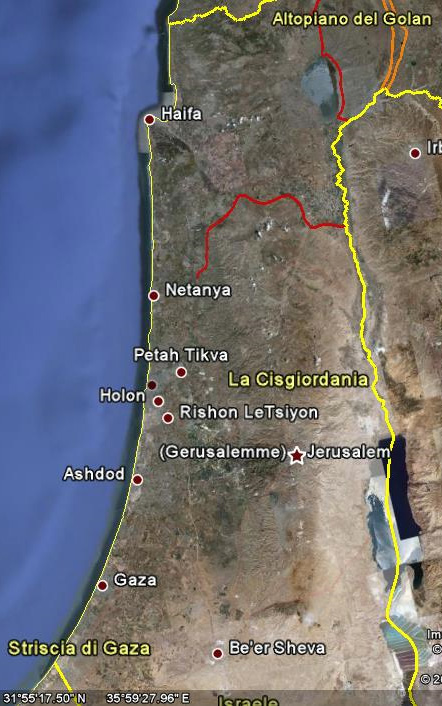
- EASTERN BORDER:
- There is a dispute between Syria and Israel along the border, in the Golan Heights region. Internationally, there is a small segment of Israel's borders that is in dispute which is covered by an Armistice Agreement (LINK ---> S/1353 of 20 July 1949)
How we get to this point is a long hard and arduous struggle. However you interpret those events that lead us to today's outcome --- we are here.
Relative to UNGA Resolution 181(II), while a matter for the record --- whether you agree or not, it happened. And Israel is admitted to the community of recognized states. You may hold to the opinion that it is not fair, that the Palestinians were treated unfairly, etc etc etc. The fact of the matter, it happened. And unless you have a time machine, you cannot change the past. Again, we are here.
As to who speaks officially for the Palestinian people, I differ to you. If you say that the Permanent Observer of Palestine to the United Nations (recently reaffirmed) has no voice, and his/her authority to speak is untrustworthy, I will of course take that under advisement. Under such an assumption, we could of course, disregard anything the Permanent Observer of Palestine to the United Nations says --- which simplifies the matter. Palestine has no official voice that is trustworthy; or --- there is no voice for the Palestinians.
(QUESTION)
In reality there are the treaties / armistice that we have, and the Gaza Strip which is very confused, and the West Bank that is not coherent, and Jerusalem --- fractured and chaotic. The question becomes:
- What is in the best interest of the people?
We can quibble all day long about borders you don't recognize, but at the end of the day, the question still remains:
- What is in the best interest of the people?
Now as I understand it, you and Paul Tinmore advocate the continuation of hostilities, in search of a lost Palestine. And you believe that this is in the best interest of the people we call today Palestinians. And you believe that this continuation of hostilities is the way that will best serve these Palestinians, even if it takes a half-century
(oops, we've already passed that benchmark) --- let's say another half-century, and this is also in the best interest of the Palestinians. Is it fair to say that, in your position, endless war and hostilities is in the best interest of the Palestinian people?
- What is in the best interest of the people?
Most Respectfully,
R