PBS Newshour, last week, did a segment (about 10 minutes) on this topic.
What members of Congress have formal training in natural sciences?
- Undergraduate:
- Seth Moulton - physics
- Jacky Rosen - computer science
- Louise Slaughter - microbiology
- Doctoral degrees: mathematician
- Jerry McNerney - mathematics
- Timothy Murphy - psychology
- Bill Foster - physics
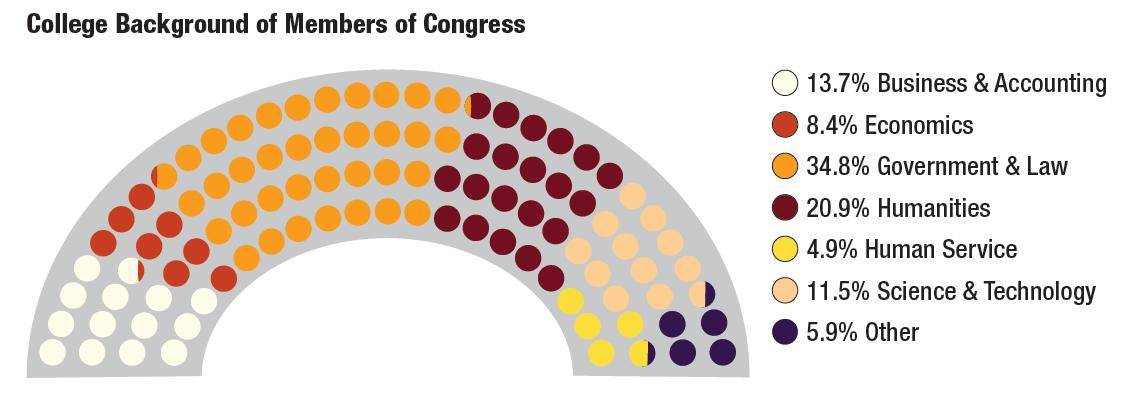
According to an already prepared compilation of most recent Roll Call profiles I could find, the members of the 113th Congress had the following educational backgrounds:
- 21 members of the House and 1 Senator have no educational degree beyond a high school diploma.
- 1 Senator and 2 Representatives were Rhodes Scholars, 2 Representatives were Fulbright Scholars, 2 Representatives were Marshall Scholars, and 1 Representative was a Truman Scholar.
- 3 Representatives and one Senator are graduates of the U.S. Military Academy and 1 Senator and 1 Representative graduated from the U.S. Naval Academy.
- 22 Members of the House and 3 Senators have a medical degree.
- 19 House Representatives have doctoral (Ph.D. or D.Phil.) degrees.
- 169 Members of the House (38% of the House) and 57 Senators (57% of the Senate), held law degrees.
- 85 members of the House and 14 Senators earned a master’s degree as their highest education degree.
- 7 Members of the House have associate’s degrees as their highest degree, and 1 House Member has an L.P.N. (nursing) degree.
Based on that, I'd say that there are lots of members of Congress who are adept at writing and reading laws, but far, far fewer who have any particular acumen associated with the specific subject matters about which those laws are written. That suggests that on many issues, we have what amounts to lawyers fixing the plumbing, something that makes about as much sense as having plumbers defending us in court. It's thus no wonder the laws we get passed are such a mess.
Now, I don't have anything for or against attorneys, but I know too that "the people" are not well served by having 200+ members of Congress who are especially adept in the arts of argumentation and rhetoric. I mean really. Could one find a better "recipe" for making legislating policy as politically charged as it possibly can be? You see a major difference between attorneys and holders of other advanced degrees is that attorneys are very good at framing one's words so they "tell the story" the attorney wants them to tell and mean what the attorney wants them to mean. Holders of other advanced degrees are adept at obtaining and sharing pertinent facts, analyzing them on their merits and demerits, and arriving at a sound conclusion. That's something scientists -- social and natural -- are very good at doing.
With regard to one social science, economics, the representation in Congress of individuals specifically trained in the that disciple is appallingly thin.
2011 Analysis found that at the time, about 80% of Congress had no business or economics training. Then as now, much of what Congress legislates pertains directly to business and economics.
There are
today even fewer Members having a keen understanding of economics. How many? Only one that I'm aware of. In 2014, there were about 25 Members who had some formal training in economics and/or business.
Economics isn't as precise a science as mathematics (not a science at all, but rather the language of sciences), chemistry or biology for we can't use "real life" trial and error on whole or partial segments of society to evaluate economic theorems, but it's far from consisting overwhelmingly of "POMA" ideas, being about on par in intellectual rigor with theoretical physics yet more speculative than is experimental physics. That said, there're few economic principles and conclusions about which economists overwhelmingly agree, but one of them -- the superiority of net gains over net cost accruing from free trade as contrasted with constrained trade -- of happens to be "front and center" among today's "hot button" issues.
What has Rep. Dave Brat of the Freedom Caucus to say about free trade? [1]
Chuck Todd: In general, what are your views of trade agreements, are you open to big free trade agreements or not?
Dave Brat: Yeah, I’m a free trader. After World War II, the GATT brought tariffs roughly from 50% down to about 4% or less today. And that’s been good for European trade with us. We set up our arch-enemies Japan and Germany after the war, started trading with them, and it enriched all of us. I have a win-win positive view about relationships with other countries that respect the rule of law. So we have to move forward on that front.
Here's the thing, given the rise and demonstrated merits of empirical economics, it just doesn't make sense in this day and age that so few members of Congress have any formal and deep [2] understanding of economics.
Note:
- Don't get me wrong, Brat can also be somewhat disingenuous. For instance, a few weeks ago, he enjoined in a line of discussion about "elites" as though they are some group of people that does not include him. C'mon now. Does it get any more elite than being both a PhD and one of the ~535 individuals who legislate the fate of the U.S., and in a broader sense, much of the "free" world?
In another instance, Brat describes his "world view" of the healthcare/health insurance debate is that the "target" to fix is the market failures associated with providing and paying for the healthcare of people, particularly people having pre-existing conditions. (I agree with that in principle.) He goes on to say, however, that Democrats say the "healthcare debate" is all about coverage, which he describes as being the wrong "non Econ 101" approach to the matter. That's disingenuous insofar as what is developing a solution that attenuates for the market failure associated with providing and paying for the healthcare of people but coverage?
Personally, I suspect that he knows, as do several economists I've spoken with, that the market failure in need of fixing is too "hot" to actually fix using the logic of Econ 101. The best one likely can do, at least in the near term and given the constraints of the current political structure in which we function, is "pseudo-fix" it, that is, "put a bandage on it and treat the symptoms rather than the cause."
That said, at least when one engages on a "peer level" with him about economics, the man won't sit there and deny/oppose the verity and application of what he knows to be so about economics and its principles and laws. That's a good start for it means one can at times have a meaningful discussion, one that isn't burdened with political ideology, with the man. That's more than I can say for many elected and appointed officials, or even USMB members.
- "Deep" in this context being, IMO, at least an undergraduate minor (at least 18 credit hours) in economics. I don't really care that one officially has a minor; I care that one has the requisite and suitably rigorous/comprehensive training associated with obtaining a minor. One does not need a PhD in economics, but one who'd vote on laws about economic matters should have enough knowledge of economics to be comfortable reading critical published works about economics and to know what to look for and focus on when reading them. Context is everything.
It is no crime to be ignorant of economics, which is, after all, a specialized discipline and one that most people consider to be a "dismal science." But it is totally irresponsible to have a loud and vociferous opinion [, voting on an "economics-heavy" bill, for example, is both quite loud and very vociferous] on economic subjects while remaining in this state of ignorance.
― Murray N. Rothbard