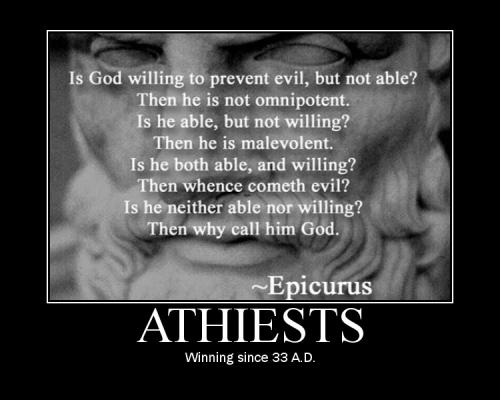
Last week, I had the opportunity to participate in several exciting panel discussions at the World Science Festival in New York City. But the most dramatic encounter took place at the panel strangely titled "Science, Faith and Religion." I had been conscripted to join the panel after telling one of the organizers that I saw no reason to have it. After all, there was no panel on science and astrology, or science and witchcraft. So why one on science and religion?
I ended up being one of two panelists labeled "atheists." The other was philosopher Colin McGinn. On the other side of the debate were two devoutly Catholic scientists, biologist Kenneth Miller and Vatican astronomer Guy Consolmagno. Mr. McGinn began by commenting that it was eminently rational to suppose that Santa Claus doesn't exist even if one cannot definitively prove that he doesn't. Likewise, he argued, we can apply the same logic to the supposed existence of God. ...
Coincidentally, I have appeared numerous times alongside Ken Miller to defend evolutionary biology from the efforts of those on various state school boards who view evolution as the poster child for "science as the enemy." These fundamentalists are unwilling to risk the possibility that science might undermine their faith, and so they work to shield children from this knowledge at all costs. To these audiences I have argued that one does not have to be an atheist to accept evolutionary biology as a reality. And I have pointed to my friend Ken as an example. ...
Messrs. Harris and Dawkins are simply being honest when they point out the inconsistency of belief in an activist god with modern science. J.B.S. Haldane, an evolutionary biologist and a founder of population genetics, understood that science is by necessity an atheistic discipline. As Haldane so aptly described it, one cannot proceed with the process of scientific discovery if one assumes a "god, angel, or devil" will interfere with one's experiments. God is, of necessity, irrelevant in science. ...
Though the scientific process may be compatible with the vague idea of some relaxed deity who merely established the universe and let it proceed from there, it is in fact rationally incompatible with the detailed tenets of most of the world's organized religions. As Sam Harris recently wrote in a letter responding to the Nature editorial that called him an "atheist absolutist," a "reconciliation between science and Christianity would mean squaring physics, chemistry, biology, and a basic understanding of probabilistic reasoning with a raft of patently ridiculous, Iron Age convictions." ...
Science is only truly consistent with an atheistic worldview with regards to the claimed miracles of the gods of Judaism, Christianity and Islam. Moreover, the true believers in each of these faiths are atheists regarding the specific sacred tenets of all other faiths. Christianity rejects the proposition that the Quran contains the infallible words of the creator of the universe. Muslims and Jews reject the divinity of Jesus. So while scientific rationality does not require atheism, it is by no means irrational to use it as the basis for arguing against the existence of God, and thus to conclude that claimed miracles like the virgin birth are incompatible with our scientific understanding of nature. Finally, it is worth pointing out that these issues are not purely academic. The current crisis in Iran has laid bare the striking inconsistency between a world built on reason and a world built on religious dogma.
Perhaps the most important contribution an honest assessment of the incompatibility between science and religious doctrine can provide is to make it starkly clear that in human affairs -- as well as in the rest of the physical world -- reason is the better guide.
Mr. Krauss, a cosmologist, is director of the Origins Initiative at Arizona State University. His most recent book is "Hiding in the Mirror" (Viking, 2005).