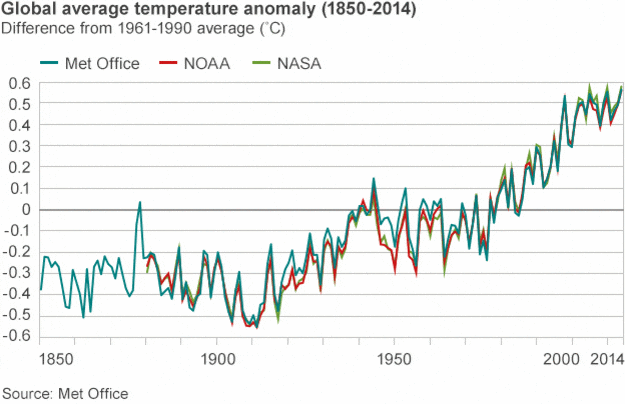
Well, since NOAA and NASA are just two of the agencies worldwide that keep and interpret this kind of data, why don't we see where the other agencies come in at.,
2014 on course to be one of hottest possibly hottest on record
2014 on course to be one of hottest, possibly hottest, on record
Exceptional heat and flooding in many parts of the world
Lima/Geneva, 3 December 2014 (WMO) - The year 2014 is on track to be one of the hottest, if not the hottest, on record, according to preliminary estimates by the World Meteorological Organization (WMO). This is largely due to record high global sea surface temperatures, which will very likely remain above normal until the end of the year. High sea temperatures, together with other factors, contributed to exceptionally heavy rainfall and floods in many countries and extreme drought in others.
WMO’s provisional statement on the Status of the Global Climate in 2014 indicated that the global average air temperature over land and sea surface for January to October was about 0.57° Centigrade (1.03 Fahrenheit) above the average of 14.00°C (57.2 °F) for the 1961-1990 reference period, and 0.09°C (0.16 °F) above the average for the past ten years (2004-2013).
If November and December maintain the same tendency, then 2014 will likely be the hottest on record, ahead of 2010, 2005 and 1998. This confirms the underlying long-term warming trend. It is important to note that differences in the rankings of the warmest years are a matter of only a few hundredths of a degree, and that different data sets show slightly different rankings.
The high January to October temperatures occurred in the absence of a full El Niño-Southern Oscillation (ENSO). ENSO occurs when warmer than average sea-surface temperatures in the eastern tropical Pacific combine, in a self-reinforcing loop, with atmospheric pressure systems, thus affecting weather patterns globally. During the year, sea surface temperatures increased nearly to El Niño thresholds but this was not coupled with an atmospheric response. However, many weather and climate patterns normally associated with El Niño/Southern Oscillation (ENSO) were observed in many parts of the world.