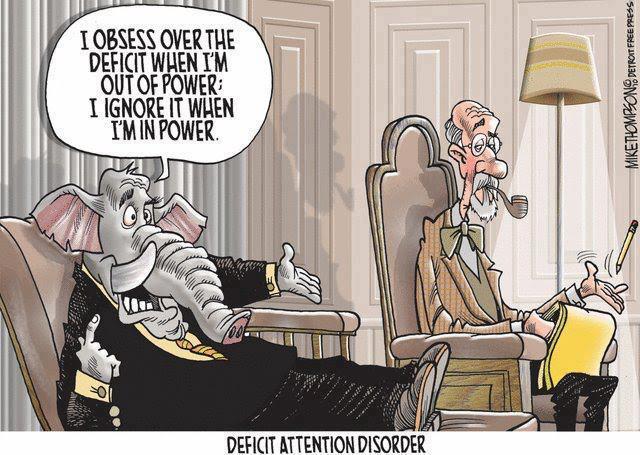
Our problem is that we constantly spend more than we budget, and more disastrously, spend more than our income. THAT difference is called the deficit. The debt, on the other hand, is the compilation of all deficits unpaid to date plus all interest incurred.
We don't spend more than we budget, we voluntarily
cut revenue which manufactures deficits. It's exactly what happened in 2001 after the Bush Tax Cuts. We had a r
ecord high budget surplus in 2000 that was turned into a
record high budget deficit by 2003.
That is entirely, 100% because of the Bush Tax Cuts.
Same thing happened in Kansas in 2013...they too had a budget surplus that was a record high...then Brownback and the Conservatives cut taxes, the surplus was turned into record deficits, and Kansas' economy cratered. Those tax cuts were repealed this spring by Republicans and Democrats in Kansas (SB 30), overriding Governor Skidmark's
-er um, I mean Brownback's- veto. Here's the budget for Kansas, both with and without tax cuts. You'll notice spending stays the same. What is it you see?
When I look at that, I see KS going from a $436M deficit to a $155M surplus. Do you see the same thing? Spending didn't change at all, only the amount of revenue collected and look at that! Without even
touching spending, Kansas got a budget surplus by repealing tax cuts.
So if that's the case in Kansas, why would repealing low taxes for the rich play out any different on the nation's budget?!
Let's address the logic of what you say ... but first, let's get the truth out there. (Looking at charts from 2008 - 2016)
1) Federal revenue has increased every year. In fact, we have continued to set records on how much money the federal government takes in. (In 2008, it was about $2.5 trillion, rising steadily to about $3.3 trillion in 2016, and expected to exceed $4 trillion this year)
2) Federal spending has increased every year, obviously setting records on how much money we spend. (In 2008, we spent $2.98 trillion, increasing every year, and in 2016, $3.84 trillion - expected to surpass $4 trillion this year).
3) The cumulative deficit has increased every year (obviously, because spending has outpaced income every year) by over $6 trillion dollars in the same time period.
4) In the same period, the national debt has increased by about $7.5 trillion (the difference being, primarily, interest on interest)
5) Recently, we just passed thru the $20 trillion in total national debt.
6) About one-third of that national debt is held by foreign countries.
7) Social Security holds about 15% of the national debt.
Clearly, we don't have an income problem - in fact, we continue to collect more and more money every year. Income is only restricted by the level the American people are willing to pay. As long as they don't complain, the government can continue to collect more and more.
Spending, however, SHOULD (but isn't) be restricted by the amount of money collected. Instead, we continue to allow our spending to outpace our income. We simply don't have a viable restriction on spending. Again, what the people ask for, they get - no matter the long term consequences.
Overspending your income is called, with a straight face, "deficit spending". It is predicated on the notion that money spent now will generate sufficient income later to pay off the money borrowed to fund the current spending. While a really nice theory, $20 trillion in debt clearly demonstrates that, in the long term, it doesn't work. Borrowing money is okay only if you can pay it off. THAT should be the first priority - not the last.
Some posit that we should ignore the national debt - just don't pay it. If, for example, China were to demand payment, the government would have to come up with about $2 trillion that it doesn't have. If that happened, the government wouldn't be able to pay - simple as that. The government would be faced with two options - trade "stuff" for the loans or, go to war. They would have to trade land, natural resources, etc for the debt instruments, or they would have to refuse, which would cause the Chinese economy to crash (and the subsequent reactions throughout the international economy). The Chinese, obviously, cannot allow that to happen, and will show up ready to take what they need. So, ignoring the national debt is NOT a viable option.
However, even if they didn't, the immediate reaction of the federal government would be to write off all its debts. The $2 trillion owed to the Social Security fund would be cancelled - payments would stop. The government wouldn't be able to borrow the money (since they have already shown they won't pay), and people will suffer. This will ripple thru all the negative spending entities of the government.
Recently, there was a proposal floated that the US should offer $0.85 on a dollar to retire some of their debt. This, of course, means that the cost of borrowing money in the future would increase. This would make our debt problem worse, not better.
Clearly, the only viable answer lies in both increasing federal revenue AND decreasing federal spending. Anything else is economic suicide. In fact, we may have reached the point where it's too late. Time will tell.
Given the length of this, I won't directly address your supposition, but will be glad to discuss it further.


 They must have brain damage.