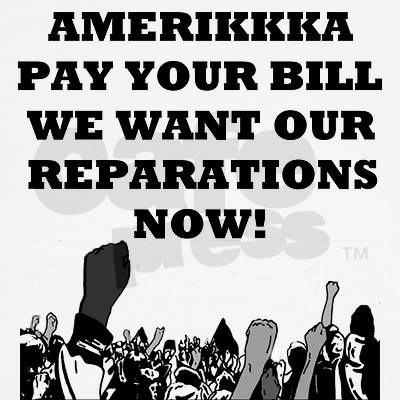

Has any white person like you ever considered the thought that we are talking about abuses created upon generations of blacks as a population by government decree?
Oh. Slavery again. OK, pay attention. For all of human history, on every continent, slavery was an accepted, widespread, and common part of the human condition. There are
still slave markets in Africa. White Christian males in Europe and North America were the very first humans on the planet to cast slavery as a moral issue, and condemn it as immoral. You're welcome.
The vast majority of Africans sold into slavery were "prisoners of war", i.e., losers captured by winners--a neighboring tribe--and, typically, sold to Arab slave traders, who brought them to the coasts where they were embarked on ships. Today, the descendants of the winners are risking their lives to join the descendants of the losers and share in the privilege of living among us whites. The enslavement of your ancestor was the best thing that ever happened to you.
I'm not just talking about slavery and your post is simply inaccurate drivel.
So pay attention:
"In the first place, the Portuguese initiated what eventually became the Trans-Atlantic slave trade mainly through slave raids along the coasts of Africa. The first of these raids came in 1444 and was led by Lançarote de Freitas."
"Therefore, the first phase of the slave trade began not with a trade, but with a series of raids. This point is especially important because although the slave trade was on some levels based on a partnership between European buyers and African traders, the slave trade did not begin as such."
"Moreover, the partnership between the traders and buyers was an uneasy one. The European slave traders often betrayed those who supplied them with slaves."
" The introduction of European weapons made these wars more drawn out and destructive affairs. Moreover, the only way Africans could acquire these firearms was through the trade of slaves. A king of Dahomey once requested that Europeans establish a firearms factory in his nation, but this request went ignored. Firearms became necessary for African nations to defend themselves both from African rivals as well as from European intrusion, but the only way to acquire these weapons was through the slave trade. This situation only benefited the competing European powers that were able to play Africans against each other."
Did We Sell Each Other Into Slavery: Misconceptions About the African Involvement in the Slave Trade | HuffPost
"Indeed, it was the Portuguese who initiated the European phase of slave raiding in Africa by attacking a sleeping village in 1444 and carting away the survivors to work for free in Europe."
" The fact of African resistance to European Imperialism and Colonialism is not well known, though it is well documented. Read, for instance, Michael Crowder (ed.), West African Resistance, Africana Publishing Corporation, New York, 1971. Europeans entered Africa in the mid 1400 s and early 1500 s during a time of socio-political transition. Europeans chose a favorite side to win between African nations at a war and supplied that side with guns, a superior war instrument. In its victory, the African side with guns rounded up captives of war who were sold to the Europeans in exchange for more guns or other barter. Whites used these captives in their own slave raids. These captives often held pre-existing grudges against groups they were ordered to raid, having formerly been sold into slavery themselves by these same groups as captives in inter-African territorial wars. In investigating our history and capture, a much more completed picture emerges than simply that we sold each other into slavery."
Reunion Black Family.
" Africans started to fight the transatlantic slave trade as soon as it began. Their struggles were multifaceted and covered four continents over four centuries. Still, they have often been underestimated, overlooked, or forgotten. African resistance was reported in European sources only when it concerned attacks on slave ships and company barracoons, but acts of resistance also took place far from the coast and thus escaped the slavers’ attention. To discover them, oral history, archaeology, and autobiographies and biographies of African victims of the slave trade have to be probed. Taken together, these various sources offer a detailed image of the varied strategies Africans used to defend themselves from and mount attacks against the slave trade."
" The Africans’ resistance continued in the Americas. They ran away, established maroon communities, used sabotage, conspired, and rose against those who held them in captivity. Freed people petitioned the authorities, led information campaigns, and worked actively to abolish the slave trade and slavery."
"In Europe, black abolitionists launched or participated in civic movements to end the deportation and enslavement of Africans. They too delivered speeches, provided information, wrote newspaper articles and books."
"Using violent as well as nonviolent means, Africans in Africa, the Americas, and Europe were constantly involved in the fight against the slave trade and slavery."
African Resistance - The Abolition of The Slave Trade
The best thing would have been for whites to have left us alone.