fanger, et al,
That is an excellent question!
News and Views about the Economy of Palestine
During the Ottoman regime, the fellaheen's economic situation was continuously precarious. The prosecution of World War I in Palestine added to the economic problems of all segments of the population. In the 1920s, during the first decade of the British Mandate, Palestine's agricultural sector did not fair well except for plantation and cash crops such as citrus and bananas. In the early 1930s before the peasant suffered five consecutive years of poor crop yields, many villagers were disillusioned by their financial difficulties; they were no longer making efforts to extricate themselves from their indebtedness to the government and moneylenders.2 In the mid-1930s, the civil unrest in Palestine further impaired the Arab rural economy. Eventually the peasant became exhausted and was beaten by forces beyond his ken or control.
Beginning in the nineteenth century or earlier, the peasant steadily became economically reliant and politically dependent upon others who gradually gained irretrievable control over his future. Classic patron-client relationships were formed. These ties were solidified and reinforced over time, with the notable elite acting as intermediaries between "government" and the peasantry. In matters pertaining to land the peasant's illiteracy made him depend upon spokesmen in coping with administrative matters like tax payment. During the early years of British rule in Palestine, the peasantry had little interest in politics yet desired changes in the rural economy which would lead to its improvement, without greatly altering customary agricultural procedures and practices. 3 Thus the Arab political arena during the British Mandate was ultimately left to those who had landowning interests, including urban merchants, professionals, religious leaders, village sheikhs, mukhtars, and local government officials. Together this elite numbered perhaps no more than several thousand out of a total Muslim and Christian population of 769,813; the rural Arabs constituted approximately two-thirds of the total Arab population of Palestine in 1931.4
2 Albert Abramson to Acting Chief Secretary of the Palestine Government, May 12, 1931, P.R.O., CO 733/207/87275.
3 Great Britain, P.R.O., CAB 24/165 1887, Herbert Samuel, "Palestine," February 25, 1924, P. 4; Lord Plumer, High Commissioner for Palestine, to Sir Leopold Amery, Secretary of State for the Colonies, April 22, 1926, I.S.A., M15/27A.
4 Palestine Government, Census for Palestine, 1931, vol. 1, pp. 96, 291-292. In 1931 there were 108,765 rural earners and 331,319 dependents. Of the earner category, 70,526 (65%) were cultivators, 32,539 (35%) were agricultural laborers, and 5,311 (5%) gained their livelihood from rents.
Was Palestine a thriving economy under a stable government before israel was invented?
(COMMENT)
Prior to 1948 and under the British Administration, the general economy of both the Arab and Jewish communities were slightly below average for the region.
After WWII (1945 on) there was a renewed focus on Palestine by the British to jump start the economy. However, the Arab-Jewish conflict reignited and the economy suffered for it.
In more recent and contemporary times, with the Israeli has had very great successes in their economy, having gradually worked its way up from one of the most disastrous economies to one of the world’s 34 most developed economies.
In terms of the West Bank and Gaza Strip the Quartet in conjunction with the EU, devised an international plan to support the Palestinian economy. However, it appears the plan was still hotly debated within the donor communities and the Quartet. The consensus was that the Palestinian economy was directly tied to the progress for peace in the region; that it was deterring investor from risking any more on the $4 Billion Dollar Plan until progress was made. Senior Palestinian officials attended the economic discussions on the sidelines of the annual UN General Assembly were unable to give and reasonable assurances that would promote further foreign investment.
The plan, proposed by Secretary of State John Kerry, aimed at boosting the Palestinian economy through a series of investment projects valued at ≈ $4 billion dollars.
The resumption of the peace talks, between the Palestinians and Israel, it gave rise to a revised Plan by Kerry, after months of shuttle diplomacy between the two sides. But as predicted, the Plan and donor commitments evaporated away, leaving Palestine critically dependent of pure donor grants.
Mohamed Abu Ramadan, the Palestinian Minister of Planning, who attended the Quartet meeting, expressed the view that the plan was welcomed by the Palestinians in principle --- due to the bad shape of their economy. Minister Ramadan stressed that to become a success, the plan has to be linked to progress in the peace process, pointing out that Israel's polices must have real practical changes "to ensure turning the plan from a strategic vision to a reality on the ground."
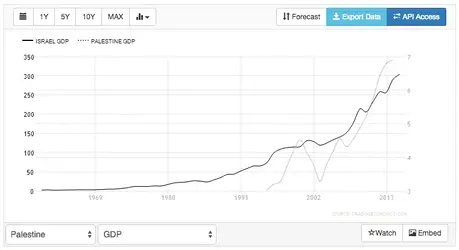
With the infusion of donor contributions, the growth of Palestine's GDP has been chaotic since the 1990's,
with the 10 year averaged -1.95 percent of GDP. By comparison, Israel's growth averaged nearly 5% per year, led by exports, for the 20 years. Israel's economy is rated as about $268B, whereas Palestine (West Bank & Gaza Strip) has a $20B economy.
Most Respectfully,
R


})
})


