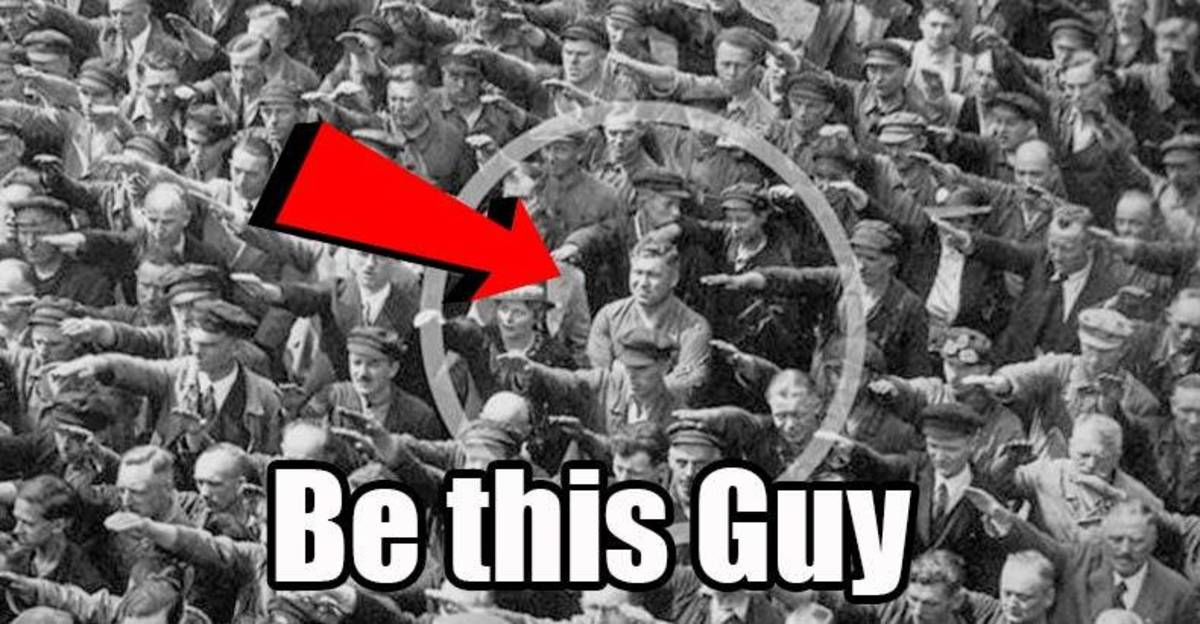
So....let's remember....all six
Nazism
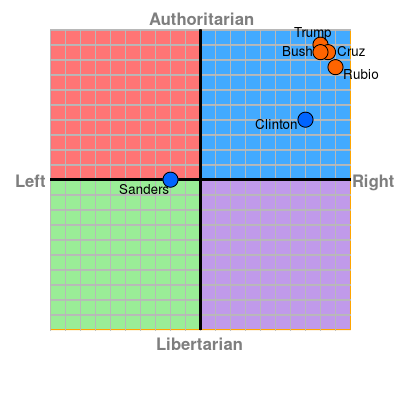
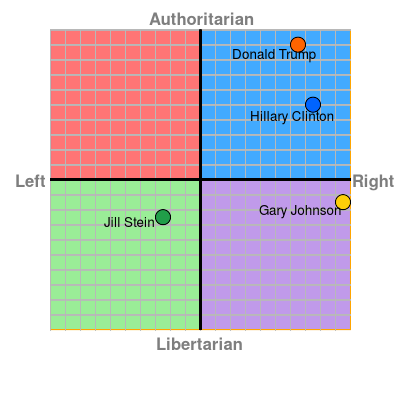
Upper right quadrant.
Middle left quadrant.
Lower middle quadrant.
Upper middle quadrant.
About halfway down on the lower left quadrant.
Any area in lower left quadrant.
...aim for exactly the same outcomes for society.
You haven't got the slightest clue about how the world works.
Interesting that the aims of the Communist Party, USA, and the Democrat Party, are almost identical.
Interesting that you seem to just make shit up as you please. The Democrat party is a slight right of center party, and this is mostly due to the fact that American politics in general is actually quite right of center. What Americans often say is "liberal" would be seen as right of center in most other parts of the world.
I recognize that Liberals rarely read any books that don't involve coloring....
...but this one is dispositive (better look that up):
"Government control of private sector activity...is aptly described as Bolshevik- or Marxist, socialist, collectivist, statist, or, for that matter, fascist, too. Indeed, nationalized health care was one of the first programs enacted by the Bolsheviks after they seized power in 1917 (Banks, insurance companies and means of communications were also taken over by Soviet authorities immediately)."
Dziewanowski, "A History of Soviet Russia," p. 107.
Which governments behave in that manner? The six I named earlier.
Please...be very careful.....if this is the first time you've tried to think you could wind up with an aneurysm!
And....clean up your language. The vulgarity give away your understanding that you've lost the argument.
You really need help. Maybe medication, too.
The left--right spectrum isn't accurate enough. I realize understanding another axis in the political spectrum is going to require some intense mental activity on your part, but wow...do you need it. There is no excuse for your aggressive ignorance.
------------------
Left<------------->Right
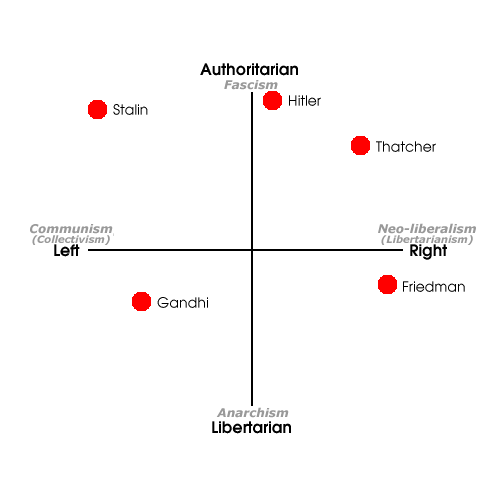
If we recognise that this is essentially an economic line it's fine, as far as it goes. We can show, for example, Stalin, Mao Tse Tung and Pol Pot, with their commitment to a totally controlled economy, on the hard left. Socialists like Mahatma Gandhi and Robert Mugabe would occupy a less extreme leftist position. Margaret Thatcher would be well over to the right, but further right still would be someone like that ultimate free marketeer, General Pinochet.
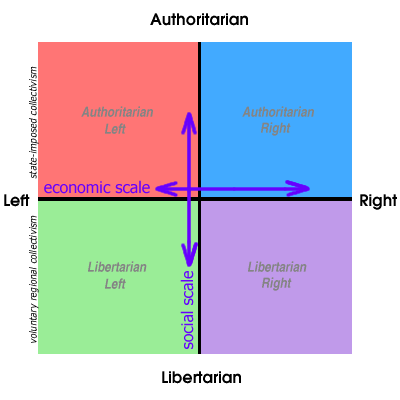
That deals with economics, but the social dimension is also important in politics. That's the one that the mere left-right scale doesn't adequately address. So we've added one, ranging in positions from extreme authoritarian to extreme libertarian.
Both an economic dimension and a social dimension are important factors for a proper political analysis. By adding the social dimension you can show that Stalin was an authoritarian leftist (ie the state is more important than the individual) and that Gandhi, believing in the supreme value of each individual, is a liberal leftist. While the former involves state-imposed arbitrary collectivism in the extreme top left, on the extreme bottom left is voluntary collectivism at regional level, with no state involved. Hundreds of such anarchist communities existed in Spain during the civil war period
You can also put Pinochet, who was prepared to sanction mass killing for the sake of the free market, on the far right as well as in a hardcore authoritarian position. On the non-socialist side you can distinguish someone like Milton Friedman, who is anti-state for fiscal rather than social reasons, from Hitler, who wanted to make the state stronger, even if he wiped out half of humanity in the process.
The chart also makes clear that, despite popular perceptions, the opposite of fascism is not communism but anarchism (ie liberal socialism), and that the opposite of communism ( i.e. an entirely state-planned economy) is neo-liberalism (i.e. extreme deregulated economy)
The usual understanding of anarchism as a left wing ideology does not take into account the neo-liberal "anarchism" championed by the likes of Ayn Rand, Milton Friedman and America's Libertarian Party, which couples social Darwinian right-wing economics with liberal positions on most social issues. Often their libertarian impulses stop short of opposition to strong law and order positions, and are more economic in substance (ie no taxes) so they are not as extremely libertarian as they are extremely right wing. On the other hand, the classical libertarian collectivism of anarcho-syndicalism ( libertarian socialism) belongs in the bottom left hand corner.
In our home page we demolished the myth that authoritarianism is necessarily "right wing", with the examples of Robert Mugabe, Pol Pot and Stalin. Similarly Hitler, on an economic scale, was not an extreme right-winger. His economic policies were broadly Keynesian, and to the left of some of today's Labour parties. If you could get Hitler and Stalin to sit down together and avoid economics, the two diehard authoritarians would find plenty of common ground.
A Word about Neo-cons and Neo-libs
U.S. neo-conservatives, with their commitment to high military spending and the global assertion of national values, tend to be more authoritarian than hard right. By contrast, neo-liberals, opposed to such moral leadership and, more especially, the ensuing demands on the tax payer, belong to a further right but less authoritarian region. Paradoxically, the "free market", in neo-con parlance, also allows for the large-scale subsidy of the military-industrial complex, a considerable degree of corporate welfare, and protectionism when deemed in the national interest. These are viewed by neo-libs as impediments to the unfettered market forces that they champion.
The Political Compass