Both Al-Wahda, which only has a limited space of 160 square meters for its worshippers, and the next door Al-Baraka Mosque, are refusing entry to non-Muslims for the prayers services. But once prayers were over Al-Wahda’s imam, Sheikh Abdulmonam, initially hesitant at speaking to a Newsweek reporter, gave me permission to enter the house of worship so that we could talk about the actions of Mohamed Bouhlel, a 31-year-old Tunisian that the Islamic State militant group (ISIS) on Saturday claimed as one their own. After Bouhlel mowed down hundreds of locals and foreigners celebrating Bastille Day on the Promenade des Anglais on Thursday night, killing at least 84 people, Muslim communities across France are once again coming to terms with a mass killing carried out in their religion’s name. “What happened on Thursday has nothing at all to do with Islam because the person who did it, even according to his outward acts, wasn’t a Muslim,” the 46-year-old Abdulmonam says in Arabic, speaking through a translator. He declined to give his last name. “He smoked, he didn’t pray, he didn’t fast, he didn’t do all these things that Muslims should do. It was a horrible crime.”
Worshippers outside the al-Wahda prayer room (far right) and the al-Baraka Mosque (far left) in the city center of Nice after Friday prayers, July 16 2016. Members of the Muslim community said that Mohamed Bouhlel was "going straight to hell" for his truck attack that left at least 84 people dead on the city's Promenade des Anglais
Nice’s Muslims, like Abdulmonam, are adamant that Bouhlel does not represent the community in any way; he was a deviant who should never be termed a Muslim, they say. Guillaume Gourves, 35, a robed French Muslim convert and worshipper at the Al-Baraka mosque, says that Bouhlel “is going straight to hell” for carrying out such a heinous act, rejecting the notion that ISIS represents Islam and Muslims. “They just represent themselves. Islam is salam, it’s peace,” he says. “This man apparently wasn’t even doing Ramadan or the prayer. He just thinks, ‘Oh let’s kill people.’ Is that what is Islam? No, it is not.”
Lhouasaine Khalfaoui, a 41-year-old French-Moroccan butcher at the Boucherie Atlas, a minute’s walk from al-Wahda, was a neighbor of the first person killed in the attack, a 60-year-old Muslim mother-of-six, Fatima Charrihi. Khalfaoui points to a fly on the counter in the shop and says that a true Muslim wouldn’t hurt it. “One person dead, is all of the community dead in the Quran. This was not a Muslim,” he says. “He did not practice the religion. No Ramadan, no prayer. This was an animal. This is a contradiction with Islam.”
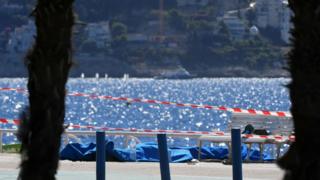
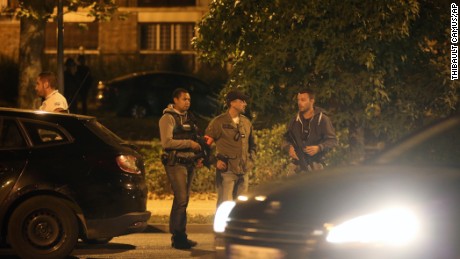
Police officers, firefighters and rescue workers are seen at the site of an attack on the Promenade des Anglais on July 15, 2016, after a truck drove into a crowd watching a fireworks display in the French Riviera town of Nice. The city's Muslim community has rejected Bouhlel as a deviant who should not be associated with Islam.
France has now suffered through three major attacks committed by radical Islamists since January 2015; the country’s Muslim community is steeling itself for a backlash. “When these things happen in France, we always become the victims because we are one of the weakest sections of society here,” Abdulmonam says. “When we saw the prime minister of France [Manuel Valls] come out and say it was a terrorist attack, we think he did that to placate the far-right so they wouldn’t rise up against him, but in reality this attack has nothing to do with Islam.”
MORE