Frank,
Let me answer this with science... First, we know the spectral band pass and absorption of our atmospheric gases.
Second, we also know how CO2 responds in a controlled environment using a full spectrum radiant source.
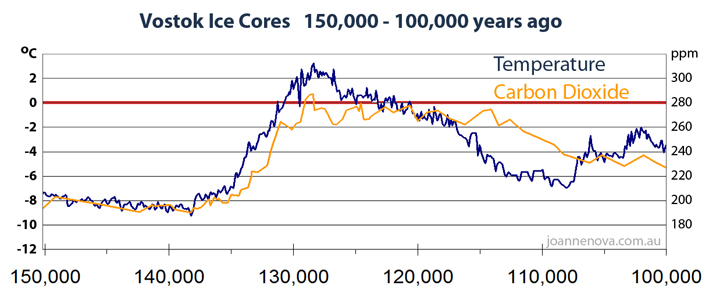
So the last remaining question is what is the light source we are going to use, what is its spectral output and how far from the source will the tube be placed. Above, The red line is EMPIRICAL OBSERVED EVIDENCE placed into the model Vs Hypothetical data used in climate modeling.
The experiment above was done with a 2,000 watt full spectrum light source, The tube was filled with argon and the parts per million of CO2 were gradually added in steps allowing the cylinder to warm to equilibrium. (one problem with this evaluation is the length of the cylinder and the temperatures at the distant ends is not representative of earths atmosphere. This makes the warming seen in the lab disproportionate to our atmosphere)
CO2 - Argon mix (room temp was maintained at 62 degrees F, cylinder is 12" in diam and 48" long), light was aimed at 70 deg towards the top of the tube and placed 16" from the tube. Three temperature sensors were placed in the tube 14" apart and 5" from each end. The gases were held at 1.5 times atmospheric pressure @ 4,250 feet above sea level)
* 0 to 50ppm we saw a rise of about 10.1 deg C which took 14 hours 35 min
* 50-100ppm we observed a rise of just 4.5 deg C which took 16.9 hours
* 100-200ppm we observed a rise of just 2.1 deg C which took 24.6 hours.
* 200-400ppm we observed a rise of just .7 deg C which took 49.8 hours.
* 400-800ppm we observed a rise of just .27 deg C which took 102.2 hours.
You will note that pure CO2 and an inert gas warm considerably slower than our atmosphere mix will. about 50% slower and 50% lower. CO2's direct affect is quite small and essentially zero above 800ppm. When we add nitrogen, oxygen, water, CO2 and other gases is when things get kind of weird.. But again, above 800ppm the effect is essentially zero as the above graph shows.
One interesting thing we did note, the time to warm decreased proportionally to the temp increase. While yet again once the tube warmed and reached equilibrium it did not warm further. When the heat was moved slightly out to 20" the temps dropped by 18% illustrating the earths axial tilt and precision (place in orbit) matter.
When you also put into perspective the ocean oscillations, winds, and seasons, also known as natural variation, the rise which could be attributed to CO2 vanishes. The warming in the lab was gradual near to far from the light source,but once equilibrium was reached it was incapable of more warming. The equal temps did not allow us to observe the cooling that would take place high in our atmosphere. We found no mid-tube warm spot which would be consistent with AGW theroy.
Without normal rise and fall convection with water vapor there are many questions unanswered. This is why a lab experiment is useless in predicting anthropogenic causes, water vapor is a positive forcing until we reach about 288ppm where it becomes a negative forcing allowing heat escape at high altitude simply by displacing other gases which hold latent heat much better..
The debate if far from over or settled...