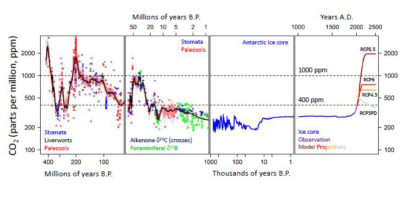
it isn't empirical evidence, it is models.
Look We have measurements. Those are empirical.
Models are used to extrapolate into the future.
Are you having a ******* meltdown because we can't take future measurements?> Is this why you are running in circles & screaming OMG OMG OMG?
L
that material doesn't explain shit. I'm asking you for measurements, ones around the globe, that big old fat fking thermometer that has average temperature of the world on it?
Oh, and have you heard that the earth has been in a few ice ages? how do you explain that? CO2 in the atmosphere twice to three times the concentration without man. still waiting.
av·er·age
/ˈav(ə)rij/
Learn to pronounce
noun
noun:
average; plural noun:
averages
- 1.
a number expressing the central or typical value in a set of data, in particular the mode, median, or (most commonly) the mean, which is calculated by dividing the sum of the values in the set by their number.
"the housing prices there are twice the national average"
synonyms: mean, median, mode, midpoint, center; More
norm, standard, rule, par;
the general run
"the price was low compared with the average of the past 25 years"
- an amount, standard, level, or rate regarded as usual or ordinary.
"they take about thirty minutes on average"
synonyms: normally, usually, ordinarily, generally, generally speaking, in general, for the most part, in most cases, as a rule, typically; More
overall, by and large, on the whole, on balance
"on average, I suppose we watch a couple of hours of television a night"
- 2.
the apportionment of financial liability resulting from loss of or damage to a ship or its cargo.
- reduction in the amount payable under an insurance policy, e.g. in respect of partial loss.
adjective
adjective:
average
- 1.
constituting the result obtained by adding together several quantities and then dividing this total by the number of quantities.
"the average temperature in May was 64°F"
synonyms: mean, median, medial, middle
"the average temperature in May was 4°C below normal"
- of the usual or ordinary standard, level, or quantity.
"a woman of average height"
synonyms: ordinary, standard, usual, normal, typical, regular, unexceptional
"a woman of average height"
- having qualities that are seen as typical of a particular person or thing.
"the average teenager prefers comfort to high fashion"
- mediocre; not very good.
"a very average director who made very average movies"
synonyms: mediocre, second-rate, uninspired, undistinguished, ordinary, commonplace, middle-of-the-road, mainstream, unexceptional, unexciting, unremarkable, unmemorable, indifferent, humdrum, nothing special, everyday, bland, run-of-the-mill, not very good, pedestrian, prosaic, lackluster, forgettable, amateur, amateurish; More
acceptable, passable, all right, adequate, fair, middling, moderate, tolerable;
garden-variety;
informalOK, so-so, bog-standard, fair-to-middling, (plain) vanilla, nothing to write home about, nothing to get excited about, a dime a dozen, no great shakes, not so hot, not up to much;
informalcommon or garden, not much cop, ten a penny;
informalbush-league;
informaljake;
informalhalf-pie
"a very average director making very average movies"
antonyms: outstanding, exceptional
verb
verb:
average; 3rd person present:
averages; past tense:
averaged; past participle:
averaged; gerund or present participle:
averaging
- 1.
achieve or amount to as an average rate or amount over a period of time.
"annual inflation averaged 2.4 percent"
- calculate or estimate the average of (figures or measurements).
"their earnings, averaged out over the month, were only $62 a week"
- result in an even distribution; even out.
"it is reasonable to hope that the results will average out"
- result in an average figure of.
"the cost should average out to about $6 per page"
Origin
late 15th century: from French
avarie ‘damage to ship or cargo’, earlier ‘customs duty’, from Italian
avaria, from Arabic
‘awār ‘damage to goods’; the suffix
-age is on the pattern of
damage . Originally denoting a duty payable by the owner of goods to be shipped, the term later denoted the financial liability from goods lost or damaged at sea, and specifically the equitable apportionment of this between the owners of the vessel and of the cargo (late 16th century); this gave rise to the general sense of calculating the mean (mid 18th century).