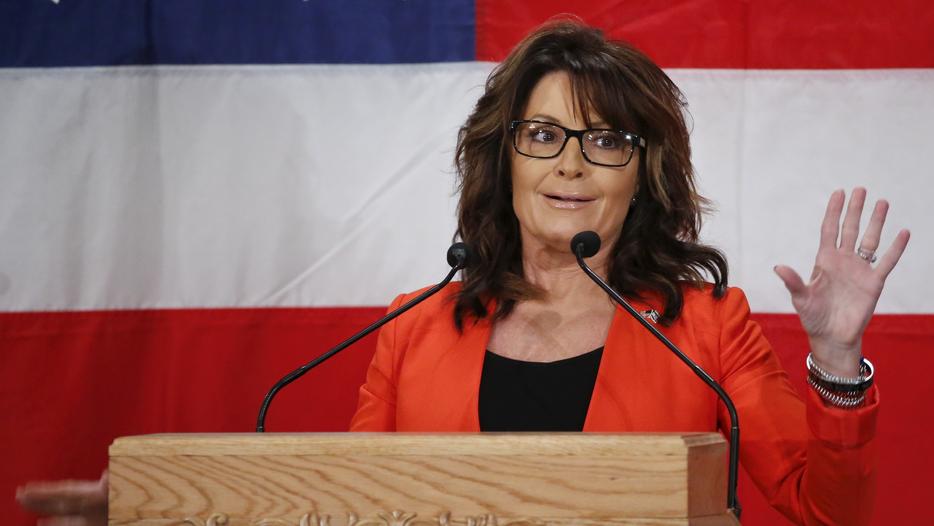
Fake News:
Federal Court Rules In Favor Of Sarah Palin's Defamation Lawsuit Against The Lying Slandering Defaming Fake News New York Times
Sarah Palin is about to get all Up In Their Business...
Jonathan Turley, of the few honest Lefties at a national level, explains:
Sarah Palin is locked and loaded.
Palin’s won a major victory in a ruling that she could go to trial on a particularly outrageous editorial by Lying Slandering Fake News New York Times In June 2017.
The editorial claimed that she incited Jared Loughner’s 2011 shooting of then-U.S. Rep. Gabrielle Giffords, D-Ariz.
This ruling comes after Nick Sandmann was able to drive his own defamation lawsuits to settlement with various Lying Slandering Fake News news organizations like the Washington Post who lied and slandered the teenager over of his victimization by a Native American activist in front of the Lincoln Memorial.
The Lying Fake News Media has plunged headlong into propaganda and Left Wing bias.
The Lying Slandering Fake News New York Times claimed Palin and other Republicans had incited the Giffords shooting.
The editorial started off on the shooting of GOP Rep. Steve Scalise and other members of Congress by
James T. Hodgkinson, a violent left-wing felon and Sanders supporter.
The attack did not fit with the Lying Fake News narrative by the Lying Fake news media that claimed constant danger by right-wing violence and the Lying Slandering Fake News Times tried to shift the focus back on conservatives. It stated that SarahPAC had posted a graphic that put Giffords in crosshairs before she was shot. It was false but it was enough for the intended spin:
“Though there’s no sign of incitement as direct as in the Giffords attack, liberals should of course hold themselves to the same standard of decency that they ask of the right.”
The editorial was grossly unfair and falsely worded. Indeed, the Court's Ruling begins with a bang: “Gov. Palin brings this action to hold James Bennet and
The Times accountable for defaming her by falsely asserting what they knew to be false: that Gov. Palin was clearly and directly responsible for inciting a mass shooting at a political event in January 2011.”
The Times stated “the link to political incitement was clear. Before the shooting, Sarah Palin‘s political action committee circulated a map of targeted electoral districts that put Ms. Giffords and 19 other Democrats under stylized cross hairs.”
In reality, the posting used crosshairs over various congressional districts, which included Giffords district.
The ruling represents a reversal of fortune for Palin after an earlier complaint was rejected. In Dec. 2019, Palin filed an amended complaint that just passed judicial muster. A three-judge panel
reestablished Palin’s defamation claim in an August decision.
What makes this ruling significant is that it is focused on an editorial about a public figure. Both elements make it difficult to sue. Opinion is generally protected under tort law and public figures have a higher burden to bring any defamation case.
The standard for defamation for public figures and officials in the United States is the product of a decision decades ago in
New York Times v. Sullivan. The Supreme Court ruled that tort law could not be used to overcome First Amendment protections for free speech or the free press. The Court sought to create “breathing space” for the media by articulating that standard that now applies to both public officials and public figures. In order to prevail, a litigant must show either actual knowledge of its falsity or a reckless disregard of the truth.
Simply saying that something is your “opinion” does not give you a license to lie and defame if you are asserting facts rather than opinion.
There is a big difference between stating fact and opinion and the Lying Slandering Fake News Times blew away that distinction in the rush to shift attention on political violence to Republicans like Palin.
What is not striking about the opinion is how the court clearly lays out the case for malice by Bennet, the key element under the
New York Times v. Sullivan standard. The Court details how internal messages immediately raised the possibility of raising violence on the right.
The court suggested that the later correction issued by the Times might be used by the jury to assume or discount malice. It is rare that such a correction would be raised as substantial evidence on intent:
The fact that Bennet and the Times were so quick to print a correction is, on the one hand, evidence that a jury might find corroborative of a lack of actual malice, as discussed later. But, on the other hand, a reasonable jury could conclude that Bennet’s reaction and the Times’ correction may also be probative of a prior intent to assert the existence of such a direct link, for why else the need to correct? Indeed, the correction itself concedes that Bennet’s initial draft incorrectly stated that there existed such a link. If, as Bennet now contends, it was all simply a misunderstanding, the result of a poor
choice of words, it is reasonable to conclude that the ultimate correction would have reflected as much and simply clarified the Editorial’s intended meaning.
Here is the opinion: Palin v. New York Times