P F Tinmore,
et al,
Yes, there is something here that needs clarification in the timeline.
Not completely true. In Britain's 1939 white paper it stated that they would not impose a Jewish state in Palestine against their will. This was a long held position that complies with international law.
(COMMENT)
The 1939 White Paper is
not something that can stand on its own. It was flawed in terms of the Mandatory's (UK) intention and that of the Permanent Mandates Commission. This was bought out in:
AD HOC COMMITTEE ON THE PALESTINIAN QUESTION COMMUNICATION FROM THE UNITED KINGDOM DELEGATION TO THE UNITED NATIONS said:
The White Paper of May 1939
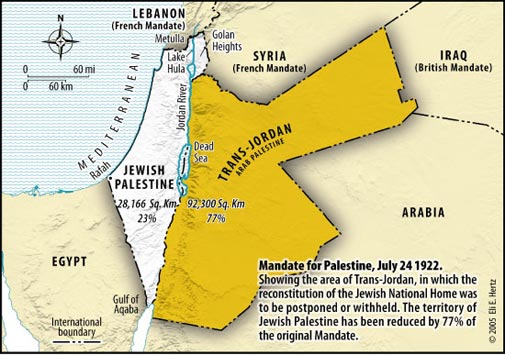
102. The statement of policy issued by His Majesty’s government in May 1939, was intended to put an end to uncertainty as to the objectives of their policy in Palestine, and to prepare the way for the termination of the Mandate. The statement opened with a clear definition of the attitude of His Majesty’s government towards the maximum claims of both Arabs and Jews. Thus, after quoting the interpretation of the Balfour Declaration contained in the White Paper of 1922, they “now declare unequivocally that it is not part of their policy that Palestine should become a Jewish State.”
At the same time they maintained their rejection of the Arab contention that they were pledged, by undertakings given during the war of 1914-18, to grant independence to the Arab population of Palestine:-
“They cannot agree that the McMahon correspondence forms a just basis for the claim that Palestine should be converted into an Arab State.”
103. The objective of His Majesty’s Government was then stated to be
“the establishment within ten years of an independent Palestine State….in which Arabs and Jews share in government in such a way as to ensure that the essential interests of each community are safeguarded.”
110. The Mandatory’s new statement of policy was examined by the Permanent Mandates Commission at their thirty-sixth session in June, 1939. the commission reported that:
“the policy set out in the White Paper was not in accordance with the interpretation which, in agreement with the Mandatory Power and the Council, the Commission had always placed upon the Palestine Mandate.”
They went on to consider whether the Mandate was open to a new interpretation with which the White Paper would not be at variance. Four of the seven members
“did not feel able to state that the policy of the White Paper was in conformity with the Mandate, any contrary conclusion appearing to them to be ruled out by the very terms of the Mandate and by the fundamental intentions of its authors.”
The other three members “were unable to share this opinion; they consider that existing circumstances would justify the policy of the White Paper, provided the Council did not oppose it.”
SOURCE: A/AC.14/8 2 October 1947
I have to agree that the Mandatory was more inclined to support a shared government in which the Arab and Jews jointly safeguarded the interests of the other. However, irreconcilable differences prevented that from ever materializing. The manifestation of these differences only became more pronounced and stronger in between the White Paper and the end of the first war. The UK asked the United Nations to consider their report, and to recommend a settlement of the problem. The UK
(as outgoing Mandatory) did not intend recommend any particular solution.
It is not that they opposed a Jewish state in Palestine, the UK could not see any workable solution in which the application of armed force would not be required. The UK did not oppose any particular set of solutions; they opposed any solution with an outcome that would lead to probability of a civil war between the belligerents
(Arab vs Jews).
The Palestinians declared independence on their own land inside their own already existing borders. What makes you believe that is more than their fair share?
(COMMENT)
While it is true that the Independence did encompass privately held lands owned by Arabs, it is not true that the Arabs ever had any claim to sovereignty over any of the territory. The territory was ceded by Treaty to the Allied Powers in trust through the Permanent Mandates Commission, which then was assumed by the International Trusteeship System for the administration
(Chapter XII, Article 77, of the UN Charter). The borders were established by the Allied Powers and had no relationship to the "ownership of land" to which you speak or any particular cultural tries or Arab tribal control.
The right to self-determination is not unique to the Arab Palestinian. The territory was not unique to the Arab-Palestinian. The territory was ultimately under the governance of the Permanent Mandates Commission and then the International Trusteeship System, and not any Arab Tribal entity or the Arab Higher Committee
(without regard to who was pulling their strings).
The right to self-determination is not something like a chit in the pocket. Independence, sovereignty and freedom are not something ultimate on a piece of paper. These are things that cultures and societies fight for and defend. Freedom is not free, you don't get it just because the concept is written on paper. The Israelis earned their right at sovereignty; fought for it, bleed for it, and died for it. It is not something that they are likely to surrender to the Hostile Arab Palestinian that wants something for nothing; to parasitically feed off the prosperity cultivated and earned by others. It is like your web site on International Human Rights Law says:
The right to self-determination in Palestine said:
Israel was effectively and lawfully established as a state, on the armistice territory, by secession from the Mandate of Palestine. A state for the Palestinians living in the Mandate of Palestine was never created and this unrealised goal still constitutes one of the core issues of the conflict.
SOURCE: IHL obligations in the struggle for self-determination
The current situation and Occupation the Hostile Arab Palestinians experience today are the consequence of more than six decades of botched Arab Leadership and ineffective commercial and economic development of the Arab, through the various wars and intifada promoted and relished by the Palestinian. The Palestinian is the very model of a cascade failure as a culture, a productive people, and government. Their failure to share when they had the chance, has lead them to this end. Now, they will even get less.
Most Respectfully,
R