And as a response to Hartung's article:
Economic Growth Obama Vs. Reagan Investing.com
Last week, Adam Hartung qualified for the
"Mark Twain Award" if there was such a thing. In
his article, "Obama Outperforms Reagan On Jobs, Growth & Investing," Adam goes to some length to try and show that unemployment rate, the
S&P 500 and economic growth are currently better under the current administration than they were during the Reagan administration.
Adam's first mistake was in the use of the Bureau Of Labor Statistics measure of unemployment (U3) as a comparative benchmark of success as President. To wit:
"“President Obama has achieved a 6.1% unemployment rate in his 6th year, fully one year faster than President Reagan did. At this point in his presidency, President Reagan was still struggling with 7.1% unemployment, and he did not reach into the mid-low 6% range for another full year. So, despite today’s number, the Obama administration has still done considerably better at job creating and reducing unemployment than did the Reagan administration."
While this is
"technically true," it falls within Twain's category of a
"statistical lie."
The BLS's measure of unemployment has become obfuscated by the rise in the number of individuals that are no longer counted as part of the labor force. As
I discussed in "Why The Unemployment Rate Is Irrelevant," the measure of labor force participation is markedly different between Reagan and Obama.
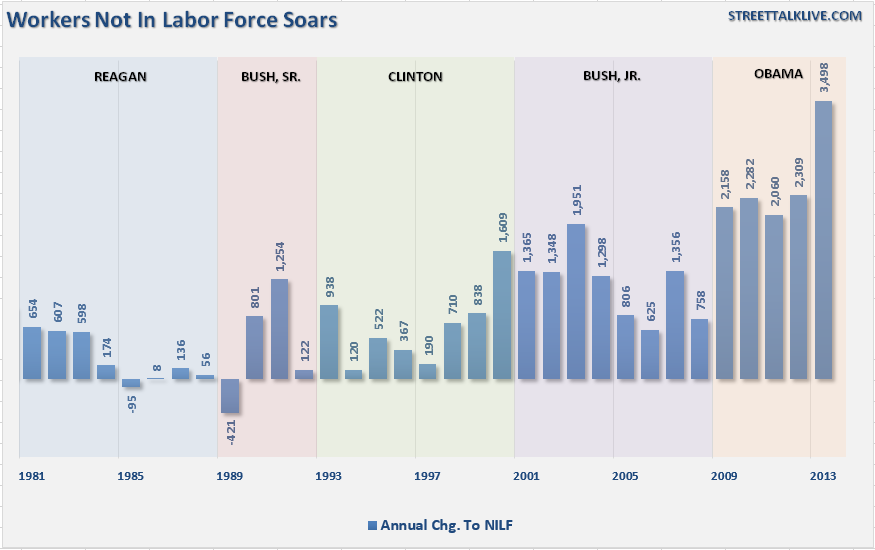
During Reagan's Presidency, workers that were unemployed longer than 52-weeks were still part of the labor force. This inclusion gave a more accurate measure of the relative size of the labor force overall. However, in 1994, Clinton removed individuals from the labor force that were currently unemployed for longer than 52-weeks. This adjustment immediately improved the overall measure of unemployment by shrinking the labor force by some 500,000 individuals. Since then, the number of individuals no longer counted as part of the labor force has swelled to more than 92 million individuals, or roughly 45% of the working age population (16-54) as of the end of 2013
In other words, a large part of the drop in the U-3 unemployment rate is due to the increase in the number of individuals excluded from the workforce. In theory, if the dropout rate continued at the current pace, the unemployment could fall towards zero allowing the Federal Reserve to win the battle of unemployment, but losing the war of economic prosperity.
The chart below shows the annual change in those not counted as part of the labor force by President from 1981-Present.