O....M....G....DJIA Hits 50,000 Another huge win for Trump

Copilot Search Branding


Images
Videos
The Clinton administration's policies, particularly the Community Reinvestment Act and the actions of HUD Secretary Andrew Cuomo, significantly contributed to the rise of subprime mortgages and the subsequent financial crisis.

Key​

  1. Community Reinvestment Act (CRA): Originally passed in 1977, the CRA was strengthened during the Clinton years. It aimed to encourage banks to lend to low-income and minority communities. Critics argue that this led to relaxed lending standards, as banks sought to meet CRA requirements by issuing loans to higher-risk borrowers, contributing to the subprime mortgage boom.

    2
  2. Andrew Cuomo's Role: As HUD Secretary from 1997 to 2001, Andrew Cuomo implemented policies that expanded access to homeownership. His initiatives included lowering credit standards and promoting loans to borrowers with poor credit histories. This approach, while aimed at increasing homeownership, also facilitated the growth of subprime lending without adequate oversight.

    2
  3. Deregulation and Risky Lending: The Clinton administration's policies encouraged a significant increase in subprime lending. By the late 1990s, the subprime loan market had grown substantially, with many loans issued without proper documentation or consideration of borrowers' ability to repay. This lack of regulation allowed lenders to engage in predatory practices, leading to widespread defaults when housing prices fell.

    2
  4. Impact on the Housing Market: The push for increased homeownership, particularly among low-income families, resulted in a surge of subprime mortgages. When the housing bubble burst, many of these borrowers faced foreclosure, contributing to the financial crisis of 2007-2008. The Financial Crisis Inquiry Commission noted that while government policies aimed to promote affordable housing, they also played a role in the crisis by encouraging risky lending practices.

    2
  5. ODF.2ha98xxSZyV4SxN1zGaRXQ

    ODF.5lm8QPi7UYlDHj9WBg8F2Q


    5 Sources
CLINTON? LMAOROG

Let's see if pics will help YOU

1774909588693.webp


1774909618345.webp


From Bush's President's Working Group on Financial Markets October 2008

"The Presidents Working Group's March policy statement acknowledged that turmoil in financial markets clearly was triggered by a dramatic weakening of underwriting standards for U.S. subprime mortgages, beginning in late 2004 and extending into 2007.


CLINTON AMD OBAMA HUH? lol

 
Fannie Mae's acquisition and use of risky, often described as "faulty," derivatives and related mortgage-backed securities accelerated heavily in the years leading up to the 2008 financial crisis, particularly between 2002 and 2008. While derivatives were initially used to manage interest rate risks, they became a major source of loss when the housing market turned in 2006–2007 - per AI

Fannie was controlled by Democrats at that time. Blaming private banks is foolish, because FNMA guaranteed their faulty loans. In addition, Fannie had loans of their own, again, based on unworthy (black) borrowers. This is a Democrat problem almost exclusively. S-190 did not get out of committee by a 10-9 vote. Republicans knew it wouldn't pass. The worst you can say about them is they were cowed by the race-baiting Democrats who slung about charges of GOP racism at committee hearings.

0bama was knee-deep in FNMA donations. He was part of the Senate. He was 100% involved in the collapse.


GSE'S FANNIE AND FREDDIE HUH?


November 27, 2007

A Snapshot of the Subprime Market


Dollar amount of subprime loans outstanding:

2007 $1.3 trillion

Dollar amount of subprime loans outstanding in 2003: $332 billion

Percentage increase from 2003: 292%


Number of subprime mortgages made in 2005-2006 projected to end in foreclosure:

1 in 5


Proportion of subprime mortgages made from 2004 to 2006 that come with "exploding" adjustable interest rates: 89-93%


Proportion approved without fully documented income: 43-50%


Proportion with no escrow for taxes and insurance: 75%


Proportion of completed foreclosures attributable to adjustable rate loans out of all loans made in 2006 and bundled in subprime mortgage backed securities: 93%
Subprime share of all mortgage originations in 2006: 28%


Subprime share of all mortgage origination in 2003: 8%

"Another form of easing facilitated the rapid rise of mortgages that didn't require borrowers to fully document their incomes. In 2006, these low- or no-doc loans comprised 81 percent of near-prime, 55 percent of jumbo, 50 percent of subprime and 36 percent of prime securitized mortgages."


Q HOLY JESUS! DID YOU JUST PROVE THAT OVER 50 % OF ALL MORTGAGES IN 2006 DIDN'T REQUIRE BORROWERS TO DOCUMENT THEIR INCOME?!?!?!?

A Yes.


Q WHO THE HELL LOANS HUNDREDS OF THOUSANDS OF DOLLARS TO PEOPLE WITHOUT CHECKING THEIR INCOMES?!?!?

A Banks.

Q WHY??!?!!!?!

A Two reasons, greed and Bush's regulators let them.
And then they sold the loan and risk to investors and GSEs clamoring for the loans. Actually banks, pension funds, investment banks and other investors clamored for them. Bush forced Freddie and Fannie to buy an additional $440 billion in mortgages in the secondary market.


Still blaming a law on the books for 30+ years for a WORLD WIDE CREDIT BUBBLE CHEERED ON BY DUBYA?


No, the CRA
Lending to Poor People Didn’t Cause the Financial Crisis
Did Not Cause the Financial Crisis

Look elsewhere for the sources of the meltdown.
...
Let’s just be clear about what the CRA does and doesn’t do. It simply says that if you open a branch office in a low income neighborhood and collect deposits there, you are obligated to do a certain amount of lending in that neighborhood. In other words, you can’t open a branch office in Harlem and use deposits from there to only fund loans in high-end Tribeca. A bank must make credit available on the same terms in both neighborhoods. In other words, a “red line” can’t be drawn around Harlem, a term that dates to when banks supposedly used colored pencils to draw no-loan zones on maps.

Showing that the CRA wasn’t the cause of the financial crisis is rather easy.


...Here’s what we should have seen:

  • Home sales and prices in urban, minority communities would have led the national home market higher, with gains in percentage terms surpassing national figures;
  • CRA mandated loans would have defaulted at higher rates;
  • Foreclosures in these distressed urban CRA neighborhoods should have far outpaced those in the suburbs;
  • Local lenders making these mortgages should have failed at much higher rates;
  • Portfolios of banks participating in the Troubled Asset Relief Program should have been filled with securities made up of toxic CRA loans;
  • Investors looking to profit should have been buying up properties financed with defaulted CRA loans; and
  • Congressional testimony of financial industry executives after the crisis should have spelled out how the CRA was a direct cause, with compelling evidence backing their claims.
Yet none of these things happened. And they should have, if the CRA was at fault.


BANKS PAID OVER $100+ BILLION IN FINES FOR THEIR BAD LENDING STANDARDS, CRA? LMAOROG


What caused the financial crisis? The Big Lie goes viral


It was not the 1977 law that drastically lowered credit standards for blacks, invented instruments like mortgage-backed securities, credit swaps, and all the other tricks designed to try to make bad fiscal ideas work.
 
Fannie Mae's acquisition and use of risky, often described as "faulty," derivatives and related mortgage-backed securities accelerated heavily in the years leading up to the 2008 financial crisis, particularly between 2002 and 2008. While derivatives were initially used to manage interest rate risks, they became a major source of loss when the housing market turned in 2006–2007 - per AI

Fannie was controlled by Democrats at that time. Blaming private banks is foolish, because FNMA guaranteed their faulty loans. In addition, Fannie had loans of their own, again, based on unworthy (black) borrowers. This is a Democrat problem almost exclusively. S-190 did not get out of committee by a 10-9 vote. Republicans knew it wouldn't pass. The worst you can say about them is they were cowed by the race-baiting Democrats who slung about charges of GOP racism at committee hearings.

0bama was knee-deep in FNMA donations. He was part of the Senate. He was 100% involved in the collapse.


1. Private markets caused the shady mortgage boom: The first thing to point out is that the both the subprime mortgage boom and the subsequent crash are very much concentrated in the private market, especially the private label securitization channel (PLS) market. The Government-Sponsored Entities (GSEs, or Fannie and Freddie) were not behind them. The fly-by-night lending boom, slicing and dicing mortgage bonds, derivatives and CDOs, and all the other shadiness of the mortgage market in the 2000s were Wall Street creations, and they drove all those risky mortgages.

Here's some data to back that up: More than 84 percent of the subprime mortgages in 2006 were issued by private lending institutions Private firms made nearly 83 percent of the subprime loans to low- and moderate-income borrowers that year.


2. The government's affordability mission didn't cause the crisis


3. There is a lot of research to back this up and little against it


4. Conservatives sang a different tune before the crash: Conservative think tanks spent the 2000s saying the exact opposite of what they are saying now and the opposite of what Bloomberg said above. They argued that the CRA and the GSEs were getting in the way of getting risky subprime mortgages to risky subprime borrowers.


MY FAV, ED PINTO'S PARTNER IN CRIME (AEI, RECKLESS ENDANGERMENT CRAP)


Peter Wallison in 2004: "In recent years, study after study has shown that Fannie Mae and Freddie Mac are failing to do even as much as banks and S&Ls in providing financing for affordable housing, including minority and low income housing."


WORLD WIDE CREDIT BUBBLE AND BUST


GOV'T BACKED LOANED PERFORMED 450%-600% BETTER THAN PRIVATE MARKETS. Fannie and Freddie FOLLOWED them down the hole BECAUSE they were losing market share!
 
It was not the 1977 law that drastically lowered credit standards for blacks, invented instruments like mortgage-backed securities, credit swaps, and all the other tricks designed to try to make bad fiscal ideas work.
LMAOROG, Yeah a 1977 law in the US did this


1774910368989.webp

The banks have known for 30 years the risks involved on the loan products they sold. This is why they lobbied so hard to allow them to sell the bad products to investors so they would not be holding the bad paper or the risks. The developed the products like stated income stated assets then bundled them to make it appear they were blended risks and then sold them to multiple investors. Who bought these high risk loans? Mostly pension funds and Insurances seeking higher returns who lost almost half of the pension funds value and the public that depended on those funds for retirement.
 

Attachments

  • 1774910534936.webp
    1774910534936.webp
    19.3 KB · Views: 0
At least you are consistent, consistently wrong
Our economy is a complex and intricate system. What caused the crisis? Look:


●Fed Chair Alan Greenspan dropped rates to 1 percent — levels not seen for half a century — and kept them there for an unprecedentedly long period. This caused a spiral in anything priced in dollars (i.e., oil, gold) or credit (i.e., housing) or liquidity driven (i.e., stocks).

●Low rates meant asset managers could no longer get decent yields from municipal bonds or Treasurys. Instead, they turned to high-yield mortgage-backed securities. Nearly all of them failed to do adequate due diligence before buying them, did not understand these instruments or the risk involved. They violated one of the most important rules of investing: Know what you own.


●Fund managers made this error because they relied on the credit ratings agencies — Moody’s, S&P and Fitch. They had placed an AAA rating on these junk securities, claiming they were as safe as U.S. Treasurys.


• Derivatives had become a uniquely unregulated financial instrument. They are exempt from all oversight, counter-party disclosure, exchange listing requirements, state insurance supervision and, most important, reserve requirements. This allowed AIG to write $3 trillion in derivatives while reserving precisely zero dollars against future claims.


The Securities and Exchange Commission changed the leverage rules for just five Wall Street banks in 2004. The “Bear Stearns exemption” replaced the 1977 net capitalization rule’s 12-to-1 leverage limit. In its place, it allowed unlimited leverage for Goldman Sachs, Morgan Stanley, Merrill Lynch, Lehman Brothers and Bear Stearns. These banks ramped leverage to 20-, 30-, even 40-to-1. Extreme leverage leaves very little room for error.

•Wall Street’s compensation system was skewed toward short-term performance. It gives traders lots of upside and none of the downside. This creates incentives to take excessive risks.


• The demand for higher-yielding paper led Wall Street to begin bundling mortgages. The highest yielding were subprime mortgages. This market was dominated by non-bank originators exempt from most regulations. The Fed could have supervised them, but Greenspan did not.

• These mortgage originators’ lend-to-sell-to-securitizers model had them holding mortgages for a very short period. This allowed them to get creative with underwriting standards, abdicating traditional lending metrics such as income, credit rating, debt-service history and loan-to-value.


• “Innovative” mortgage products were developed to reach more subprime borrowers. These include 2/28 adjustable-rate mortgages, interest-only loans, piggy-bank mortgages (simultaneous underlying mortgage and home-equity lines) and the notorious negative amortization loans (borrower’s indebtedness goes up each month). These mortgages defaulted in vastly disproportionate numbers to traditional 30-year fixed mortgages.


●To keep up with these newfangled originators, traditional banks developed automated underwriting systems. The software was gamed by employees paid on loan volume, not quality.


Bush tried to rein in the out-of-control mortgage mess at Fannie Mae that came from the 2000 deregulation bill signed by Clinton. Democrats blocked him at every turn. Barney Frank famously said, "There is nothing wrong at Fannie Mae", an extremely erroneous statement which he later apologized for making.


Loved by media, Barney Frank Helped Cause Financial Crisis​

ibd-placeholder.png

FacebookXLinkedInShare
Licensing
  • 06:24 PM ET 11/28/2011


Congress: Establishment media are swooning over the unexpected departure of ultraliberal Barney Frank. But this "champion of the little guy" actually helped cause the mortgage disaster, then kept the system broken.

'Congress will now be a little dumber," was the kind of nonsense we heard from the mainstream liberal media after Frank, D-Mass., former chairman of the House Banking Committee, said no to running for re-election next year.

Formally reprimanded by a heavily Democratic House on a 408-to-18 vote in 1990 for ethics offenses regarding his financial relationship with a male prostitute, Frank has for decades been a fast-talking, acidic presence in House debates.

But he wasn't smart enough to realize that the politically correct poisoning of mortgages would lead to a calamity rivaling the Great Depression. "I, like many others, did not see the crisis coming," Frank said Monday.
 
It was not the 1977 law that drastically lowered credit standards for blacks, invented instruments like mortgage-backed securities, credit swaps, and all the other tricks designed to try to make bad fiscal ideas work.
World wide huh? lmaorog


Blacks? Yes we saw all the building going on in predominantly black and hispanic areas of the US during Dubya's subprime bubb;e 2004-2007 right? lol
 
CLINTON? LMAOROG

Let's see if pics will help YOU

View attachment 1237370

View attachment 1237371

From Bush's President's Working Group on Financial Markets October 2008

"The Presidents Working Group's March policy statement acknowledged that turmoil in financial markets clearly was triggered by a dramatic weakening of underwriting standards for U.S. subprime mortgages, beginning in late 2004 and extending into 2007.


CLINTON AMD OBAMA HUH? lol
The Bush administration was repeatedly blocked by democrats from enacting reforms to the 2000 Community Reinvestment Act.

[FONT=Arial, Helvetica, sans-serif]Setting the Record Straight: Six Years of Unheeded Warnings for GSE Reform
The Washington Times Fails To Research The Administration's Efforts To Reform Fannie Mae And Freddie Mac
[/FONT]

Fact sheet
Setting the Record Straight
Fact sheet
In Focus: Economy

Today, the Washington Times incorrectly accused the White House of ignoring warnings of trouble ahead for government-sponsored enterprises (GSEs) and neglecting to "adopt any reform until this summer," when it was too late. "Neither the White House nor Congress heeded the warnings, Fannie and Freddie retained strong bipartisan support during the 1990s and early part of this decade." (Editorial, "Hear, See And Speak No Evil About Fannie And Freddie," The Washington Times, 10/9/08)
Over the past six years, the President and his Administration have not only warned of the systemic consequences of failure to reform GSEs but also put forward thoughtful plans to reduce the risk that either Fannie Mae or Freddie Mac would encounter such difficulties. In fact, it was Congress that flatly rejected President Bush's call more than five years ago to reform the GSEs. Over the years, the President's repeated attempts to reform the supervision of these entities were thwarted by the legislative maneuvering of those who emphatically denied there were problems with the GSEs.


2005

  • April: Then-Secretary Snow repeats his call for GSE reform, saying "Events that have transpired since I testified before this Committee in 2003 reinforce concerns over the systemic risks posed by the GSEs and further highlight the need for real GSE reform to ensure that our housing finance system remains a strong and vibrant source of funding for expanding homeownership opportunities in America … Half-measures will only exacerbate the risks to our financial system." (Secretary John W. Snow, "Testimony Before The U.S. House Financial Services Committee," 4/13/05)
  • July: Then-Minority Leader Harry Reid rejects legislation reforming GSEs, "while I favor improving oversight by our federal housing regulators to ensure safety and soundness, we cannot pass legislation that could limit Americans from owning homes and potentially harm our economy in the process." ("Dems Rip New Fannie Mae Regulatory Measure," United Press International, 7/28/05)
 
Bush tried to rein in the out-of-control mortgage mess at Fannie Mae that came from the 2000 deregulation bill signed by Clinton. Democrats blocked him at every turn. Barney Frank famously said, "There is nothing wrong at Fannie Mae", an extremely erroneous statement which he later apologized for making.


Loved by media, Barney Frank Helped Cause Financial Crisis​

ibd-placeholder.png

FacebookXLinkedInShare
Licensing
  • 06:24 PM ET 11/28/2011


Congress: Establishment media are swooning over the unexpected departure of ultraliberal Barney Frank. But this "champion of the little guy" actually helped cause the mortgage disaster, then kept the system broken.

'Congress will now be a little dumber," was the kind of nonsense we heard from the mainstream liberal media after Frank, D-Mass., former chairman of the House Banking Committee, said no to running for re-election next year.

Formally reprimanded by a heavily Democratic House on a 408-to-18 vote in 1990 for ethics offenses regarding his financial relationship with a male prostitute, Frank has for decades been a fast-talking, acidic presence in House debates.

But he wasn't smart enough to realize that the politically correct poisoning of mortgages would lead to a calamity rivaling the Great Depression. "I, like many others, did not see the crisis coming," Frank said Monday.

Good, you have right wingers LYING. THINK


Dubya could get TWO UNFUNDED WARS, TWO UNFUNDED TAX CUTS, UNFUNDED MEDICARE EXPANSION, BUT COULDN'T GET THE GOP HOUSE OR SENATE TO "REFORM" GSE'S THAT HE WAS ALREADY IN CHARGE OF???


Right-wingers Want To Erase How George Bush's "Homeowner Society" Helped Cause The Economic Collapse


2004 Republican Convention:


Another priority for a new term is to build an ownership society, because ownership brings security and dignity and independence.
...

Thanks to our policies, home ownership in America is at an all- time high.

(APPLAUSE)

Tonight we set a new goal: 7 million more affordable homes in the next 10 years, so more American families will be able to open the door and say, "Welcome to my home."


June 17, 2004


Builders to fight Bush's low-income plan


NEW YORK (CNN/Money) - Home builders, realtors and others are preparing to fight a Bush administration plan that would require Fannie Mae and Freddie Mac to increase financing of homes for low-income people, a home builder group said Thursday.


Home builders fight Bush's low-income housing - Jun. 17, 2004


Predatory Lenders' Partner in Crime

Predatory lending was widely understood to present a looming national crisis.

What did the Bush administration do in response? Did it reverse course and decide to take action to halt this burgeoning scourge?

Not only did the Bush administration do nothing to protect consumers, it embarked on an aggressive and unprecedented campaign to prevent states from protecting their residents from the very problems to which the federal government was turning a blind eye

In 2003, during the height of the predatory lending crisis, the OCC invoked a clause from the 1863 National Bank Act to issue formal opinions preempting all state predatory lending laws, thereby rendering them inoperative


Agency's Rule Let Banks Pile Up New Debt

2004 Dubya allowed the leverage rules to go from 12-1 to 35-1+ which flooded the market with cheap money!


After 55 minutes of discussion, which can now be heard on the Web sites of the agency and The Times, the chairman, William H. Donaldson, a veteran Wall Street executive, called for a vote. It was unanimous. The decision, changing what was known as the net capital rule, was completed and published in The Federal Register a few months later.

With that, the five big independent investment firms were unleashed.

In loosening the capital rules, which are supposed to provide a buffer in turbulent times, the agency also decided to rely on the firms; own computer models for determining the riskiness of investments, essentially outsourcing the job of monitoring risk to the banks themselves.

Over the following months and years, each of the firms would take advantage of the looser rules.

http://www.nytimes.com/2008/10/03/business/03sec.html?pagewanted=all


Bush drive for home ownership fueled housing bubble


He insisted that Fannie Mae and Freddie Mac meet ambitious new goals for low-income lending.

Concerned that down payments were a barrier, Bush persuaded Congress to spend as much as $200 million a year to help first-time buyers with down payments and closing costs.

And he pushed to allow first-time buyers to qualify for government insured mortgages with no money down
 
The Bush administration was repeatedly blocked by democrats from enacting reforms to the 2000 Community Reinvestment Act.

[FONT=Arial, Helvetica, sans-serif]Setting the Record Straight: Six Years of Unheeded Warnings for GSE Reform
The Washington Times Fails To Research The Administration's Efforts To Reform Fannie Mae And Freddie Mac[/FONT]


Fact sheet
Setting the Record Straight

Fact sheet
In Focus: Economy

Today, the Washington Times incorrectly accused the White House of ignoring warnings of trouble ahead for government-sponsored enterprises (GSEs) and neglecting to "adopt any reform until this summer," when it was too late. "Neither the White House nor Congress heeded the warnings, Fannie and Freddie retained strong bipartisan support during the 1990s and early part of this decade." (Editorial, "Hear, See And Speak No Evil About Fannie And Freddie," The Washington Times, 10/9/08)
Over the past six years, the President and his Administration have not only warned of the systemic consequences of failure to reform GSEs but also put forward thoughtful plans to reduce the risk that either Fannie Mae or Freddie Mac would encounter such difficulties. In fact, it was Congress that flatly rejected President Bush's call more than five years ago to reform the GSEs. Over the years, the President's repeated attempts to reform the supervision of these entities were thwarted by the legislative maneuvering of those who emphatically denied there were problems with the GSEs.


2005

  • April: Then-Secretary Snow repeats his call for GSE reform, saying "Events that have transpired since I testified before this Committee in 2003 reinforce concerns over the systemic risks posed by the GSEs and further highlight the need for real GSE reform to ensure that our housing finance system remains a strong and vibrant source of funding for expanding homeownership opportunities in America … Half-measures will only exacerbate the risks to our financial system." (Secretary John W. Snow, "Testimony Before The U.S. House Financial Services Committee," 4/13/05)
  • July: Then-Minority Leader Harry Reid rejects legislation reforming GSEs, "while I favor improving oversight by our federal housing regulators to ensure safety and soundness, we cannot pass legislation that could limit Americans from owning homes and potentially harm our economy in the process." ("Dems Rip New Fannie Mae Regulatory Measure," United Press International, 7/28/05)
Come on, GET SERIOUS

Nobody forced the big five investment banks to do what they did; they were not subject to CRA or other regulations common to depository banks. In fact, they mainly bought and sold loans rather than originate them. They did it because they thought they would make money.


Regulators and policymakers enabled this process at virtually every turn. Part of the reason they failed to understand the housing bubble was willful ignorance: they bought into the argument that the market would equilibrate itself. In particular, financial actors and regulatory officials both believed that secondary and tertiary markets could effectively control risk through pricing.

tobinproject.org/sites/default/files/assets/Fligstein_Catalyst%20of%20Disaster_0.pdf


1774911236749.webp


You meant he 'warned' GOP Congress 17 times on GSE reforms, but blocked the only bill to get out of the GOP House with bipartisan support?


Bush talked about reform. He talked and he talked. And then he stopped reform. (read that as many times as necessary. Bush stopped reform). And then he stopped it again

Testimony from W's Treasury Secretary John Snow to the REPUBLICAN CONGRESS concerning the 'regulation of the GSE's 2004

Mr. Frank: ...Are we in a crisis now with these entities?

Secretary Snow. No, that is a fair characterization, Congressman Frank, of our position. We are not putting this proposal before you because of some concern over some imminent danger to the financial system for housing; far from it


October 26, 2005

STATEMENT OF ADMINISTRATION POLICY

The Administration strongly believes that the housing GSEs should be focused on their core housing mission, particularly with respect to low-income Americans and first-time homebuyers. Instead, provisions of H.R. 1461 that expand mortgage purchasing authority would lessen the housing GSEs' commitment to low-income homebuyers.

George W. Bush: Statement of Administration Policy: H.R. 1461 - Federal Housing Finance Reform Act of 2005

Yes, he said he was against it because it "would lessen the housing GSEs' commitment to low-income homebuyers"


June 17, 2004

(CNN/Money) - Home builders, realtors and others are preparing to fight a Bush administration plan that would require Fannie Mae and Freddie Mac to increase financing of homes for low-income people, a home builder group said Thursday.


Home builders fight Bush's low-income housing - Jun. 17, 2004


BUT NO, THOUGH BUSH CRUSHED F/F (AS REGULATOR), THE GSE'S DIDN'T CAUSE THE BUSH SUBPRIME CRISIS
Private sector loans, not Fannie or Freddie, triggered crisis
 
Bush tried to rein in the out-of-control mortgage mess at Fannie Mae that came from the 2000 deregulation bill signed by Clinton. Democrats blocked him at every turn. Barney Frank famously said, "There is nothing wrong at Fannie Mae", an extremely erroneous statement which he later apologized for making.


Loved by media, Barney Frank Helped Cause Financial Crisis​

ibd-placeholder.png

FacebookXLinkedInShare
Licensing
  • 06:24 PM ET 11/28/2011


Congress: Establishment media are swooning over the unexpected departure of ultraliberal Barney Frank. But this "champion of the little guy" actually helped cause the mortgage disaster, then kept the system broken.

'Congress will now be a little dumber," was the kind of nonsense we heard from the mainstream liberal media after Frank, D-Mass., former chairman of the House Banking Committee, said no to running for re-election next year.

Formally reprimanded by a heavily Democratic House on a 408-to-18 vote in 1990 for ethics offenses regarding his financial relationship with a male prostitute, Frank has for decades been a fast-talking, acidic presence in House debates.

But he wasn't smart enough to realize that the politically correct poisoning of mortgages would lead to a calamity rivaling the Great Depression. "I, like many others, did not see the crisis coming," Frank said Monday.


Barney Frank blocked Dubya in the House? How? PLEASE explain? HE COULD BE ON FIRE, AND HE COULDN'T STOP A SINGLE THING IN THE GOP MAJORITY HOUSE!. Dems FINALLY won the House back in Jan 2007 remember?
 
You don’t remember when he decided that blacks who don’t qualify for mortgages should get houses anyway because….. equity? Crashed the entire market.
Wow Obama was a damn strong Jr Senator huh?

Private sector loans, not Fannie or Freddie, triggered crisis


The "turmoil in financial markets clearly was triggered by a dramatic weakening of underwriting standards for U.S. subprime mortgages, beginning in late 2004 and extending into 2007," the President's Working Group on Financial Markets OCT 2007


1774912293645.webp


Subprime mortgage lending jumped dramatically during the 2004–2006 period preceding the crisis
"Another form of easing facilitated the rapid rise of mortgages that didn't require borrowers to fully document their incomes. In 2006, these low- or no-doc loans comprised 81 percent of near-prime, 55 percent of jumbo, 50 percent of subprime and 36 percent of prime securitized mortgages."

Q HOLY JESUS! DID YOU JUST PROVE THAT OVER 50 % OF ALL MORTGAGES IN 2006 DIDN'T REQUIRE BORROWERS TO DOCUMENT THEIR INCOME?!?!?!?

A Yes.


Q WHO THE HELL LOANS HUNDREDS OF THOUSANDS OF DOLLARS TO PEOPLE WITHOUT CHECKING THEIR INCOMES?!?!?

A Banks.

Q WHY??!?!!!?!

A Two reasons, greed and Bush's regulators let them
. And then they sold the loan and risk to investors and GSEs clamoring for the loans. Actually banks, pension funds, investment banks and other investors clamored for them. Bush forced Freddie and Fannie to buy an additional $440 billion in mortgages in the secondary market.


Key data points from 2006 regarding low/no-doc loan prevalence:
  • Near-prime: 81%
  • Jumbo: 55%
  • Subprime: 50%
  • Prime: 36%
These types of loans contributed to a significant increase in mortgage fraud and financial risk, which were later identified by the FBI in this article from New Times San Luis Obispo as a major factor in the financial crisis.

 
15th post
Wow Obama was a damn strong Jr Senator huh?

Private sector loans, not Fannie or Freddie, triggered crisis


The "turmoil in financial markets clearly was triggered by a dramatic weakening of underwriting standards for U.S. subprime mortgages, beginning in late 2004 and extending into 2007," the President's Working Group on Financial Markets OCT 2007


View attachment 1237384

Subprime mortgage lending jumped dramatically during the 2004–2006 period preceding the crisis
"Another form of easing facilitated the rapid rise of mortgages that didn't require borrowers to fully document their incomes. In 2006, these low- or no-doc loans comprised 81 percent of near-prime, 55 percent of jumbo, 50 percent of subprime and 36 percent of prime securitized mortgages."

Q HOLY JESUS! DID YOU JUST PROVE THAT OVER 50 % OF ALL MORTGAGES IN 2006 DIDN'T REQUIRE BORROWERS TO DOCUMENT THEIR INCOME?!?!?!?

A Yes.


Q WHO THE HELL LOANS HUNDREDS OF THOUSANDS OF DOLLARS TO PEOPLE WITHOUT CHECKING THEIR INCOMES?!?!?

A Banks.

Q WHY??!?!!!?!

A Two reasons, greed and Bush's regulators let them
. And then they sold the loan and risk to investors and GSEs clamoring for the loans. Actually banks, pension funds, investment banks and other investors clamored for them. Bush forced Freddie and Fannie to buy an additional $440 billion in mortgages in the secondary market.


Key data points from 2006 regarding low/no-doc loan prevalence:
  • Near-prime: 81%
  • Jumbo: 55%
  • Subprime: 50%
  • Prime: 36%
These types of loans contributed to a significant increase in mortgage fraud and financial risk, which were later identified by the FBI in this article from New Times San Luis Obispo as a major factor in the financial crisis.

W should have been I....for IDIOT.
 
Private sector loans, not Fannie or Freddie, triggered crisis
That bubble was created by laws put in place during Clinton's era. I watched it occur in CA and I wish I had a dime for every time I asked "where's the money coming from?" as the banks--spurred by the Clinton era laws, loaned money for half million dollar homes to minimum wage earners. Your graph clearly shows the trend. It started in 2001 and it didn't get better until the bubble burst in 2006. The ill effects of those terrible decisions are still being felt in the market today.

1774913110095.webp
 
You don’t remember when he decided that blacks who don’t qualify for mortgages should get houses anyway because….. equity? Crashed the entire market.


Bush's documented policies and statements in time-frame leading up to the start of the Bush Mortgage Bubble include (but not limited to)

Wanting 5.5 million more minority homeowners
Tells congress there is nothing wrong with GSEs
Pledging to use federal policy to increase home ownership
Routinely taking credit for the housing market
Forcing GSEs to buy more low income home loans by raising their Housing Goals
Lowering Invesntment banks capital requirements, Net Capital rule
Reversing the Clinton rule that restricted GSEs purchases of subprime loans
Lowering down payment requirements to 0%
Forcing GSEs to spend an additional $440 billion in the secondary markets
Giving away 40,000 free down payments
PREEMPTING ALL STATE LAWS AGAINST PREDATORY LENDING


But the biggest policy was regulators not enforcing lending standards.

James Kennedy and Alan Greenspan, on the effect of mortgage equity withdrawals (MEWs) on the growth of the US economy.


Notice that in both 2001 and 2002, the US economy continued to grow on an annual basis (the "technical" recession was just a few quarters). Their work suggests that this growth was entirely due to MEWs. In fact, MEWs contributed over 3% to GDP growth in 2004 and 2005, and 2% in 2006. Without US homeowners using their homes as an ATM, the economy would have been very sluggish indeed, averaging much less than 1% for the six years of the Bush presidency. Indeed, as a side observation, without home equity withdrawals the economy would have been so bad it would have been almost impossible for Bush to have won a second term.


One president controlled the regulators that not only let banks stop checking income but cheered them on. And as president Bush could enact the very policies that caused the Bush Mortgage Bubble and he did. And his party controlled Congress.
 
Last edited:
That bubble was created by laws put in place during Clinton's era. I watched it occur in CA and I wish I had a dime for every time I asked "where's the money coming from?" as the banks--spurred by the Clinton era laws, loaned money for half million dollar homes to minimum wage earners. Your graph clearly shows the trend. It started in 2001 and it didn't get better until the bubble burst in 2006. The ill effects of those terrible decisions are still being felt in the market today.

View attachment 1237398


Wow the graph shows a trend? Hmm


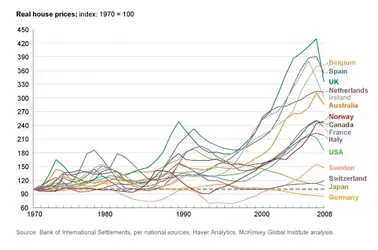
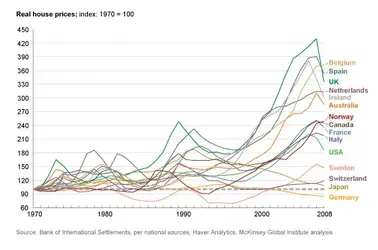
Let's go deeper then, THIS WAS THE WORLD WIDE CREDIT BUBBLE POST 9/11 WHEN MONEY RUSHED INTO THE US FOR "SAFETY", SEE IT GOING UP IN 2000? Maybe later right? 2002? NOW LOOK BELOW THE GRAPH

1774913634242.webp

Nonbank mortgage underwriting exploded from 2001 to 2007, along with the private label securitization market, which eclipsed Fannie and Freddie during the boom.
Here are key things we know based on data. Together, they present a series of tough hurdles for the big lie proponents.


— The boom and bust was global. Proponents of the Big Lie ignore the worldwide nature of the housing boom and bust.


A McKinsey Global Institute report noted “from 2000 through 2007, a remarkable run-up in global home prices occurred.”


I
t is highly unlikely that a simultaneous boom and bust everywhere else in the world was caused by one set of factors (ultra-low rates, securitized AAA-rated subprime, derivatives) but had a different set of causes in the United States. Indeed, this might be the biggest obstacle to pushing the false narrative. How did U.S. regulations against redlining in inner cities also cause a boom in Spain, Ireland and Australia? How can we explain the boom occurring in countries that do not have a tax deduction for mortgage interest or government-sponsored enterprises? And why, after nearly a century of mortgage interest deduction in the United States, did it suddenly cause a crisis?


Dissecting the Big Lie About the Economic Crisis​


The market share of financial institutions that were subject to the CRA has steadily declined since the legislation was passed in 1977. As noted by Abromowitz & Min, CRA-regulated institutions, primarily banks and thrifts, accounted for only 28 percent of all mortgages originated in 2006.


— Nonbank mortgage underwriting exploded from 2001 to 2007, along with the private label securitization market, which eclipsed Fannie and Freddie during the boom. Check the mortgage origination data: The vast majority of subprime mortgages -- the loans at the heart of the global crisis -- were underwritten by unregulated private firms. These were lenders who sold the bulk of their mortgages to Wall Street, not to Fannie or Freddie. Indeed, these firms had no deposits, so they were not under the jurisdiction of the Federal Deposit Insurance Corp or the Office of Thrift Supervision. The relative market share of Fannie Mae and Freddie Mac dropped from a high of 57 percent of all new mortgage originations in 2003, down to 37 percent as the bubble was developing in 2005-06.


Private lenders not subject to congressional regulations collapsed lending standards. Taking up that extra share were nonbanks selling mortgages elsewhere, not to the GSEs. Conforming mortgages had rules that were less profitable than the newfangled loans. Private securitizers -- competitors of Fannie and Freddie -- grew from 10 percent of the market in 2002 to nearly 40 percent in 2006. As a percentage of all mortgage-backed securities, private securitization grew from 23 percent in 2003 to 56 percent in 2006.


These firms had business models that could be called “Lend-in-order-to-sell-to-Wall-Street-securitizers.” They offered all manner of nontraditional mortgages -- the 2/28 adjustable rate mortgages, piggy-back loans, negative amortization loans. These defaulted in huge numbers, far more than the regulated mortgage writers did.


Consider a study by McClatchy: It found that more than 84 percent of the subprime mortgages in 2006 were issued by private lending. These private firms made nearly 83 percent of the subprime loans to low- and moderate-income borrowers that year. And McClatchy found that out of the top 25 subprime lenders in 2006, only one was subject to the usual mortgage laws and regulations.


A 2008 analysis found that the nonbank underwriters made more than 12 million subprime mortgages with a value of nearly $2 trillion. The lenders who made these were exempt from federal regulations.


A study by the Federal Reserve shows that more than 84 percent of the subprime mortgages in 2006 were issued by private lending institutions. The study found that the government-sponsored enterprises were concerned with the loss of market share to these private lenders -- Fannie and Freddie were chasing profits, not trying to meet low-income lending goals.


IT WAS A REGULATOR FAILURE, DUBYA HAD CONGRESS AND THE AGENCIES
 

Attachments

  • 1774913753068.webp
    1774913753068.webp
    19.3 KB · Views: 0
Back
Top Bottom