Strange that you should be leaning so hard on that one graph and study.. And calling us "fooking idiots" when you couldn't figure out the significance of this little calculation that I did a couple weeks back.. I posted it TWICE --- right after you referenced the BTK study for the umpteenth time.. Got no response or even RECOGNITION of what that calculation implied..
Mamooth said I didn't explain it.. That was ON PURPOSE. I expect that folks REPOSTING that BTK study would automatically know the challenge I was making.. I'd like to believe that I'm not dealing with "fooking idiots"...
I`m only concerned about this part:
1.6W/m2 * (361*10e12)m2 * (3.15e7)sec/yr * 15yr * 0.90 = 24.6e22 joules
Joules is the same as watt seconds anyway, but neither will tell you by how much it will raise the
temperature unless it has been specified what the
mass (or volume) of water was that absorbed the 1.6 W/m^2.
1 watt second = 0.239 calories...= the heat energy required to raise 1 gram of water by 1 degree. So you need to know the mass, not just the area and the # of watts & the time.
With 1.6 watts per square meter we get about as much heating as a 25 watt pencil soldering iron dipped into a 5 X 5 meter swimming pool.
There is no way to calculate with any degree of accuracy how long it would take to raise the pool temperature by 1 degree C not even if I would give you the depth which would then also give you the mass of water.
Unless the heat source is near the bottom, not at the top and the pool is covered and 100% insulated you would be way off.
But in reality on the ocean the 1.6 watts/m^2 is above the surface, 15 µm IR does not deep penetrate liquid water and the slightest breeze of air will cause more heat loss per time & m^2 than the 1.6 watts can supply.
To say that the "missing heat" can be found in the deep part is utter nonsense. You could hold a blow torch all day long to the top of a bucket full of water and never manage to bring it to a boil.
If you don`t have a blowtorch just go & disconnect the lower element of your hot water tank and try heat it just with the top element.
The only part that warms up is from where that element is & the top.
Open the drain valve at the bottom and all you get is cold water.
There are only a few places along the coasts where you get some "up-welling" and bottom/top heat transfer in our oceans where the extra 1.6 W/m^2 could get transferred down.
That is certainly not the case for the entire ocean area and for 24/7 year-round. And in addition to that the bulk of the surface water heat is dissipated into the air above it by evaporation & convection...not down into the depth.
So in the final analysis it`s rather silly to "calculate" by how much 1.6 watts/m^2 surface heat can warm up an entire ocean over a decade, while a few gusts of wind can drain more surface water heat in a matter of minutes than what had been absorbed with a mere 1.6 watts/m^2 all day long.
With hurricanes it`s called "rapid intensification" for a good reason...it`s a rapid heat exchange on a much larger magnitude than just a few watts/m^2 !
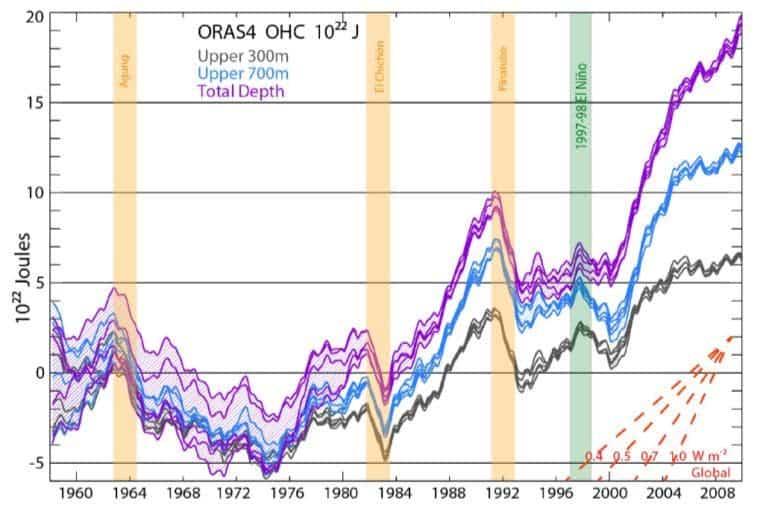


 decreased.


