Wola massacre - Wikipedia
The
Wola massacre (
Polish:
Rzeź Woli, "Wola slaughter") was the systematic killing of between 40,000 and 50,000 people in the
Wola district of Poland's capital city
Warsaw by
German troops and collaborationist forces during the early phase of the
Warsaw Uprising.
Heuaktion
From Wikipedia, the free encyclopedia
Jump to navigationJump to search
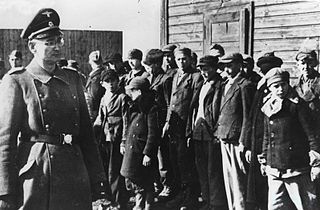
Roll-call for boys at the main
children's concentration camp in
Łódź, to which
KZ Dzierżązna for Polish girls as young as eight, belonged to as a sub-camp
The
Heuaktion (
German:
literally: harvesting of hay, or hay operation)
[1] was a
Nazi German World War II operation, in which 40,000 to 50,000
Polish children aged 10 to 14 were
kidnapped by the German occupational forces and transported to Germany proper as slave labourers.
[2] The term "heuaktion" was an acronym for homeless, parent-less and unhoused (heimatlos, elternlos, unterkunftslos, i.e. "HEU", or the
hay action).
[
Heuaktion - Wikipedia
Operation Tannenberg
Unternehmen Tannenberg

Operation Tannenberg, 20 October 1939,
the mass murder of Polish townsmen in
western Poland
Location German-occupied Poland
Date September 1939 – January 1940
Target Poles
Attack type
Genocidal massacre, mass shooting
Weapons Automatic weapons
Deaths 20,000 deaths in 760 mass executions by
SS Einsatzgruppen
Perpetrators  Nazi Germany
Operation Tannenberg
Nazi Germany
Operation Tannenberg (
German:
Unternehmen Tannenberg) was a codename for one of the extermination actions by
Nazi Germany that was directed at the
Poles during the opening stages of
World War II in Europe, part of the
Generalplan Ost for the German colonization of the East. The shootings were conducted with the use of a proscription list (
Sonderfahndungsbuch Polen), compiled by the
Gestapo in the span of two years before
the 1939 invasion.
[1]
The top secret lists identified more than 61,000 members of the Polish elite:
activists,
intelligentsia, scholars, clergy, actors, former officers, and others, who were to be interned or shot. Members of the German minority living in Poland assisted in preparing the lists.
[1] It is estimated that up to 20,000 Germans living in Poland belonged to organizations involved in various forms of subversion.
[2]
Operation Tannenberg - Wikipedia
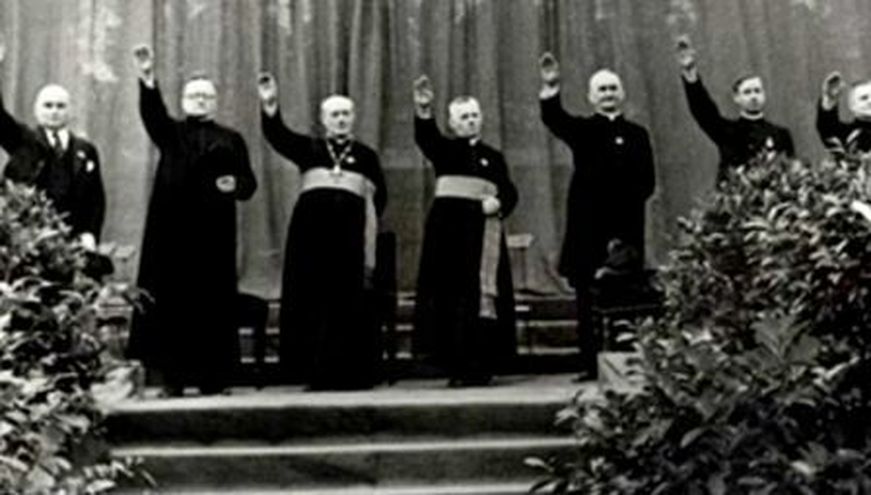
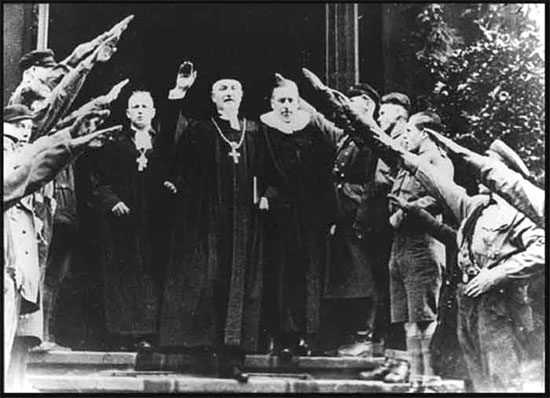
Nazi persecution of the Catholic Church in Germany - Wikipedia
The
Roman Catholic Church suffered
persecution in
Nazi Germany. The
Nazis claimed jurisdiction over all collective and social activity and the party leadership hoped to dechristianize Germany in the long term. Clergy were watched closely, and frequently denounced, arrested and sent to concentration camps. Welfare institutions were interfered with or transferred to state control. Catholic schools, press, trade unions, political parties and youth leagues were eradicated. Anti-Catholic propaganda and "morality" trials were staged. Monasteries and convents were targeted for expropriation. Prominent Catholic lay leaders were murdered, and thousands of Catholic activists were arrested.
In all, an estimated one third of German priests faced some form of reprisal in Nazi Germany and 400 German priests were sent to the dedicated
Priest Barracks of Dachau Concentration Camp. Persecution of the Church in Germany was at its most severe in the
annexed Polish regions. Here the Nazis set about systematically dismantling the Church and most priests were murdered, deported or forced to flee. Of 2,720 clergy imprisoned at Dachau from Germany and occupied territories, the some 2,579 (or 94.88%) were Catholic.
Anti-Catholicism - Wikipedia
The Catholic Church faced repression in
Nazi Germany (1933-1945). Hitler despised the Church although he had been brought up in a Catholic home. The long term aim of the Nazis was to de-Christianise Germany and restore
Germanic paganism.
[62][63][64][65][66][67][68][69][70] Richard J. Evans writes that Hitler believed that in the long run National Socialism and religion would not be able to co-exist, and he stressed repeatedly that Nazism was a secular ideology, founded on modern science: "Science, he declared, would easily destroy the last remaining vestiges of superstition". Germany could not tolerate the intervention of foreign influences such as the Pope and "Priests, he said, were 'black bugs', 'abortions in black cassocks'".
[71] Nazi ideology desired the subordination of the church to the state and could not accept an autonomous establishment, whose legitimacy did not spring from the government.
[72] From the beginning, the Catholic Church faced general persecution, regimentation and oppression.
[73] Aggressive anti-Church radicals like
Joseph Goebbels and
Martin Bormann saw the conflict with the Churches as a priority concern, and anti-church and
anti-clerical sentiments were strong among grassroots party activists.
[74] To many Nazis, Catholics were suspected of insufficient patriotism, or even of disloyalty to the Fatherland, and of serving the interests of "sinister alien forces".
[75]
Adolf Hitler had some regard for the organisational power of Catholicism, but towards its teachings he showed only the sharpest hostility, calling them "the systematic cultivation of the human failure":
[76] To Hitler, Christianity was a religion fit only for slaves and he detested its ethics.
Alan Bullock wrote: "Its teaching, he declared, was a rebellion against the natural law of selection by struggle and the survival of the fittest". From political considerations, Hitler was prepared to restrain his anti-clericalism, seeing danger in strengthening the Church by persecution, but intended a show-down after the war.
[77] Joseph Goebbels, the Minister for Propaganda, led the Nazi persecution of the Catholic clergy and wrote that there was "an insoluble opposition between the Christian and a heroic-German world view".
[74] Hitler's chosen deputy, Martin Bormann, was a rigid guardian of Nazi orthodoxy and saw Christianity and Nazism as "incompatible", as did the official Nazi philosopher,
Alfred Rosenberg, who wrote in
Myth of the Twentieth Century (1930) that Catholics were among the chief enemies of the Germans.
[78][79][80] In 1934, the
Sanctum Officium put Rosenberg's book on the
Index Librorum Prohibitorum (forbidden books list of the Church) for scorning and rejecting "all dogmas of the Catholic Church, indeed the very fundamentals of the Christian religion".
[81]
The Nazis claimed jurisdiction over all collective and social activity, interfering with Catholic schooling, youth groups, workers' clubs and cultural societies.
[82] Hitler moved quickly to eliminate
Political Catholicism, rounding up members of the Catholic aligned
Bavarian People's Party and
Catholic Centre Party, which ceased to exist in early July 1933. Vice Chancellor Papen meanwhile, amid continuing molestation of Catholic clergy and organisations, negotiated a
Reich concordat with the Holy See, which prohibited clergy from participating in politics.
[83][84] Hitler then proceeded to close all Catholic institutions whose functions weren't strictly religious:
[85]
It quickly became clear that [Hitler] intended to imprison the Catholics, as it were, in their own churches. They could celebrate mass and retain their rituals as much as they liked, but they could have nothing at all to do with German society otherwise. Catholic schools and newspapers were closed, and a propaganda campaign against the Catholics was launched.
— Extract from
An Honourable Defeat by
Anton Gill
Almost immediately after agreeing the Concordat, the Nazis promulgated their sterilization law, an offensive policy in the eyes of the Catholic Church and moved to dissolve the Catholic Youth League. Clergy, nuns and lay leaders began to be targeted, leading to thousands of arrests over the ensuing years, often on trumped up charges of currency smuggling or "immorality".
[86] In Hitler's
Night of the Long Knives purge,
Erich Klausener, the head of
Catholic Action, was assassinated.
[87] Adalbert Probst, national director of the Catholic Youth Sports Association,
Fritz Gerlich, editor of Munich's Catholic weekly and
Edgar Jung, one of the authors of the
Marburg speech, were among the other Catholic opposition figures killed in the purge.
[88]
By 1937, the church hierarchy in Germany, which had initially attempted to co-operate with the new government, had become highly disillusioned. In March,
Pope Pius XI issued the
Mit brennender Sorge encyclical - accusing the Nazis of violations of the Concordat, and of sowing the "tares of suspicion, discord, hatred, calumny, of secret and open fundamental hostility to Christ and His Church". The Pope noted on the horizon the "threatening storm clouds" of religious wars of extermination over Germany.
[86] The Nazis responded with, an intensification of the
Church Struggle.
[74] There were mass arrests of clergy and church presses were expropriated.
[89] Goebbels renewed the regime's crackdown and propaganda against Catholics. By 1939 all Catholic denominational schools had been disbanded or converted to public facilities.
[90] By 1941, all Church press had been banned.