And happy not to be born as
kurds I assume?
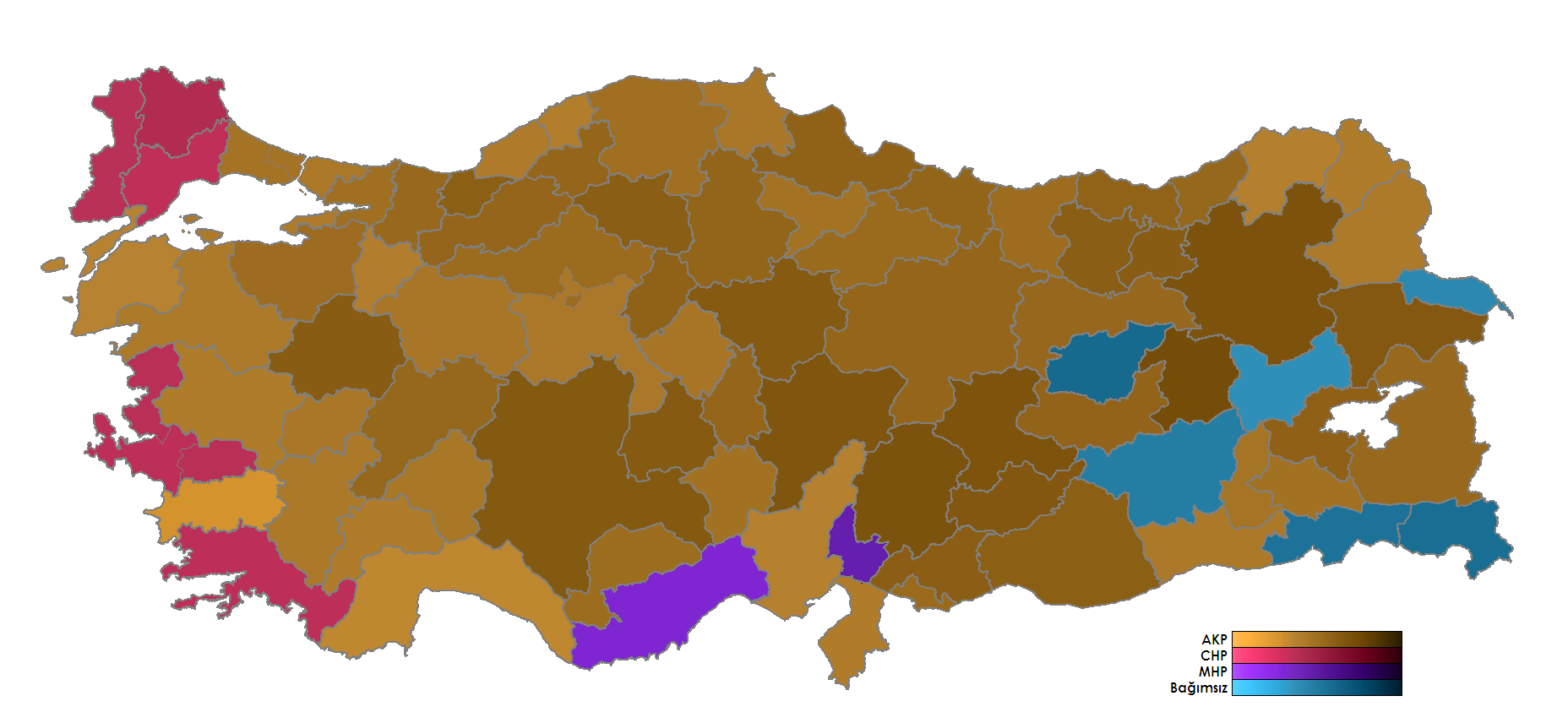
2007 election results:
Out of 550 parliament seats,
Kurdist party DTP achieved 21 seats
Turkish general election, 2007 - Wikipedia, the free encyclopedia
Parties having opposite agenda to Turkish unity, do not have support from Turkish Kurds in case of Kurdist party.
Especially in the Kurd issue is floating a lot of propaganda around.
Benchmark is election performance.
Turkish Kurds are for Turkish Unity and - like everyone else in Turkey - look into bright future under roof of Turkish Republic.
Munin said:
Your links do not prove me wrong.
I myself said, that in domestic politics the head-scarf issue is a heated debate.
Secularists are Muslims, too.
A poll conducted in October 2000 showed that 71 percent of Turks have an interest in Palestinian affairs and 60 percent demand a more active Turkish role on behalf of the Palestinian people.
Another poll conducted in November 2000 showed that 41 percent favor delivering Jerusalem to Palestinian rule, 29 percent proposed autonomous administration, and only two percent favor Israeli rule over the city.
Another poll, conducted in November 2003 surveying 2,183 people in different parts of
Turkey, assessed the Turkish peoples attitudes toward Palestinians.
66 percent support the Palestinians in their struggle.
Public support for Prime Minister Erdoğans blaming of Israel for pursuing state terror was 82 percent in another poll conducted in July 2004.
Different segments of Turkish society, ranging from political parties to student unions, have joined their hands and hearts for extending support to the Palestinians.
http://www.setav.org/document/Policy_Brief_No_27_Bulent_Aras_Turkey_and_the_Palestinian_Question.pdf
If you ask normal Turk, what is injustice in world, they will answer you Palestine.
As Middle East is like an Aquarium with defined and restricted space, all the fishes around will have less breathing space with the Turkish whale deciding also to swim in that defined and restricted space.
The Turkish whale, producing more then half the economic output of whole Middle East and North-Africa combined, feels Anatolia is not enough anymore.
The International Crisis Group (ICG) published a report earlier this week (...).
The report notes, for example, that Turkey's economy
produces the equivalent of half the entire output of the Middle East and North Africa.
Original report
International Crisis Group - 203 Turkey and the Middle East: Ambitions and Cons
Via
Turkey's Complicated Middle East Role - The Washington Note
You do not seem to understand, that Turkish outreach to periphery has not primarily something to do with "Islam-Secular" rift in domestic politics.
Outreach happens, because Turkey can, Turkey expands economically and with outreach Turkey will secure its own security and that of the region. Every citizen supports this.
This is a transiition process, kickstarted by US military adventures whose outcome was diametral to Turkish interests.
Off course, there are also other reasons, but US invasion of Iraq kickstarted several processes in the region, not only limited to Turkey.
The region is in transition and there is no reason Turkey to come out as a looser of this transition. Simple as that.
Now i went a little bit thematically riot, but I hope you now understand to uncouple opposing views within Turkey from united stance in foreign policy.
Stratfor
Decade Forecast: 2010-2020
Iraq, Afghanistan and Iran will remain issues by 2020, but not defining issues in the region. Two other countries will be more important. Turkey is emerging as a self-confident regional leader, with a strong military and economy. We expect that trend to continue, and see Turkey emerging as the dominant regional power. The growth of Turkish power and influence in the next decade is one reason we feel confident in the decline of the U.S.-jihadist war and the transformation of the Iran issue. The dynamic in the region between the Mediterranean and Iran and even in the Caucasus and Central Asia will be redefined by Turkeys re-emergence. Of course, Turkey will feel tremendous internal tensions during this process, as is the case for any emerging power. For Turkey, the relationship between the Ataturkian tradition and the Islamic tradition is the deep fault line. It could falsify this forecast by plunging the country into chaos. While that is possible, we feel that the crisis will be managed over the next decade, albeit with much pain and stress.
By 2020, Egypt will be changing from the type of country it has been since the 1970s for the past generation it has lacked the capacity to influence developments beyond its borders. Like Turkey, Egypt is caught between secularism and Islam, and that tension could continue paralyzing it. However, as Turkey rises, Ankara will need a large source of cheap labor and markets for exports. The result will be a coattails effect for Egypt. With this synergetic fortification we expect not only an end to Egyptian quiescence, but increased friction between Egypt and all other regional players. In particular, Israel will be searching for the means to maintain its balance between the powerful Turkey and the re-emerging Egypt. This will shape all of its foreign and domestic policies.
Free Article for Non-Members | STRATFOR
We can, and we will do, as we did in past several times.