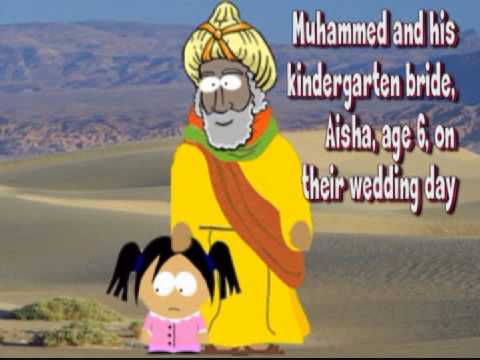
According to a couple of Sunni hadith Aisha was around 6 when engaged to Muhammad (she was living as a refugee in Abyssinia at the time and Muhammad was in the Arabian peninsula) and married him when she was 9. The early biographies of Muhammad all contradict themselves as to Aisha's age, so as a secular historian we don't know how old she was. And why her? She was the daughter of an important ally (abu Bakr) for Muhammad and given thep olitical and social structures of the time, it was important to secure him through marriage to thus make him a part of Muhammad's family. Her father would go on to lead the ummah after Muhammad died.
Muslims know quite well. That's why they keep marrying 8 and 9 year olds, they are simply following in the footsteps of the "most perfect human" <cough>
"Most religions, over history, influenced the marriageable age. For example, Christian
ecclesiastical law forbade marriage of a girl before the age of puberty. Hindu
vedic scriptures mandated the age of a girl's marriage to be adulthood which they defined as three years after the onset of puberty. Jewish scholars and rabbis strongly discouraged marriages before the onset of puberty.
In contrast, some Islamic marriage practices have permitted marriage of girls below the age of 10, because Shariat law is based in part on the life and practices of Muhammad, the Prophet, as described in part in Sahih Bukhari and Sahih Muslim. The Prophet married Aisha, his third wife, when she was about age six, and consummated the marriage when she was about age nine.
Narrated 'Aisha: that the Prophet married her when she was six years old and he consummated his marriage when she was nine years old, and then she remained with him for nine years (i.e., till his death).
—
Sahih al-Bukhari,
7:62:64"
***Sucks to have a pervert as prophet and founder of your religion, doesn't it?
right. Bukhari is only a Sunni hadith collection. It isn't the Quran.
And? No question that Muslims believe they are sanctioned by their prophets actions to marry prepubescent girls.
You realize that not every Muslim follows the Bukhari collection right? I know you don't, the question was just for the sake of pushing the point. I am familiar with the last time we spoke of Yemen and you couldn't tell the difference between hadiths and Quranic verse. At least you still don't think that hadiths come from the Quran.
As usual you are squirming. Doesn't matter what a non-Muslim infidel kafar like me thinks. Nor does it matter what your bogus thoughts are. Muslim men are allowed to marry little girls because their prophet did so. On this most of them agree, Sunni, Shia, or otherwise. Period end of story.
Hadith (
/ˈhædɪθ/[1] or
/hɑːˈdiːθ/;
[2] Arabic: حديث) in
Islamic religious use is often translated as "prophetic traditions", meaning the corpus of the reports of the teachings, deeds and sayings of the Islamic prophet
Muhammad. The hadith literature was compiled from oral reports that were in circulation in society around the time of their compilation long after the death of Muhammad.
Bukhari's collection is considered the most reliable by many traditional religious scholars who are Sunnis. The Shi'as believe in an entirely separate body of
hadith.
The
hadith also had a profound and controversial influence on moulding the commentaries (
tafsir) on the Quran. The earliest commentary of the Quran by
Muhammad ibn Jarir al-Tabari is mostly sourced from the hadith.
The hadith was used in forming the basis of 'Shariah' Law. Much of early Islamic history available today is also based on the hadith and is challenged for lack of basis in primary source material and contradictions based on secondary material available.
Each hadith is based on two parts, a chain of narrators reporting the hadith (
isnad), and the text itself (
matn). Hadiths are still regarded by traditional
Islamic schools of jurisprudence as important tools for understanding the
Quran and in matters of
jurisprudence. Hadith were
evaluated and gathered into large collections during the 8th and 9th centuries. These works are referred to in matters of
Islamic law and
history to this day. The largest denominations of Islam,
Sunni,
Shiʻa, and
Ibadi, rely upon different sets of hadith collections.
Ahmadis generally rely upon Sunni Hadith collections. Clerics and jurists of all denominations classify individual hadith as
sahih("authentic"),
hasan ("good") and
da'if ("weak"). However, different traditions within each denomination, and different scholars within each tradition, may differ as to which hadith should be included in which category.