I’m asking you, because you made the allegations that cops have a bias against blacks. Have you personally had experience with police, and if so were you treated differently by black cops than whites? Were they more likely to show you more respect or give you a break? Or are all cops equally [emoji90] I’m your opinion.
Sent from my iPhone using Tapatalk
The USA police force has been infiltrated by white supremacists.
Kentucky Cop (John Nissen) was supposed to drive black female rape victim home, but took her to a motel and
raped her again
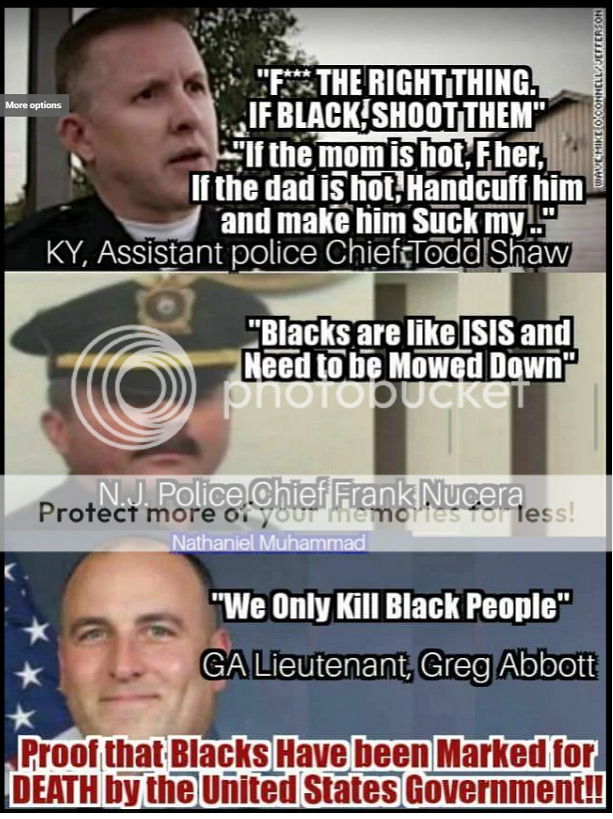
You have the likes of New Jersey chiefs of police wanting to
kill all black people ? and the white Philly Police Union president call BLM activists "
Wild Animals" and the Cali Police are
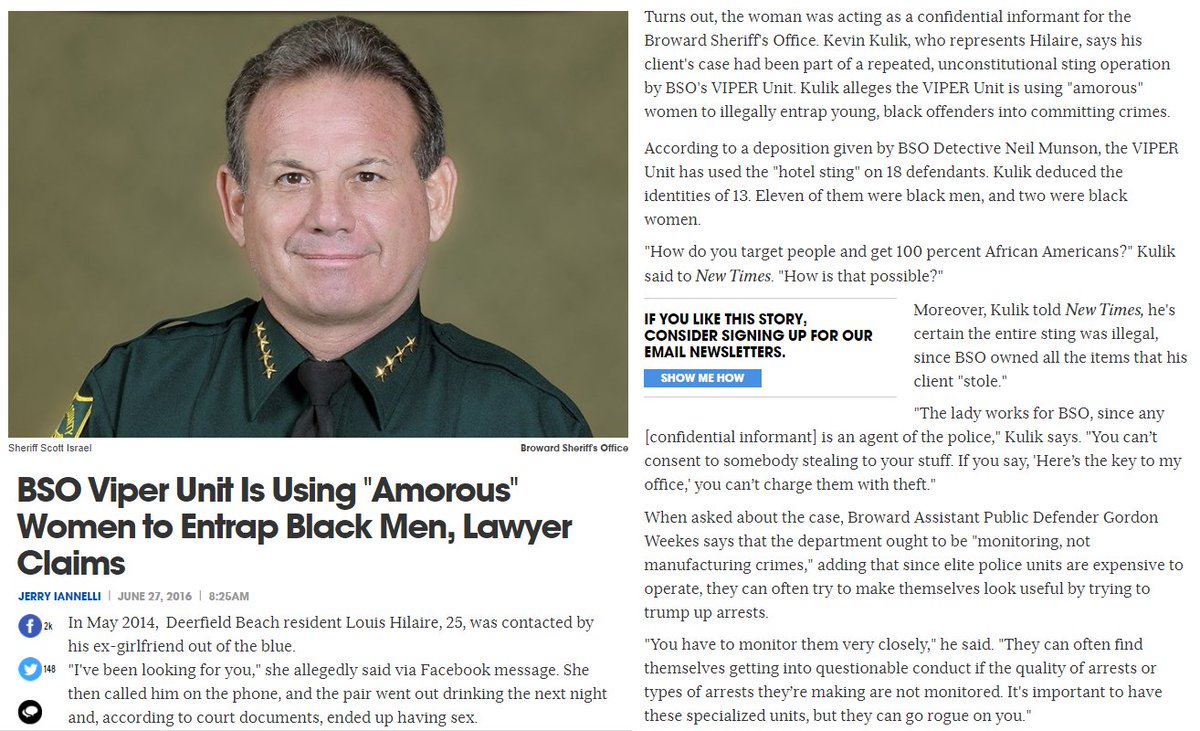
sympathizing with white supremacists. And you Sheriff Scott Israel in Florida who got caught entrapping 18 black people in 2016 (0 white people,) but is more recently accused of directing deputies to put on ski masks & bust up a venue repeatedly on hip hop nights.
This is sure to get the young 20 something white snowflake college kids feeling guilty about nothing. I don’t know any white supremest cops personally, and I know a lot. The black cops I know also have to enforce the law. If something comes up, they are all called and respond. If they are not quick enough, that becomes a problem too.
Sent from my iPhone using Tapatalk
Bureau policies have been crafted to take into account the active presence of domestic extremists in U.S. police departments.
Alice Speri
W
hite supremacists and other domestic extremists maintain an active presence in U.S. police departments and other law enforcement agencies. A striking reference to that conclusion, notable for its confidence and the policy prescriptions that accompany it, appears in a classified FBI Counterterrorism Policy Guide from April 2015, obtained by The Intercept. The guide, which details the process by which the FBI enters individuals on a terrorism watchlist, the Known or Suspected Terrorist File, notes that “domestic terrorism investigations focused on militia extremists, white supremacist extremists, and sovereign citizen extremists often have identified active links to law enforcement officers,” and explains in some detail how bureau policies have been crafted to take this infiltration into account.
Although these right-wing extremists have posed a growing threat for years, federal investigators have been reluctant to publicly address that threat or to point out the movement’s longstanding strategy of infiltrating the law enforcement community.
No centralized recruitment process or set of national standards exists for the 18,000 law enforcement agencies in the United States, many of which have deep historical connections to racist ideologies. As a result, state and local police as well as sheriff’s departments present ample opportunities for white supremacists and other right-wing extremists looking to expand their power base.
In a
heavily redacted version of an October 2006 FBI internal intelligence assessment, the agency raised the alarm over white supremacist groups’ “historical” interest in “infiltrating law enforcement communities or recruiting law enforcement personnel.” The effort, the memo noted, “can lead to investigative breaches and can jeopardize the safety of law enforcement sources or personnel.” The memo also states that law enforcement had recently become aware of the term “ghost skins,” used among white supremacists to describe “those who avoid overt displays of their beliefs to blend into society and covertly advance white supremacist causes.” In at least one case, the FBI learned of a skinhead group encouraging ghost skins to seek employment with law enforcement agencies in order to warn crews of any investigations.
That report appeared after a series of scandals involving local police and sheriff’s departments.
In Los Angeles, for example, a U.S. District Court judge found in 1991 that members of a local sheriff’s department had formed a neo-Nazi gang and habitually terrorized black and Latino residents. In Chicago, Jon Burge, a police detective and
rumored KKK member, was fired, and eventually prosecuted in 2008, over charges relating to the torture of at least 120 black men during his decadeslong career. Burge notoriously referred to an electric shock device he used during interrogations as the “****** box.” In Cleveland, officials found that a number of police officers had scrawled “
racist or Nazi graffiti” throughout their department’s locker rooms. In Texas, two police officers were fired when it was discovered they were Klansmen. One of them said he had tried to boost the organization’s membership by giving an application to a fellow officer he thought shared his “
white, Christian, heterosexual values.”
Although the FBI has not publicly addressed the issue of white supremacist infiltration of law enforcement since that 2006 report, in a 2015
speech, FBI Director James Comey made an unprecedented acknowledgment of the role historically played by law enforcement in communities of color: “All of us in law enforcement must be honest enough to acknowledge that much of our history is not pretty.” Comey and the agency have been less forthcoming about that history’s continuation into the present.
The FBI Has Quietly Investigated White Supremacist Infiltration of Law Enforcement