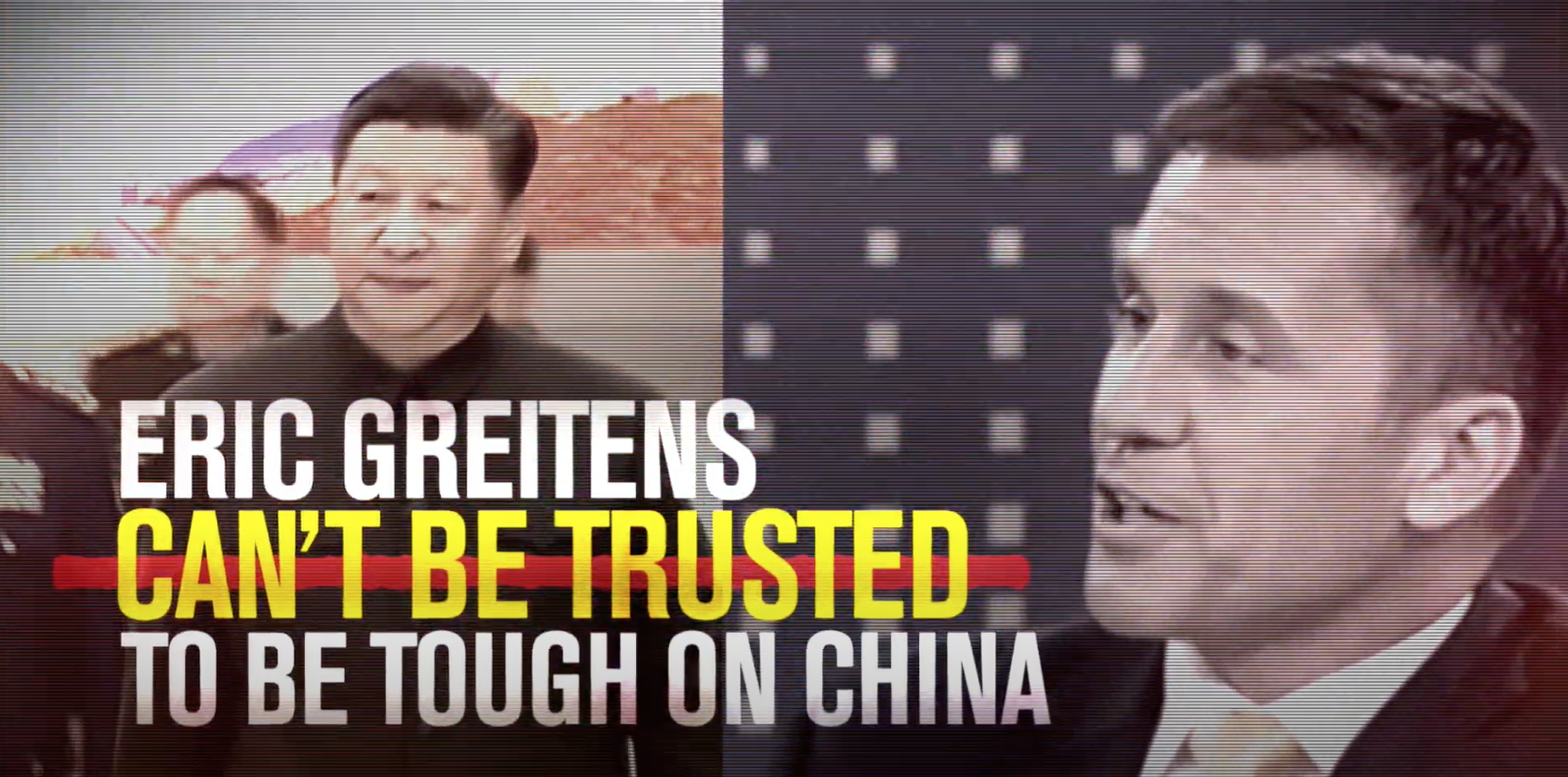
“Good for China, bad for Missouri,” is a line Olympics-watching Missourians might hear frequently this week.
themissouritimes.com
excerpt from politico:
The Greitens PAC video calls out Schmitt for his support as state senator in 2011 of the St. Louis Lambert International Airport Aerotropolis “China Hub” designed to make the city the axis of air cargo between China and the Midwest. The ad’s kicker: “Eric Schmitt: Good for China. Bad for Missouri.”
The Schmitt PAC video slams Greitens for an appearance on Chinese state television during an official visit to Beijing as governor in 2017. The ad’s kicker: “Eric Greitens: Good for China. Bad for Missouri.”
Schmitt even tried to sue the Chinese government in April 2020 for “misrepresentations, concealment, and retaliation” regarding the emergence and severity of Covid-19. Chinese Foreign Ministry spokesperson Geng Shuang responded by saying the lawsuit “only invites ridicule.” A month later, Chinese state-affiliated news platform Global Times reported that Beijing was mulling retaliatory sanctions against Schmitt. Long and McCloskey also have called for probes into Covid’s possible Chinese origins.
Long goes one step further by asserting that the Chinese government has knowingly allowed the export to the U.S. of the deadly synthetic opioid fentanyl. Synthetic opioids killed more than 64,000 Americans from April 2020 to April 2021, according to the CDC. The bulk of the illegal synthetic opioids that reach the U.S. are sourced in China by Mexico’s Sinaloa and Jalisco New Generation cartels.
The Missouri GOP primary, to be held in August, has caught the attention of the Chinese government, which said it believes the candidates are not in sync with American public opinion.
“We are not interested in the electoral politics in the United States, but we firmly oppose some politicians hyping up ‘China threat’ in their campaigns to gain attention and votes,” Liu Pengyu, spokesperson for the Chinese Embassy in Washington, D.C., told POLITICO in an emailed statement. “These remarks cannot fully represent the American people’s attitude toward China [and] we hope these politicians can have a correct stance and a rational view of China’s development and China-U.S. relations.”
Candidates’ arguments about China’s malign impact on Missouri’s economy aren’t supported by the data. Missouri’s goods’ exports to China — mostly oilseeds and meat products — totaled $1.7 billion in 2020, making China the state’s third-largest export destination behind Mexico and Canada, according to a recent U.S.-China Business Council report. China is also Missouri’s third-largest destination of service exports, valued at $796 million in 2019.
Missouri has also been relatively insulated from the impact of job losses linked to industrial outsourcing to China. An analysis by the Economic Policy Institute in Washington, D.C., concludes that the state has recorded a loss of 2 percent of its total employment base due to China outsourcing from 2001-2018. It places Missouri 30th among the 50 states and Washington, D.C. in the severity of that impact.
Advocates for Missouri’s Asian American community warn that such rhetoric is dangerous. Caroline Fan, president of the Missouri Asian American Youth Foundation, noted that Missouri’s Asian community constitutes a swing vote that GOP Senate candidates risk alienating. Eligible voters among Missouri’s Asian American, Hawaiian American and Pacific Islander population rose 44 percent from 2012 to 2018 and now make up 2.7 percent of the state’s voting-age population.
“When our elected officials just continue to engage in xenophobia, and in stoking fears of the Yellow Peril,” Fan said, “it is very harmful.”


 www.politico.com