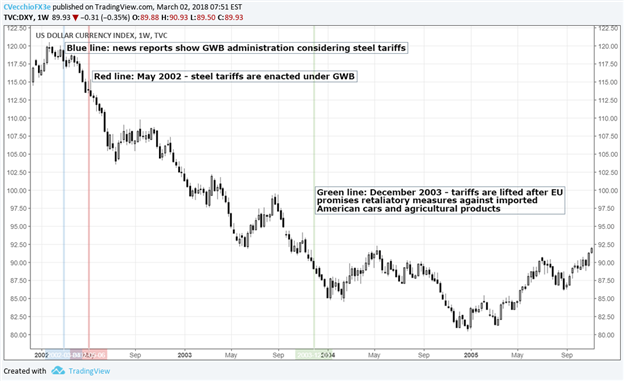
some (but not all to their credit ) Trump fans in here are all excited over the tariff moves by trump .
Many of those same posters flip out over any minwage increase because it adds to the costs of goods/services.
Can you justify being for tariffs and against min wage ?
It's a false choice and a false premise. The main problem with the minimum wage is that it imposes the double-whammy of job losses and increased labor costs. Even Warren Buffet has argued that a better way to help the working poor is through the Earned Income Tax Credit, and I agree with him. Using the EITC spreads the cost of higher income for the poor much more broadly so that its impact on labor costs is greatly reduced.
Protective tariffs give you a net job growth for a minimal cost or no cost, as we've seen over and over again in economic history.
One of the good things Obama did was to impose stiff tariffs on Chinese tires, which had the effect of revitalizing the U.S. tire industry.
The main problem with the minimum wage is that it imposes the double-whammy of job losses and increased labor costs.
??? Tariffs have exactly those impacts, most especially in an economy that's at or near full capacity. Full capacity as goes labor is precisely where the U.S., which is right at structural unemployment level, currently finds itself. We know this from inferences made by economic theory (science use of "theory") and from recent empirical evidence:
The Tariff of Abominations (1828),
Smoot-Hawley and the Bush II Tariffs of 2002 (detailed in the paper linked just below).
- The Unintended Consequences of U.S. Steel Import Tariffs: A Quantification of the Impact During 2002
- 200,000 Americans lost their jobs to higher steel prices during 2002. These lost jobs represent approximately $4 billion in lost wages from February to November 2002.
- One out of four (50,000) of these job losses occurred in the metal manufacturing, machinery and equipment and transportation equipment and parts sectors.
- Job losses escalated steadily over 2002, peaking in November (at 202,000 jobs), and slightly declining to 197,000 jobs in December.
- More American workers lost their jobs in 2002 to higher steel prices than the total number employed by the U.S. steel industry itself (187,500 Americans were employed by U.S. steel producers in December 2002).
- Every U.S. state experienced employment losses from higher steel costs, with the highest losses occurring in:
- California (19,392 jobs lost),
- Texas (15,826 jobs lost),
- Ohio (10,553 jobs lost),
- Michigan (9,829 jobs lost),
- Illinois (9,621 jobs lost),
- Pennsylvania (8,400 jobs lost),
- New York (8,901 jobs lost) and
- Florida (8,370 jobs lost).
- Sixteen states lost at least 4,500 steel consuming jobs each over the course of 2002 from higher steel prices.
The impact of tariffs is immensely well understood, and it doesn't take much but actually bothering to comprehend them at a very basic level to understand that the economic contraction that results from tariffs outstrip the narrow gains tariffs provide. What laymen think about them may be a matter of politics, but what economists have learned from studying them is not.

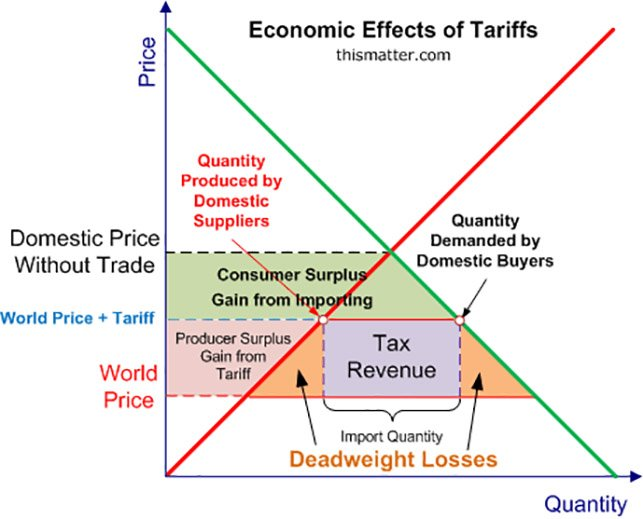
And the deleterious impacts of tariffs can been seen throughout an economy; they aren't just limited to the industry of the tariff itself, most especially when the tariff is on raw materials rather than on specific finished goods.
Additional references on the impact of tariffs (a mix of ECON101 and distillate content):