The fatal flaw in Obama's plan to let unauthorized immigrants into the military
[QUOTE]
On Thursday, the
Obama administration announced that it was going to allow unauthorized immigrants who have already been protected from deportation (under the
Deferred Action for Childhood Arrivals program, or DACA) to serve in the military.
a catch-22 might make it impossible for any immigrant to enlist under the new program
The announcement was something that some young unauthorized immigrants, or DREAMers, have been waiting to hear for years. They'd been frustrated that, since 2012, many of them had been able to work legally in the US under DACA, but hadn't been able to serve in the armed forces. And they'd gotten their hopes up when
news had leaked in May that the administration was going to allow them to serve — only to have the administration
put that plan on hold less than a day later.
But when it comes to the details, it turns out the administration's move will, in a best-case scenario, only affect a very limited number of DREAMers — an estimated "few dozen," in the words of one leading advocate. And that's, again, the best-case scenario. In the worst-case scenario, a catch-22 could make it impossible for any DACA recipient to enlist under the new program at all.
The best-case scenario: a few dozen immigrants can enlist
What the Obama administration is doing is expanding an existing program for certain types of immigrants: the Military Accessions Vital to the National Interest program, or MAVNI.
The program is only open to immigrants with very particular skills
Currently, MAVNI is only open to legal immigrants. The Obama administration is now opening it up to unauthorized immigrants — as long as they have protection under the deferred-action program — as well. But MAVNI is only open to immigrants with very particular skills: they have to be experts in a particular foreign language (Spanish doesn't count), or have medical expertise.
There are plenty of "DACAmented" immigrants who have expertise in an uncommon language, or who have health-care training. There are plenty who want to serve in the military. But there aren't a lot who fit into both categories.
Cesar Vargas of DRM Capitol Group, who's been the most visible "military DREAMer" since he "came out" as unauthorized in 2010, said that of all the would-be immigrant service members he's in touch with, he only knows of two people who could be eligible for MAVNI under the current restrictions.
Even those immigrants may get excluded because of their families
Having the skills for the program is, relatively speaking, the easy part. The hard part is that the military places restrictions on anyone — even a US citizen — who has any unauthorized immigrants in his or her family. Because DACA recipients generally came over as children with their parents, it's hard to think of a "DACAmented" immigrant who
wouldn't have any unauthorized-immigrant relatives.
"items that cause 'failure' (on the background check) include having undocumented relatives"
Cesar Vargas says that some branches of the armed forces take the current restrictions on enlisting more seriously than others: "It's not uniform. Some people have undocumented siblings, or undocumented parents, and they're fine," he says. "I've heard the Marines are pretty tough. US citizens are getting turned away" if their relatives don't have the right immigration status.
But for immigrants who are trying to apply under the MAVNI program, the immigration status of their relatives might not be something a recruiter can wave off — because it's part of a mandatory background check. As Margaret Stock, an immigration lawyer who came up with the idea of the MAVNI program to begin with,
explained to me in May:
As of 2012, the requirements for enlisting under MAVNI include what's called a "Single Scope Background Investigation," or SSBI — an investigation used throughout the government, usually to give people security clearances. And according to Stock, it's impossible for an unauthorized immigrant, with or without temporary "deferred action" protection, to pass an SSBI.
"SSBI items that cause 'failure' include having undocumented relatives, as well as any 'law violations'," Stock writes in an email to Vox. "I don't see how any DACA can 'pass' unless the contractor doing the investigation ignores his or her instructions."
In theory, the military (or at least the branches of it that are currently taking a more lenient attitude toward citizens with unauthorized relatives) could choose to "override" the requirement in the background check. But that means, for the "few dozen" DACA recipients that Vargas estimates might qualify for MAVNI, getting approved for the background check will be a massive risk.
In order to apply, they'll have to tell contractors which of their relatives aren't in the US legally. Even if that's not going to make them ineligible to enlist — which looks like a pretty big "if" — that could be a pretty big chilling effect on them wanting to apply at all. And even those immigrants who manage to jump through all those hoops are still fighting for a limited number of slots, as I wrote in May:
Additionally, Stock notes, only 1,500 immigrants a year are currently able to enlist under MAVNI — and there are "16,000 legal immigrants currently vying for the few hundred slots left" between now and September. So even if any unauthorized immigrants are able to pass the investigation, they'd have to compete with legal immigrants for the remaining slots.
Advocates' reaction: "Nice Try"
For all of these reasons, many of the politicians and advocates who had been asking Obama to allow DREAMers to serve in the military are taking the news as a defeat.
Rep. Luis Gutierrez (D-IL), the biggest supporter of executive action on immigration in Congress, released a statement Thursday saying that the administration has "decided not to let DACA recipients enlist in the military except in very limited circumstances." And United We Dream, one of the leading DREAMer advocacy groups, titled
their statement "Nice Try."
Gutierrez' statement floated one possibility: "Maybe after the season of midterm elections passes and the Obama Administration makes a top-to-bottom review of its immigration policies and its ability to make adjustments under current law this matter will be revisited."
That suggests that Gutierrez and advocates aren't giving the administration any credit for making this move before the midterms. And it suggests that the advocates and Latinos who are waiting for the administration to do something really big on immigration aren't going to stop holding their breath.
An unauthorized immigrant is anyone who is in the United States but doesn't have any form of legal immigration status and, therefore, no legal authorization to be here. In 2013, there were approximately\u00a0
Launch cards
What is an unauthorized immigrant?
An unauthorized immigrant is anyone who is in the United States but doesn't have any form of legal immigration status and, therefore, no legal authorization to be here. In 2013, there were approximately
11.3 million undocumented immigrants in the United States.
Approximately half of them entered the country illegally (in most cases, by crossing the border from Mexico into the southwestern United States). The other half entered legally — on temporary visas — but didn't leave the country when the visas expired: they're known as visa overstays.
Roughly
85 percent of undocumented immigrants have been in the US for at least five years, and the majority have lived here for at least 10 years. In 2013, the median unauthorized immigrant had lived
12.7 years in the US.
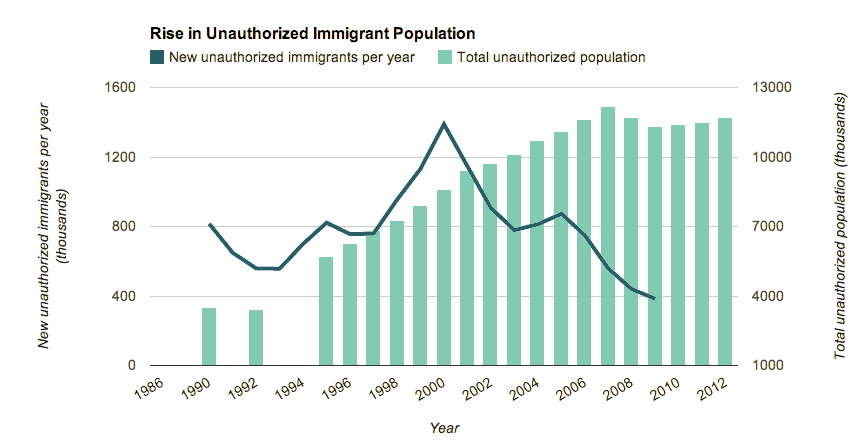
The unauthorized immigration wave peaked from 1996 to 2006:
Experts cite a number of reasons for the growth in the unauthorized population since 1996. Many believe the legal immigration system just couldn't satisfy US companies' demand for labor. Some cite poor immigration enforcement,
especially at the workplace — on the other hand, others say that increased border security has made people less likely to leave. And some point to a 1996 law that made it more difficult for unauthorized immigrants to receive legal status while living in the United States.
About a third of the unauthorized immigrants in the United States have children who are native-born US citizens. An estimated
4.5 million US-born children have at least one unauthorized parent.
[/
QUOTE]
The fatal flaw in Obama x27 s plan to let unauthorized immigrants into the military - Vox



 I guess you never served in a combat theatre....I never knew a GI who quoted regs chapter and verse who wasn't some REMF clerk who got rank for time in instead of merit. A "Frank Burns" type of noncom who's remembered for making making everybody around him miserable. Ask anybody who served in the RVN or Iraqistan and they'll tell you their MOS had little to do with being called on to shoulder a weapon on occasion. Jessica Lynch comes to mind. And next time I give you a link to what you ask for will be a cold day on the SUN, asshole.


