excalibur
Diamond Member
- Mar 19, 2015
- 29,391
- 59,573
- 2,290
Another correct ruling.
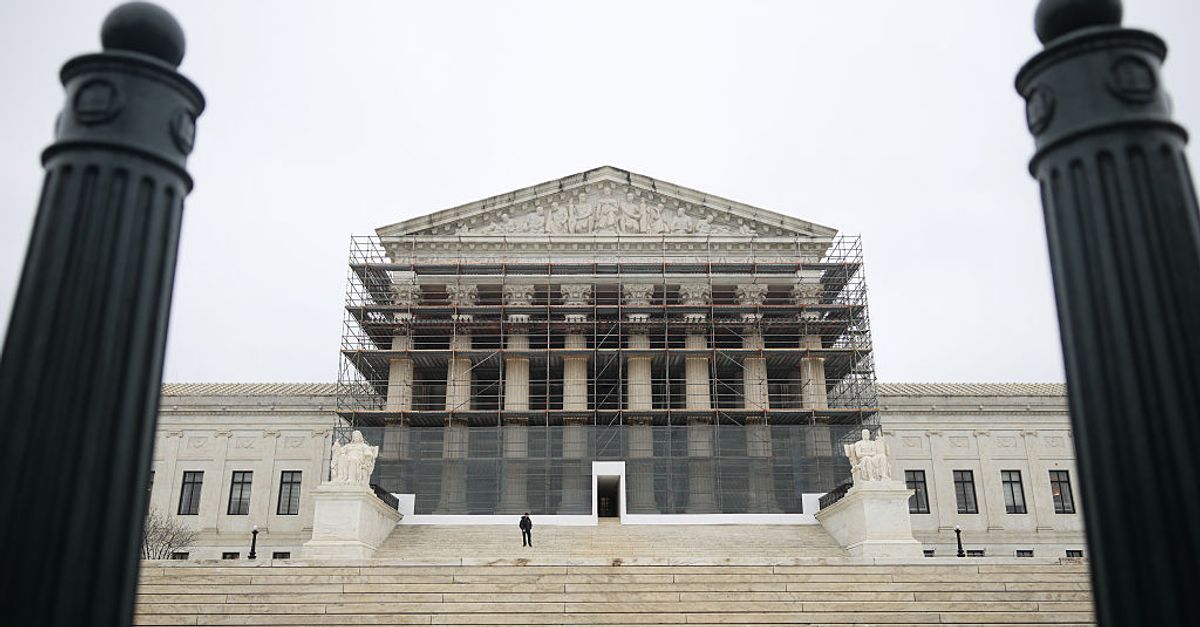
It was a good day at SCOTUS.
The usual dissenters.
It was a good day at SCOTUS.
The usual dissenters.
The Supreme Court on Thursday upheld the federal government’s policy of systematically turning back asylum seekers before they can reach the U.S.-Mexico border. By a vote of 6-3, the justices agreed with the Trump administration in Mullin v. Al Otro Lado that the policy, which was adopted a decade ago as a response to a surge in the number of Haitian immigrants seeking asylum outside San Diego, does not violate a federal law that permits noncitizens to apply for asylum when they “arrive[] in the United States.”
Writing for the majority, Justice Samuel Alito called the question before the court a “straightforward” one. “In ordinary speech,” he wrote, “no one would say that a person ‘arrives in’ a place—for example, a house, a city, or a country—before the person enters that place. The context in which the phrase ‘arrives in the United States’ is used in the immigration statutes at issue here supports an ordinary meaning.’”
Justice Sonia Sotomayor dissented, in an opinion joined by Justice Elena Kagan and Ketanji Brown Jackson. She wrote that “[t]he consequences of today’s decision are predictable. More people will die. More people will attempt to cross the border illegally, and some will make it while others will not.”
The policy at the center of the case is known as “metering.” Officials from the Customs and Border Patrol agency implemented the policy – which was formalized in a memorandum in 2018 – by standing along the U.S. border with Mexico and turning back noncitizens without valid travel documents, including asylum seekers, before they could enter the United States.
The challengers in the case are Al Otro Lado, Inc., an immigrant rights group, and 13 people who are seeking asylum, which is a form of legal protection for people who fear persecution or harm in their own countries. When noncitizens who arrive at a port of entry (an officially designated site to enter the country), such as an airport or a land crossing, indicate that they want to seek asylum, they are normally screened by border officials and then channeled into the asylum system, which may include either an interview with an asylum officer or proceedings in immigration court.
...
Writing for the majority, Justice Samuel Alito called the question before the court a “straightforward” one. “In ordinary speech,” he wrote, “no one would say that a person ‘arrives in’ a place—for example, a house, a city, or a country—before the person enters that place. The context in which the phrase ‘arrives in the United States’ is used in the immigration statutes at issue here supports an ordinary meaning.’”
Justice Sonia Sotomayor dissented, in an opinion joined by Justice Elena Kagan and Ketanji Brown Jackson. She wrote that “[t]he consequences of today’s decision are predictable. More people will die. More people will attempt to cross the border illegally, and some will make it while others will not.”
The policy at the center of the case is known as “metering.” Officials from the Customs and Border Patrol agency implemented the policy – which was formalized in a memorandum in 2018 – by standing along the U.S. border with Mexico and turning back noncitizens without valid travel documents, including asylum seekers, before they could enter the United States.
The challengers in the case are Al Otro Lado, Inc., an immigrant rights group, and 13 people who are seeking asylum, which is a form of legal protection for people who fear persecution or harm in their own countries. When noncitizens who arrive at a port of entry (an officially designated site to enter the country), such as an airport or a land crossing, indicate that they want to seek asylum, they are normally screened by border officials and then channeled into the asylum system, which may include either an interview with an asylum officer or proceedings in immigration court.
...