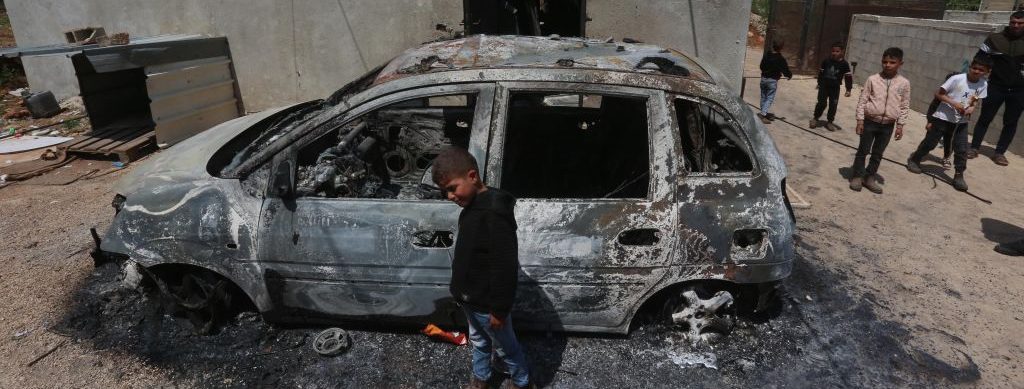
Israel versus Palestine

which side are you on?

  • Israel

  • Palestine

  • both

  • none


Results are only viewable after voting.
Israel is not at fault like Russia, and there is your difference.

The Arabs are at fault. They lost the wars, they lost their lands, they lost their homes.

They are losers. **** them.
According to your new findings, how many cases of Israeli rape were there in 1948?

“About a dozen. In Acre four soldiers raped a girl and murdered her and her father. In Jaffa, soldiers of the Kiryati Brigade raped one girl and tried to rape several more. At Hunin, which is in the Galilee, two girls were raped and then murdered. There were one or two cases of rape at Tantura, south of Haifa. There was one case of rape at Qula, in the center of the country. At the village of Abu Shusha, near Kibbutz Gezer [in the Ramle area] there were four female prisoners, one of whom was raped a number of times. And there were other cases. Usually more than one soldier was involved. Usually there were one or two Palestinian girls. In a large proportion of the cases the event ended with murder. Because neither the victims nor the rapists liked to report these events, we have to assume that the dozen cases of rape that were reported, which I found, are not the whole story. They are just the tip of the iceberg.”

According to your findings, how many acts of Israeli massacre were perpetrated in 1948?

“Twenty-four. In some cases four or five people were executed, in others the numbers were 70, 80, 100. There was also a great deal of arbitrary killing. Two old men are spotted walking in a field – they are shot. A woman is found in an abandoned village – she is shot. There are cases such as the village of Dawayima [in the Hebron region], in which a column entered the village with all guns blazing and killed anything that moved
 
According to your new findings, how many cases of Israeli rape were there in 1948?

“About a dozen. In Acre four soldiers raped a girl and murdered her and her father. In Jaffa, soldiers of the Kiryati Brigade raped one girl and tried to rape several more. At Hunin, which is in the Galilee, two girls were raped and then murdered. There were one or two cases of rape at Tantura, south of Haifa. There was one case of rape at Qula, in the center of the country. At the village of Abu Shusha, near Kibbutz Gezer [in the Ramle area] there were four female prisoners, one of whom was raped a number of times. And there were other cases. Usually more than one soldier was involved. Usually there were one or two Palestinian girls. In a large proportion of the cases the event ended with murder. Because neither the victims nor the rapists liked to report these events, we have to assume that the dozen cases of rape that were reported, which I found, are not the whole story. They are just the tip of the iceberg.”

According to your findings, how many acts of Israeli massacre were perpetrated in 1948?

“Twenty-four. In some cases four or five people were executed, in others the numbers were 70, 80, 100. There was also a great deal of arbitrary killing. Two old men are spotted walking in a field – they are shot. A woman is found in an abandoned village – she is shot. There are cases such as the village of Dawayima [in the Hebron region], in which a column entered the village with all guns blazing and killed anything that moved

 
No such people.
The land that we have bought (for the colony of Ghederal constitutes the "soul and spirit" (nefesh vi ruah)
of the [Arab] village [of Qatra]. The villagers borrowed from the French moneylender Polivar at such a
high rate that they were finally compelled to sell their lands at the loanshark's price. As long as Polivar
remained owner of the land, the fel laheen did not feel the full burden of their misfortune because he leased
it to them. But now that the fellaheen realize that our [Jewish] brothers work the land on their own, and will
not lease it ... the fellaheen are bare-how will they come by their daily bread? [15 November 1885, Muyal
to Pinsker, in Druyanov 1919,1:670-71]
The Ottoman fiscal and land reforms (of the second phase of tanzimat), which first took
effect in Palestine around 1870, soon resulted in the peasantry losing title to much of the land
they cultivated (Schumacher 1889; Post 1891). But life conditions hardly deteriorated: improved
physical security and opportunities provided by the emerging agricultural market more than
offset the cost of paying rent to absentee titleholders (Scholch 1984; Gilbar 1986; cf. Oliphant
1887). Then came the Jewish colonists. Exchanging meager savings for precious deeds in Zion,
they had left behind the alienating commerce of pogrom-ridden Eastern Europe to work the land
of Abraham and Isaac for themselves: "that is why, all of a sudden, many fellaheen had no land
to till; this affected their very existence and provoked the conflicts [at Petah Tikvah] that set our
(Arab] brothers against us" (4 April 1886, Hirsch to Pinsker, in Druyanov 1919,1:746-54, 761-
65). Many of these early colonists were genuinely surprised to find the children of Abraham's
half-forgotten son, Ishmael, still dwelling on their father's land. A few saw the Arabs as long-lost
brothers. Others dreamed the Arabs could be forced back to their desert banishment. The Arab
peasants, it appears, were similarly disconcerted.
 
The land that we have bought (for the colony of Ghederal constitutes the "soul and spirit" (nefesh vi ruah)
of the [Arab] village [of Qatra]. The villagers borrowed from the French moneylender Polivar at such a
high rate that they were finally compelled to sell their lands at the loanshark's price. As long as Polivar
remained owner of the land, the fel laheen did not feel the full burden of their misfortune because he leased
it to them. But now that the fellaheen realize that our [Jewish] brothers work the land on their own, and will
not lease it ... the fellaheen are bare-how will they come by their daily bread? [15 November 1885, Muyal
to Pinsker, in Druyanov 1919,1:670-71]
The Ottoman fiscal and land reforms (of the second phase of tanzimat), which first took
effect in Palestine around 1870, soon resulted in the peasantry losing title to much of the land
they cultivated (Schumacher 1889; Post 1891). But life conditions hardly deteriorated: improved
physical security and opportunities provided by the emerging agricultural market more than
offset the cost of paying rent to absentee titleholders (Scholch 1984; Gilbar 1986; cf. Oliphant
1887). Then came the Jewish colonists. Exchanging meager savings for precious deeds in Zion,
they had left behind the alienating commerce of pogrom-ridden Eastern Europe to work the land
of Abraham and Isaac for themselves: "that is why, all of a sudden, many fellaheen had no land
to till; this affected their very existence and provoked the conflicts [at Petah Tikvah] that set our
(Arab] brothers against us" (4 April 1886, Hirsch to Pinsker, in Druyanov 1919,1:746-54, 761-
65). Many of these early colonists were genuinely surprised to find the children of Abraham's
half-forgotten son, Ishmael, still dwelling on their father's land. A few saw the Arabs as long-lost
brothers. Others dreamed the Arabs could be forced back to their desert banishment. The Arab
peasants, it appears, were similarly disconcerted.

Don’t know why you bothered. :bigbed:
 
Consider first the case of an Israeli named Ami Popper. In May 1990, two years after the original publication of this book, Popper put on his army uniform and asked men waiting at a bus stop in a southern Israeli town for their identity cards. After confirming they were Arabs he lined them up and opened fire, killing seven. Prime Minister Yitzhak Shamir immediately declared that the killings had no political significance, but were instead the act of a "deranged individual." Popper, however, was found sane and fit to stand trial. He is now serving a long prison sentence for murder and recently married the adopted daughter of Rabbi Meir Kahane's son, Benjamin Kahane, leader of the Kahane Chai (Kahane Lives) movement. Popper's sentence is the subject of regular appeals by settlers and other Jewish fundamentalists who demand his release as a "political prisoner."

Approximately six years later, on February 28, 1994, Dr. Baruch Goldstein woke up early in Kiryat Arba, an Israeli settlement on the West Bank near the ancient Jewish town and contemporary Palestinian Arab city of Hebron. Goldstein was an American Jewish immigrant to Israel also affiliated to Meir Kahane's organization. The previous day he had meticulously updated his patients' files and composed a farewell note to his coworkers thanking them for the opportunity to work with them toward the fulfillment of the "complete redemption." He donned his army uniform, picked up his assault rifle and several clips of ammunition, and went to the Tomb of the Patriarchs in the center of Hebron, where Abraham (Ibrahim to Muslims) is believed buried.

With a marksman's headset protecting his ears Goldstein brushed aside the unarmed Arab guard and entered the portion of the site reserved as a mosque. The room was packed with Muslims reciting their prayers for the holy month of Ramadan. Goldstein pointed his gun and began killing the kneeling men and boys. When his gun jammed he was beaten to death by desperate survivors, but not before he had shot twenty-nine people to death, wounded dozens more, and unleashed a torrent of violence that seriously jeopardized the budding peace process
 
Kach
Kahane Chai
Description

Stated goal is to restore the biblical state of Israel. Kach (founded by radical Israeli-American rabbi Meir Kahane) and its offshoot Kahane Chai, which means "Kahane Lives," (founded by Meir Kahane’s son Binyamin following his father’s assassination in the United States) were declared to be terrorist organizations in March 1994 by the Israeli Cabinet under the 1948 Terrorism Law. This followed the groups’ statements in support of Dr. Baruch Goldstein’s attack in February 1994 on the al-Ibrahimi Mosque— Goldstein was affiliated with Kach—and their verbal attacks on the Israeli Government. Palestinian gunmen killed Binyamin Kahane and his wife in a drive-by shooting in December 2000 in the West Bank.

Activities

The group has organized protests against the Israeli Government. Kach has harassed and threatened Arabs, Palestinians, and Israeli Government officials. Has vowed revenge for the deaths of Binyamin Kahane and his wife. Suspected of involvement in a number of low-level attacks since the start of the al-Aqsa intifadah
 
About the Jewish Defense League
The Jewish Defense League, also known as JDL, was established in 1968 for the declared purpose of protecting Jews by whatever means necessary in the face of what was seen by the group’s principals as their dire peril. The founder, national chairman and leader of the JDL was a then-38-year-old ordained rabbi from Brooklyn, New York, Meir Kahane, who, in 1990, was assassinated in New York by an Arab extremist.

In Rabbi Kahane’s gross distortion of the position of Jews in America, American Jews were living in a fiercely hostile society, facing much the same dangers as the Jews in Nazi Germany or those in Israel surrounded by 100-million Arab enemies. Rabbi Kahane believed that the major Jewish organizations in the United States had failed to protect America’s Jews from anti-Semitism, which he saw as “exploding” all over the country. "If I have succeeded in instilling fear in you," Rabbi Kahane said in the closing statement of his standard speech, "I consider this evening a success."

In fact, Kahane consistently preached a radical form of Jewish nationalism which reflected racism, violence and political extremism.

In Their Own Words
Irv Rubin -- Chairman of the Jewish Defense League
After the attack on the Jewish community center in Los Angeles: "Those kids at that community center were sitting ducks. We have to realize as Jews that this is going to happen again and again until we learn to defend ourselves, and the only way to defend yourself is to fire back." The Sacramento Bee, August 14, 1999
On training camps in the Catskills: "We teach young people to have a sane fist attached to a sane head, not to advocate this nebbish posture people seem to think is so popular."
"A lot of energy, and ideology classes will create an authentic Jew. A Jew who will know how to act when all Jews are in trouble." The Times Herald-Record, June, 28, 1998
On Jewish extremists in the United States: "Violence in self-defense is absolutely justifiable." Los Angeles Times, November 9, 1995
From the JDL Web Site
"JDL upholds the principle of Barzel -- iron -- the need to both move to help Jews everywhere and to change the Jewish image through sacrifice and all necessary means -- even strength, force and violence. The Galut image of the Jew as a weakling, as one who is easily stepped upon and who does not fight back is an image that must be changed. Not only does that image cause immediate harm to Jews but it is a self-perpetuating thing. Because a Jew runs away or because a Jew allows himself to be stepped upon, he guarantees that another Jew in the future will be attacked because of the image that he has perpetuated. JDL wants to create a physically strong, fearless and courageous Jew who fights back. We are changing an image, an image born of 2,000 years in the Galut, an image that must be buried because it has buried us. We train ourselves for the defense of Jewish lives and Jewish rights. We learn how to fight physically, for it is better to know how and not have to, than have to and not know how."

"We feel that [Baruch] Goldstein took a preventative measure against yet another Arab attack on Jews. We understand his motivation, his grief and his actions. And we are not ashamed to say that Goldstein was a charter member of the Jewish Defense League
 
15th post

New Topics

Back
Top Bottom