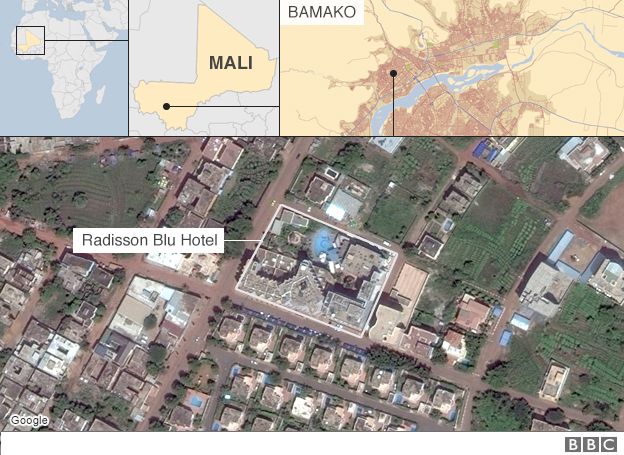
Malian officials earlier said militants had "no more hostages" and special forces were chasing them. Reports suggest at least 27 people were killed. Al-Qaeda in the Islamic Maghreb and its offshoot al-Murabitoun said they carried out the attack. A UN official, who spoke on condition of anonymity, said 12 bodies were found in the basement and 15 on the second floor. It is not clear if this includes two of the attackers who are reported to have died. One of the hostages killed was Geoffrey Dieudonne, a member of parliament in Belgium's Wallonia region. China's state news agency Xinhua says three Chinese nationals are among the dead.
The US state department said one US citizen was killed. UK Foreign Secretary Philip Hammond said three Britons in the hotel were safe. Pictures showed that some of the hostages leaving the hotel were wounded. The US-owned hotel is popular with foreign businesses and airline crews. Eyewitnesses said up to 13 gunmen had entered the hotel shooting and shouting "God is greatest!" in Arabic. The claim by an obscure Saharan jihadist group allied to al-Qaeda that they were behind the attack is a reminder that the country still faces an insurgency.
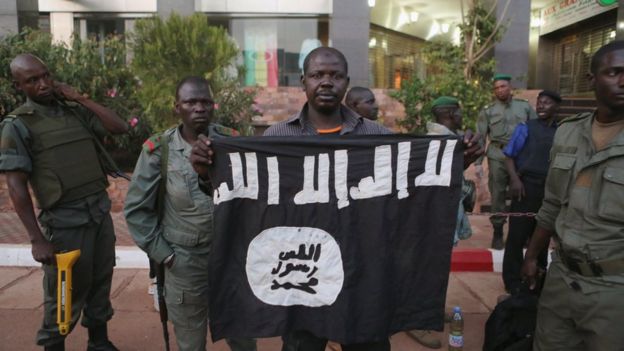
Malian security officials show a jihadist flag they said belonged to the attackers.
In 2013 French forces effected a stunningly swift reversal of al-Qaeda's takeover of most of Mali. But Mali is a large, poor country with porous borders and large areas of ungoverned space where jihadist groups have been able to hide and plan attacks. It has not been helped by the ease with which weapons can come across from Libya, nor by the proximity of a murderous insurgency in Nigeria where Boko Haram reportedly killed more people last year than Islamic State did in Syria and Iraq. It is clear that Mali will continue to need international military support. But to defeat terrorism in the long term it will also need secure borders, good governance and more economic opportunities for young Malians.
Why Mali is an insurgent hotspot