Zone1 Is the Book of John Gospel?

Cassandro

Diamond Member
Joined
Aug 15, 2012
Messages
23,596
Reaction score
12,778
Points
1,405
I have read that the Book of John was written as a counter-argument to Gnostic beliefs around 100 A.D. Unlike the other Gospels, John seems loaded with personal interpretations more like Paul's Letters than historical recordings.

For example, John 1:1 is not based on anything Jesus said. And John 3:15-16 does not sound like Jesus talking about himself. Further, John's subsequent Revelations do not indicate him to be an unbiased reporter of percipient events. What might Christianity look like without his ravings?
 
I have read that the Book of John was written as a counter-argument to Gnostic beliefs around 100 A.D. Unlike the other Gospels, John seems loaded with personal interpretations more like Paul's Letters than historical recordings.

For example, John 1:1 is not based on anything Jesus said. And John 3:15-16 does not sound like Jesus talking about himself. Further, John's subsequent Revelations do not indicate him to be an unbiased reporter of percipient events. What might Christianity look like without his ravings?
Don't all four gospels make a concerted effort to portray Jesus as divine?
 
I have read that the Book of John was written as a counter-argument to Gnostic beliefs around 100 A.D. Unlike the other Gospels, John seems loaded with personal interpretations more like Paul's Letters than historical recordings.

For example, John 1:1 is not based on anything Jesus said. And John 3:15-16 does not sound like Jesus talking about himself. Further, John's subsequent Revelations do not indicate him to be an unbiased reporter of percipient events. What might Christianity look like without his ravings?
How do you explain the Great Commision? Weren't the apostles hiding in fear? What changed their minds? Why did they risk imprisonment, persecution and death?
 
The Book of John seems to have been written by an "enlightened individual" - who likely read/debated/studied along/against many Gnostic Christians at the time.

From what I understand - it was written in an enlightened way (Gnosis) but intended to counter the extreme Gnostic sects - who had dozens and dozens of translations/versions - most countering themselves - which have evolved into many of the modern day conspiracy theories against Jesus and the Gospels.

It was a way to demonstrate that the Gospels of Matthew, Mark and Luke - can come through Gnosis as well - without needing to counter or Blashphem most of their teachings.

It is a near perfect example of what Jesus spoke about in Matthew 12:

Then they brought to him a man who was unable to either see or speak and who was possessed by a demon. He cured him, so that the man who was mute both spoke and saw. 23. All the people were astonished, and they said, “Is this not the Son of David?” ;But when the Pharisees heard this, they said, “It is only by Beelzebul, the prince of demons, that this man casts out demons.”

He knew what they were thinking, and he said to them, “Every kingdom divided against itself is laid waste, and every city or household divided against itself cannot survive. 26. If Satan drives out Satan, he is divided against himself. How then can his kingdom survive? 27. If it is by Beelzebul that I cast out demons, by whom do your own children cast them out? Therefore, they will be your judges.

But if it is by the Spirit of God that I cast out demons, then the kingdom of God has come to you.


Based on history and according to what Jesus taught in Matthew - John's Gnosis came from "The Spirit of God" since it has withstood all the trials and tribulations the faith has endured over the past 2000 years and is still among the most quoted Gospels.

Where as - it is apparent that the more extreme Gnostics - who's texts and version of events can run directly contrary to one another - some resorting in a spiritual version of paganism - was indeed "Satan vs Satan" since the church of "Christian Gnosis" essentially fell and is currently only taught in much smaller denominations - and some secretive cults and societies (some using the texts as a mockery of Christianity) - with most having vastly different teachings, meanings and translations.

In comparison, John's Gnosis is taught to over 2.1 Billion people worldwide - to this day.
 
Last edited:
I have read that the Book of John was written as a counter-argument to Gnostic beliefs around 100 A.D. Unlike the other Gospels, John seems loaded with personal interpretations more like Paul's Letters than historical recordings.

For example, John 1:1 is not based on anything Jesus said. And John 3:15-16 does not sound like Jesus talking about himself. Further, John's subsequent Revelations do not indicate him to be an unbiased reporter of percipient events. What might Christianity look like without his ravings?

On the other hand John chapters thirteen to seventeen sure do sound like modern near death experience accounts to me?

e. His Observations of the Temple of Wisdom​

The following is the testimony of George Ritchie’s Temple of Wisdom and Heavenly City Experience. They then travel to a completely different realm where some kind of enormous university is located. Spirits dressed as monks busily and happily engaged in some form of artistic behavior or research. An enormous library exists here where all the important books of the universe are assembled. Ritchie asks Jesus if this is heaven. These are the spirits of people who grew beyond selfish desires while on Earth; but, like the spirits in hell, these spirits cannot see Jesus either.

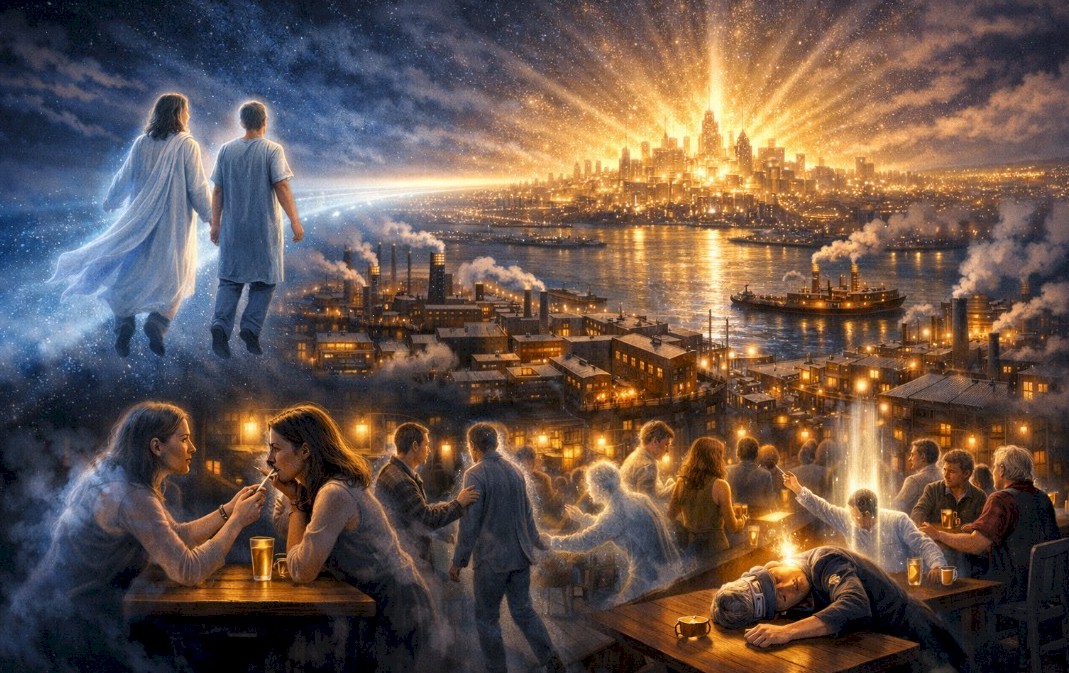
Ritchie is then taken into outer space toward a distant city made of brilliant light – similar in description to the heavenly city in the Book of Revelation (see also Revelation 21:10-27.) This is the place where people go who have become like Jesus while on Earth – a place where love is the dominant focus of life. This is heaven he realizes; but he is not allowed to enter it. Instead, Jesus shows him the future of Earth and is told to return to his physical body. At this point, Ritchie is revived from death.

 
Back
Top Bottom