August West
Platinum Member
- Sep 5, 2014
- 17,123
- 8,266
- 950
Red China! I haven`t heard that one in years.Good. That means they have to cut back on exports to Red China.

We taught them capitalism and now they`re kicking the world`s ass with it.
Follow along with the video below to see how to install our site as a web app on your home screen.
Note: This feature may not be available in some browsers.
Red China! I haven`t heard that one in years.Good. That means they have to cut back on exports to Red China.
Red China! I haven`t heard that one in years.
We taught them capitalism and now they`re kicking the world`s ass with it.

It will likely be beneficial for the nation's health if people ate less.But what if the real truth is that Trumpfy as the Deep
State front man went ahead deliberately because that is the base of this Psy Op ?
To Depopulate and Starve the Sheeple herds over the next two?years .
Until proven otherwise it looks like these unbelievable blunders could be deliberate .
It will likely be beneficial for the nation's health if people ate less.
More farmers might change from 'hydroponic' farming to sustainable farming.
Yes, we know you love Xi and wank yourself to sleep over his picture in your ceiling.
?I love teasing you Munchers .
It's like having my own little troop of virtual puppets .
Thanks. I'll be 86 on the 23rd.Free Pass to anybody over the age of 84 .
Four score plus four -- very respectable if you can still see and walk straight .
Unlike Snider85 and Freefall , say , who are male equivalents of Lady Ga Ga .
 I actually can't walk straight (neuropathy in my feet). If you walked behind me you would think I was drunk.

OFFS! TDS gone wild.I guess I'd put this in the 'unintended consequences' file.
The conflict in Iran has reduced the amount of fertilizer available and increased the cost.
As one might expect, this will increase prices and possible reduce supply of food in the US.
Farmers in the U.S. and Canada, already worried about another year of low profits or losses, now could have spring planting disrupted as they struggle to find fertilizer.
Prices for any available supplies have spiked more than a third since the war in Iran paralyzed global trade.
The U.S., which in some years imports half of its urea fertilizer, is about 25% short of the usual supplies that farmers buy for spring planting, according to The Fertilizer Institute, which represents the U.S. fertilizer supply chain.
Supplies could grow still scarcer if fertilizer destined for the U.S. gets rerouted to other places willing to pay more for it, an analyst said.
Josh Linville, a fertilizer market analyst at StoneX, said the price offered in New Orleans, the port area where most offshore U.S. imports enter and prices are set, is as much as $119 less per metric ton than global prices.
"Not only am I worried about incoming vessels being turned around to other, better-paying destinations, there's an argument to be made, if somebody was willing to go and buy up (supply on) barges, to load them onto a vessel and export it," Linville said.
Farmers who do significant springtime fertilizer application and have not already purchased their supplies are finding retail centers empty, or stocked with supplies sold at such a premium that it's unaffordable.
"It sends shivers down your spine," said Saskatchewan, Canada farmer David Altrogge, whose broker told him that a local fertilizer dealer had stopped offering prices for fertilizer due to the shortage.
He bought his urea in December, but if he bought it today it would cost C$44,000 ($32,070) more. Some farmers in his area now face that price hike or may not even be able to buy any, he said.
The Iran war has cut off critical nitrogen fertilizer supplies from the Gulf to the world's farmers. More than 30% of world nitrogen fertilizer exports, as well as fertilizer components like sulfur, pass through the now effectively closed Strait of Hormuz.
Unlike China, most countries do not hold strategic reserves of fertilizer, and much of the U.S. fertilizer dealer system does not hold stocks, leaving it vulnerable to sudden supply shortages.
"It's not like there's a whole lot of fertilizer sitting on the shelf," said Veronica Nigh, an economist at The Fertilizer Institute. "It's very much a just-in-time business model."
The length of time that the Strait of Hormuz is closed is critical. Fertilizer loaded onto ships in the Gulf can take weeks to reach markets like the U.S., and then must be transferred to river barges, trucks or trains to reach farmland. Most fertilizer needs to be applied before the crop starts growing, so any supplies arriving too late cannot be used for the 2026 crop.
Earlier this week, the American Farm Bureau Federation warned that fertilizer supply shortages could hit the U.S. food supply.
On Thursday, Senator Josh Hawley asked Attorney General Pam Bondi to investigate whether fertilizer companies were involved in price-gouging. Hawley noted that prices have soared as much as 32% since the start of the war and said this was not reasonable. Nigh of The Fertilizer Institute said fertilizer prices have been rising sharply around the world, a dynamic that is expected when supplies suddenly become scarce.
He also sent a letter to the largest fertilizer companies demanding they explain the price hikes.
Most already purchased theirs last fall, so I've heard.Still waiting for all that evidence US farmers aren't getting fertilizer.
Most already purchased theirs last fall, so I've heard.
 gardenerbible.com

Claiming "TDS" is what idiots do in lieu of actually making a cogent point.OFFS! TDS gone wild.
Why? It's obviously your OP was inspired wholly byTDS.Claiming "TDS" is what idiots do in lieu of actually making a cogent point.
Idiot~
Nitrogen fertilizer is made largely from natural gas. Potassium and phosphorous are minerals that are made into fertilizer with the aid of natural gas, mostly by fueling some of the machinery used in processing. Natural gas doesn't not contain potassium or phosphorous. So, these rock minerals are usually imported.Most of it is made from natural gas. We have no shortage of that. In fact we export a hell of a lot of it.
How Is Fertilizer Made From Natural Gas? The Energy-Based Process - GardenerBible
Have you ever wondered how the food on your plate is connected to the natural gas beneath your feet? The surprising truth is that a significant portion of the
Wallyworld and Lowe's have pallets stacked neck high with 40 pound sacks of it.
Potassium:Nitrogen fertilizer is made largely from natural gas. Potassium and phosphorous are minerals that are made into fertilizer with the aid of natural gas, mostly by fueling some of the machinery used in processing. Natural gas doesn't not contain potassium or phosphorous. So, these rock minerals are usually imported.
 chemicalresearchinsight.com

I'm pretty sure bullshit makes great fertilizer. We need more cows, IMO.I guess I'd put this in the 'unintended consequences' file.
The conflict in Iran has reduced the amount of fertilizer available and increased the cost.
As one might expect, this will increase prices and possible reduce supply of food in the US.
Farmers in the U.S. and Canada, already worried about another year of low profits or losses, now could have spring planting disrupted as they struggle to find fertilizer.
Prices for any available supplies have spiked more than a third since the war in Iran paralyzed global trade.
The U.S., which in some years imports half of its urea fertilizer, is about 25% short of the usual supplies that farmers buy for spring planting, according to The Fertilizer Institute, which represents the U.S. fertilizer supply chain.
Supplies could grow still scarcer if fertilizer destined for the U.S. gets rerouted to other places willing to pay more for it, an analyst said.
Josh Linville, a fertilizer market analyst at StoneX, said the price offered in New Orleans, the port area where most offshore U.S. imports enter and prices are set, is as much as $119 less per metric ton than global prices.
"Not only am I worried about incoming vessels being turned around to other, better-paying destinations, there's an argument to be made, if somebody was willing to go and buy up (supply on) barges, to load them onto a vessel and export it," Linville said.
Farmers who do significant springtime fertilizer application and have not already purchased their supplies are finding retail centers empty, or stocked with supplies sold at such a premium that it's unaffordable.
"It sends shivers down your spine," said Saskatchewan, Canada farmer David Altrogge, whose broker told him that a local fertilizer dealer had stopped offering prices for fertilizer due to the shortage.
He bought his urea in December, but if he bought it today it would cost C$44,000 ($32,070) more. Some farmers in his area now face that price hike or may not even be able to buy any, he said.
The Iran war has cut off critical nitrogen fertilizer supplies from the Gulf to the world's farmers. More than 30% of world nitrogen fertilizer exports, as well as fertilizer components like sulfur, pass through the now effectively closed Strait of Hormuz.
Unlike China, most countries do not hold strategic reserves of fertilizer, and much of the U.S. fertilizer dealer system does not hold stocks, leaving it vulnerable to sudden supply shortages.
"It's not like there's a whole lot of fertilizer sitting on the shelf," said Veronica Nigh, an economist at The Fertilizer Institute. "It's very much a just-in-time business model."
The length of time that the Strait of Hormuz is closed is critical. Fertilizer loaded onto ships in the Gulf can take weeks to reach markets like the U.S., and then must be transferred to river barges, trucks or trains to reach farmland. Most fertilizer needs to be applied before the crop starts growing, so any supplies arriving too late cannot be used for the 2026 crop.
Earlier this week, the American Farm Bureau Federation warned that fertilizer supply shortages could hit the U.S. food supply.
On Thursday, Senator Josh Hawley asked Attorney General Pam Bondi to investigate whether fertilizer companies were involved in price-gouging. Hawley noted that prices have soared as much as 32% since the start of the war and said this was not reasonable. Nigh of The Fertilizer Institute said fertilizer prices have been rising sharply around the world, a dynamic that is expected when supplies suddenly become scarce.
He also sent a letter to the largest fertilizer companies demanding they explain the price hikes.

Maybe it's a good time to rethink our agricultural practices.
The rat in the woodpile is the fertilizer itself, which is largely responsible for global soil fertility and topsoil losses. Chemical agriculture is unsustainable, yet we keep doing it.Potassium:
On March 20, 2025, President Trump declared potash a “critical mineral” and called for an increase in
domestic production to reduce import dependence and strengthen national security (EO 14241).
...
The largest potash reserves are found in the
following countries (in order): Canada, Russia, Belarus, and Laos.5 Currently, most American potash
production comes from the southeastern region of New Mexico, and only two U.S. states produce
potash—Utah and New Mexico. Based on U.S. Geological Survey (USGS) estimates (figure 1), the United
States produced about 420,000 metric tons of potash, which is equivalent to less than 1 percent of global
potash production for 2024. As a result, the United States is the third largest importer of potash in the
world (behind Brazil and China) with the United States’ apparent consumption6 of potash for 2024
estimated at 6.4 million metric tons. During 2023–24 (figure 2), the United States imported most of its
potash from Canada7 (88 percent), Russia (9 percent), and Israel (2 percent).
Phosphorous:
Top 10 Companies in the United States Phosphorus Market (2025): Industry Leaders Driving American Agriculture and Industry - Chemical Research Insight
The United States Phosphorus Market was valued at an estimated USD 2.1 Billion in 2023 and is projected to grow steadily, driven by consistent demand from the agricultural sector and emerging applications in lithium-ion batteries and flame retardants. This growth is underpinned by the essential...
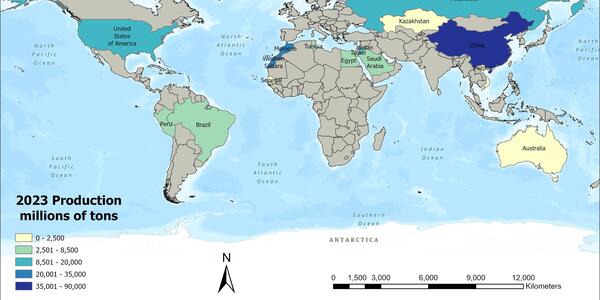
Map of 15 countries with the highest phosphate rock mine production in 2023
This global map highlights the 15 countries that had the highest phosphate rock mine production in 2023. The 15 countries are color coded by volume, in millions of tons (2023 estimates). (Morocco includes the Western Sahara province as well.) USGS mapwww.usgs.gov
We're well covered there as well. As I said earlier, this isn't just some wild spur pf the moment hissy fit as the commies keep trying to peddle; it was planned and bases well covered months ago, if not earlier.
The rat in the woodpile is the fertilizer itself, which is largely responsible for global soil fertility and topsoil losses. Chemical agriculture is unsustainable, yet we keep doing it.

 www.everydayhealth.com


