[
Why yes, the most abundant and prevalent GHG is water vapor. And it's residence time in the atmosphere is about 10 days. While that of CO2 is centuries. So, in times of rapidly declining CO2, like the end of the Ordivician, there were continental glaciations near the equator. Even though there was still the same amount of water on this planet..
One word for you rocks....BULLSHIT. You know perfectly well that the residence time for CO2 is nothing like that and study after study has stated as much...
Here are 37 studies...31 of them find the residence time of CO2 in the atmosphere to be less than 10 years...notice that the IPCC has pegged the bullshit meter at 100 years and you are claiming multiple centuries....
Here is some figures from Princeton University;
http://www.princeton.edu/~lam/TauL1b.pdf
From Yale;
Common Climate Misconceptions: Atmospheric Carbon Dioxide - Yale Climate Connections
Understanding the carbon cycle is a key part of understanding the broader climate change issue. But a number of misconceptions floating around the blogosphere confuse basic concepts to argue that climate change is irrelevant because of the short residence time of carbon molecules in the atmosphere and the large overall carbon stock in the environment.
It turns out that while much of the “pulse” of extra CO2 accumulating in the atmosphere would be absorbed over the next century if emissions miraculously were to end today, about 20 percent of that CO2 would remain for at least tens of thousands of years.
Residence Time of Carbon Dioxide in the Atmosphere
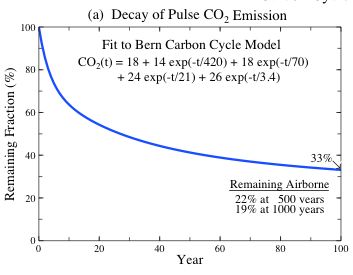
Fig. 9a: Decay of a small pulse of CO2 added to today's atmosphere, based on analytic approximation to the Bern carbon cycle model
(Joos F et al., An efficient and accurate representation of complex oceanc and biospheric models of anthropogenic carbon uptake, Tellus, 48B, 397-417, 1996; Shine et al., Alternatives to the global warming potential for comparing climate impacts of emissions of greenhouse gases, Clim. Change, 68, 281-302, 2005, see equation given in figure).
In this approximation of the carbon cycle,
- about 1/3 of the anthropogenic CO2 emissions remain in the atmosphere after 100 years, and
The complex global carbon cycle process involves carbon absorption and release by the atmosphere, oceans, soils, and organic matter, and also emissions from anthropogenic fossil fuel combustion and land-use changes. The figure below shows the best estimate of annual carbon fluxes from main sources and sinks.


 I think you've confused my comment with that of a liberal Warmer. It had nothing to do with sea ice. Our median global temperature is up 1 degree over the past 100 years according to all the data we have. There is no proof this is the result of anything man is doing, excess CO2 or GHGs, or anything else. While there might be some melting of ice shelves in the Arctic, there is growing ice shelves in the Antarctic. The median sea level is not rising and if it ever rose more than a foot, the natural convection system of the ocean would cease to function and we'd have bigger problems than coastal flooding.