It was published in 1758...in French. However, it wasn't translated into English until 1760, and didn't include any reference to 'natural born citizen' in any edition in any language....until 1797. Years after the Constitution had already been ratified. The term that would eventually be changed to 'natural born citizen' was the french word for 'Indigenes' or 'native'.
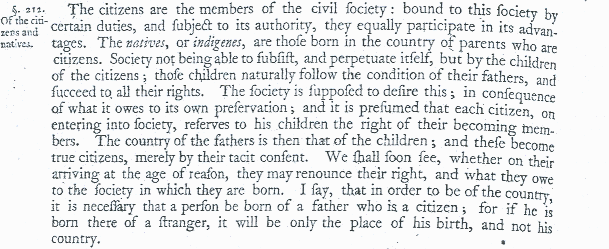
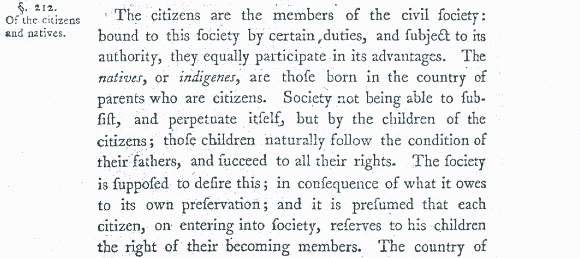
Here's an image of the relevant section of the 1760 English Edition of the Law of Nations:
With zero reference to 'natural born' anything. Here's an image of the relevant section of the 1787 English edition of Law of Nations:
You'll notice there is no reference whatsoever to natural born citizen here either. It isn't until the 1797 edition that term 'natural born citizen' first appears in any English edition. In any edition in any language, in fact. As the original french doesn't match it either. The 1797 English edition of Vattel is amended to read as follows:
"The natives, or natural-born citizens, are those born in the country, of parents who are citizens"
Here's is the original French:
"Les Naturels ou indigènes font ceux qui font nés dans le pays de Parens Citoyens.
The word for 'citizen' in French....is Citoyens. And it appears only once in that sentence. At the end in reference to parents.
No where does the term 'natural born citizen' appear in the orginal french, the 1760 English edition, the 1787 English edition, or any edition in any language.......until 1797.
10 full years after the constitution was written. Its thus physically impossible for the Founders to have used Vattel's Law of Nations as the basis of their understanding of 'natural born citizen'.
Instead, the Founders used the British Common Law understanding of the term, as British Common law absolutely *did* use the term 'natural born'. Which the Supreme Court in Wong Kim Ark indicated was the lens through which the term 'natural born' could be understood when they offered this:
Place of birth, being born in the jurisdiction of the King's law....established natural born status. Even if your parents were aliens. Parentage is essentially irrelevant in the founder's understanding of 'natural born'. As James Madison, the 'Father of the Constitution' reiterated only a handful of months after the Constitution had been ratified:
The United States is based heavily in the British legal tradition, with British Common Law being the law with which the founders were most familiar.
As for the topic being discussed by Madison being 'too far' from Article 2, Section 1, I utterly disagree.
Its a discussion by Madison of the nature of allegiance in citizenship in US and British law. Which as the Supreme Court demonstrated with their citation of British Common Law, was the beating heart of natural born status. Madison's words mirror British Common Law on the topic almost exactly. British Common Law had no concern for parentage, but only place. Madison had no concern for parentage, only place.
Madison does two things with this citation.
First, he establishes that its the British Legal tradition from which American law on citizenship and allegiance is drawn. With Madison citing British law as *evidence* of his arguments regarding American law. With American law mirroring British law. This alone stomps on the neck of any reference ot Vattel.
Second, he establishes that the American conception of allegiance in citizenship mirrors the British Common law understanding exactly. Place of birth alone defines allegiance. And it is unnecessary to investigate any other critiera. Which stomps on the neck of 'Law of Nations' with both feet.
So Vattel fails four times.
1) The 'Law of Nations' makes no mention of 'natural born citizen' or 'natural born' anything at the time of the ratification of the Constitution.
2) Madison makes it ludicrously clear that in terms of citizenship and allegiance, British Common law is the progenitor of the US conception of both.
3) Madison's explanation of allegiance following place of birth in the US mirrors the very British Common Law that he cites exactly.
4) While British law is explicitly cited as evidence of American law by the Founders (by the Father of the Constitution, no less),
Vattel's law of nation isn't. It was 'known to be known' to the founders. That's it. They were aware it existed.
There's zero evidence it was the basis of their understanding of natural born citizenship. Its never mentioned once, in any capacity, in any session of the Constitutional convention. Nor is it cited in any debates on the 1790 Naturalization act as the basis of any understanding of citizenship, allegiance, natural born status, or in any capacity whatsoever.
Take special note that in the *entirity* of your block quote of Wikipedia, the Declaration of Independence and Vattel....there's zero mention of the natural born anything.
Now, as to Cruz's natural born status, there is only one relevant question: Did the founders intend the term 'natural born citizen' to be embodied exclusively in the constitution, or did they intend that it could be embodied in congressional statute? I argue the latter. As the founders did exactly that in the 1790 Naturalization Act, extending natural born citizenship to those born outside the US to US parents.
In the very first session of congress.