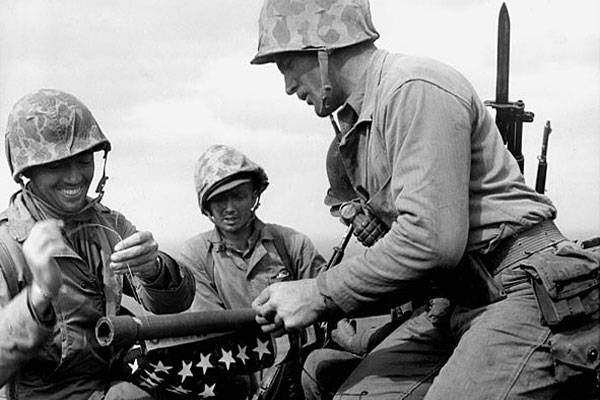
Some time later in the afternoon, another six Marines raised a second flag on the mountain -- and that act, captured by Associated Press photographer Joe Rosenthal, would become the most celebrated image of the war. Just months after the Marine Corps announced in June that it had misidentified the men in the Rosenthal photograph and was correcting its official records in light of new information, the service on Wednesday announced that it was wrong about the troops who participated in the first flag-raising and is altering its records again following a new review of evidence. For some, this may be a historical fine point; for others, it's a long-overdue move with great significance for the families of the men who were there. Most notably, the Marine Corps findings, reviewed by Military.com, prove that Navy corpsman John Bradley, a pharmacist's mate second class, participated in the first flag-raising.
The Marine Corps is updating its historical records to identify who participated in the first flag-raising atop Mount Suribachi during World War II.
In June, officials concluded that Bradley, long believed to be pictured in the Rosenthal photo, was not in fact in the shot. Bradley, who died in 1994 at age 70, had been perhaps one of the best-known flag raisers. He posed for the sculpture that would become the Marine Corps memorial in Washington, D.C., and his story was told in the bestseller Flags of our Fathers, written by his son James Bradley. In a four-day review, a nine-member panel of Marine Corps leaders and historians determined that those who participated in the first flag-raising were Bradley, 1st Lt. Harold Schrier, Platoon Sgt. Ernest Thomas Jr., Sgt. Henry Hanson, Cpl. Charles Lindberg, and Pvt. Philip Ward. Marine Corps records had previously not listed Ward and Bradley as participants, and had incorrectly identified two other Marines, Pfcs. Louis Charlo and James Michels, as flag-raisers.
The panel also reviewed photographic evidence and military records to identify 24 of the men in the patrol that summited Mount Suribachi ahead of the flag-raising, as well as the troops who provided support and security for the event. "We had suspicions … that the official record was in error and needed to be updated," Charles Neimeyer, director of the Marine Corps' History Division, told Military.com. "After the second flag raising [review] that we did, the commandant made a suggestion that, wouldn't it be a good idea to look at the first one." While the task was complicated by the lack of photographic evidence of the flag-raising itself -- the combat cameraman, Staff Sgt. Lou Lowery, had run out of film when it went up -- images immediately before and after the event allowed the researchers to determine where the men were during the event.
In Bradley's case, there could be little doubt: The photographs showed him smiling, with his hand on the flagpole. "When he was remembering, he wasn't being disingenuous; he was remembering his role in that first flag-raising," Neimeyer said. "This confirms that, yes, he was a participant, and reaffirms that tight Navy-Marine Corps bond." Marine Corps Commandant Gen. Robert Neller personally called the families of those affected by the findings, Neimeyer said. And, he added, the news was largely well received. In the case of Michels, the findings showed he hadn't been a flag-raiser as he was providing security for the other Marines with his M1 carbine. Neimeyer had a conversation with Michels' daughter, he said, who agreed his role fit with what she knew about her father. "She said he always looked out for the guys raising the flag," Neimeyer said. "And that's what he's doing in the photos."
Charlo, while not a member of the flag-raising team, had been a member of the reconnaissance team ahead of the event and later provided security for the second flag-raising, the panel found. In a statement, Neller said the findings did not change the heroism or legend of those who were on the mountain. "In my mind, all of the Marines involved in getting the flags flying above Mt. Suribachi could rightfully consider themselves 'flag raisers,' " he said. "Although Marines like Cpl. Raymond Jacobs, Pfc. Louis Charlo and Pfc. James Michels may not have been directly involved in the physical act of the first flag raising, their presence on Mt. Suribachi is irrefutable and their contributions were instrumental in raising the flags that inspired thousands of Marines to keep fighting."
MORE