Try reading some history books. The Roman Warming Period of a few hundred years was on average 2.7 degrees C warmer than today and life was good...very good in fact. The period witnessed widespread prosperity.
Jump forward to the Medieval Warming Period of several hundred years and you find the historical record once again shows widespread prosperity. Average temps were 2.4 degrees C warmer than today.
Now lets look at the times when it is cold.... Things don't look so good. Widespread poverty, wars, and famine. I know which temperature zone I want to live in. After reading some history books and determining the fact that I have not lied to you come back and tell us whether you would rather live while it is warmer or colder.
As you well know, none of the temps you cite were from direct instrument measurements, nor are they global. They come from PROXY data from very limited locations and cannot be HONESTLY equated to global direct instrument measurements.
But deniers are NEVER honest!
But, but, but, but Mann used the EXACT SAME TECHNIQUES TO DERIVE HIS HOCKEY STICK (only because he is such a poor statistician and because he was basing it all on a single tree it got kinda fucked up)(oh damn I said a bad word...well in Mann's case it is deserved, he is the moral equivalent of a ...oh damn I can't say it...it's just to bad a description...even though it is accurate) so once again Bozo, ya can't have it both ways now can you!
What a load of crap.
Can you make a hockey stick without tree rings?
In the field of paleoclimatology, there are a variety of independent methods to determine past temperature changes: tree rings, ice cores, lake sediments, boreholes, stalagmites, etc. What do these independent methods find?
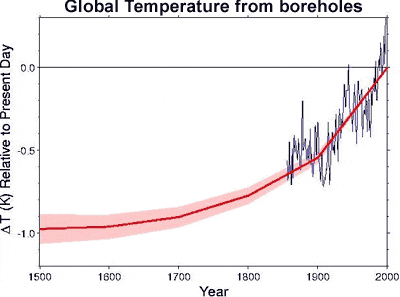
Surface temperature changes send thermal waves underground, cooling or warming the subterranean rock. Boreholes can be used to measure these changes. In Huang 2000, underground temperature measurements were examined from over 350 bore holes in North America, Europe, Southern Africa and Australia. Borehole reconstructions aren't able to give annual or even decadal variation, yielding only century-scale trends. What they find is that the 20th century is the warmest of the past five centuries. This provides independent confirmation that the Earth is warming dramatically (the blue line is the instrumental record).
Figure 1: Global surface temperature change over the last five centuries from boreholes (thick red line). Shading represents uncertainty. Blue line is a five year running average of HadCRUT global surface air temperature (Huang 2000).
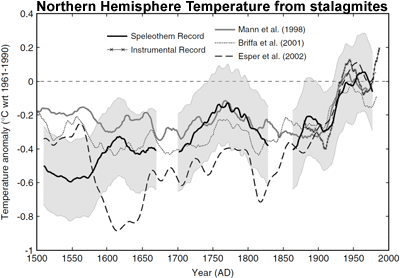
Stalagmites (or speleothems) are formed from groundwater within underground caverns. As they're annually banded, the thickness of the layers are used as climate proxies. Figure 2 shows a Northern Hemisphere temperature reconstruction from stalagmites. While the uncertainty band (grey area) is significant, the temperature in the latter 20th Century exceeds the maximum estimate over the past 500 years.
Figure 2: Northern Hemisphere annual temperature reconstruction from speleothem reconstructions shown with 2 standard error (shaded area) (Smith 2006).
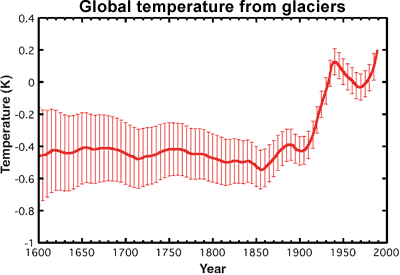
Oerlemans 2005 used historical records of glacier length as a proxy for temperature. As the number of monitored glaciers diminishes in the past, the uncertainty grows accordingly. Nevertheless, temperatures in recent decades exceed the uncertainty range over the past 400 years.
Figure 3: Global mean temperature calculated form glaciers. The red vertical lines indicate uncertainty.
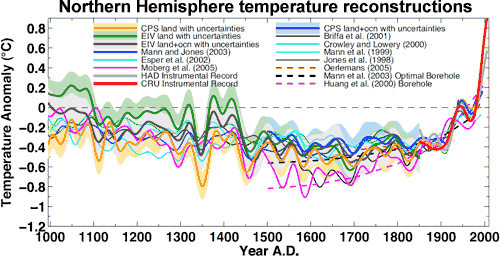
Of course, these examples only go back as far as 500 years - this doesn't even cover the Medieval Warm Period. When you combine all the various proxies, including ice cores, coral, lake sediments, glaciers, boreholes & stalagmites, it's possible to reconstruct Northern Hemisphere temperatures without tree-ring proxies going back 1,300 years (Mann 2008). The result is that temperatures in recent decades exceed the maximum proxy estimate (including uncertainty) for the past 1,300 years. When you include tree-ring data, you find the same result for the past 1,700 years.
Figure 4: Composite Northern Hemisphere land and land plus ocean temperature reconstructions and estimated 95% confidence intervals. Shown for comparison are published Northern Hemisphere reconstructions (Mann 2008).
Paleoclimatology draws upon a range of proxies and methodologies to calculate past temperatures. This allows independent confirmation of the basic hockey stick result: that the past few decades are the hottest in the past 1,300 years.