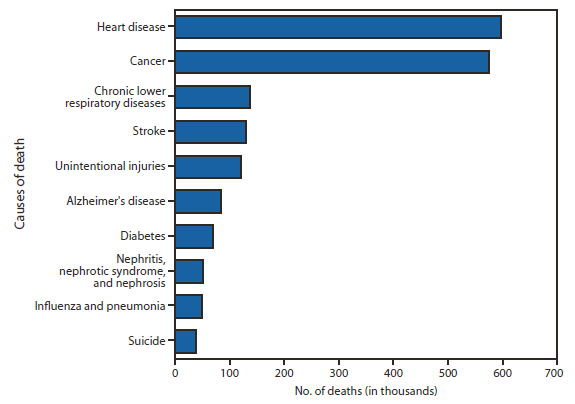
The media, and the public at large, also has a tendency to exaggerate small (but catastrophic) risks, while downplaying substantial (but less "sexy") risks. That helps explain our national obsession with terrorism, even though you are much likelier to die in a car accident. And as scary as mass shootings are, you are more than twice as likely to die from suicide (12.4 deaths per 100,000) than homicide (5.3 deaths per 100,000). (Gun homicides cause 3.6 deaths per 100,000.)
RealClearScience - Top 10 Causes of Death in the U.S.
In an article dated Jan 9, 2013, during the peak of the push for gun bans, USAToday posted a misleading article stating that in 2010 10 out of every 100,000 died from fire-arm related deaths, almost as high as traffic accidents. The truth is only 3.6 per 100,000 die from homicides. And some of those were accidental, not murder.
Truth is, homicides of any kind is on the decline.
December 30, 2013 NCJ 243035
Presents data on homicide trends from 1992 to 2011. The report describes homicide patterns and trends by age, sex, and race of the victim. It explores weapon use, with a focus on trends in firearm use and homicide trends by city size. It also includes special discussions of missing offender data and firearm use in nonfatal violent victimizations. The data are from the FBI's Supplementary Homicide Reports, with summary data from Crime in the United States, for homicide data prior to 1980. Data on nonfatal victimizations are from BJS's National Crime Victimization Survey, 1993 to 1995 and 2008 to 2011.
Highlights:
The U.S. homicide rate declined by nearly half (49%), from 9.3 homicides per 100,000 U.S. residents in 1992 to 4.7 in 2011, falling to the lowest level since 1963. From 2002 to 2011, the average homicide rate for males was 3.6 times higher than the rate for females. The average homicide rate for blacks was 6.3 times higher than the rate for whites.
From 2002 to 2011, young adults ages 18 to 24 had the highest homicide rate of any age group and experienced the greatest rate decline (down 22%) over the 10-year period, from 15.2 per 100,000 in 2002 to 11.9 in 2011.
The rate of homicides involving a firearm decreased by 49% from 1992 to 2011, while the percentage of homicide victims killed by a firearm (67%) remained stable.
Large cities of 100,000 or more residents experienced the largest decline (23%) in homicide rates from 2002 to 2011, compared to communities with less than 100,000 residents.
From 2002 to 2011, the majority (95%) of homicide incidents involved a single victim. In 2011, 66% of homicides with a single victim involved a firearm, compared to 79% of homicide incidents with multiple victims.
However, anti-gun propaganda by the media is on the rise. The problem isn't getting worse like the media claims, yet. Thanks to the Department of Justice and ICE, thousands of violent criminals and illegal immigrant criminals are being released into our cities to wreak havoc on the population. I suspect these numbers will be going up pretty soon.