
mamooth
Diamond Member
I wonder how much the quadruplets are being paid to spam every point in this thread and ensure that no flow of discussion of any issue can take place?
"Well-known troll is declares everyone else is a troll. Film at 11."
Follow along with the video below to see how to install our site as a web app on your home screen.
Note: This feature may not be available in some browsers.
I wonder how much the quadruplets are being paid to spam every point in this thread and ensure that no flow of discussion of any issue can take place?
*You are quite welcome to demonstrate your superior math skills. *I've been trying to engage you, anyone, for that matter.
*But so far, all you've been able to muster are vague and generalize statements that amout to "You're wrong because I said so." The difference this makes is obvious. *
I emailed a couple of people re the apparent linear trend on temp v CO2 and got clear, succinct, and detailed resonces within an hour. *They included complete linear regressions with r^2 and p-values as well as the basic reference to the radiation physics that leads the modelers to utilize the ln function. *Everyone with the full knowledge of fundamentals gets why the in atmosphere measures present themselves as linearly related and makes no quibble re a linear function. *The difference is that of seeing the math and theory as tools or as some authority. *It's all just tools in the toolbox.
To the contrary, you present nothing of substance. *You simply make vague and generalized objections, complaining about things like the accuracy amd precision of Mauna Loa CO2 measures without actually knowing what the precisionmof the measures are. *If you want to claim they aren't good enough, you have to demonstrate with specific value, how they aren't good enough? *But you can't because you can be sure that Keeling went through extra-ordinary effort to assure that the Mauna Loa measurements accurately and precisely represent the global changes in atmospheric CO2.
Quick, in basic terms, what does the derivative and the integral represent? What's the derivative of a*ln(x)? *What is the slope at 350 and 400? *How does the difference between the variation in slope over the range 350 to 400 compare to the range from 1 to 51? *What does this tell us about the regression of temp to CO2 for the range of CO2 as measured in the atmosphere?
*That you can't predict temp anomoly doesn't mean no one else can. Your lack of knowledge doesn't mean everyone else lacks the knowledge. *That you can't only means that you can't.
Without any math at all, it seems intuitively obvious that the odds of a photon colliding with a carbon dioxide molecule is directly proportional to the number of them per unit volume. No?
A good pool table analogy?
you have a naïve understanding of how CO2 works. the main radiative component is how certain wavelengths of IR get dispersed rather than escape directly into space. it has been completely dispersed after 10 meters, it cannot get any more dispersed than completely dispersed. that is why it is a logarithmic function rather than linear. while further CO2increases still have ever smaller impacts on the escape of radiation it is the CO2 closest to the surface that has the major impact.
*You are quite welcome to demonstrate your superior math skills. *I've been trying to engage you, anyone, for that matter.
*But so far, all you've been able to muster are vague and generalize statements that amout to "You're wrong because I said so." The difference this makes is obvious. *
I emailed a couple of people re the apparent linear trend on temp v CO2 and got clear, succinct, and detailed resonces within an hour. *They included complete linear regressions with r^2 and p-values as well as the basic reference to the radiation physics that leads the modelers to utilize the ln function. *Everyone with the full knowledge of fundamentals gets why the in atmosphere measures present themselves as linearly related and makes no quibble re a linear function. *The difference is that of seeing the math and theory as tools or as some authority. *It's all just tools in the toolbox.
To the contrary, you present nothing of substance. *You simply make vague and generalized objections, complaining about things like the accuracy amd precision of Mauna Loa CO2 measures without actually knowing what the precisionmof the measures are. *If you want to claim they aren't good enough, you have to demonstrate with specific value, how they aren't good enough? *But you can't because you can be sure that Keeling went through extra-ordinary effort to assure that the Mauna Loa measurements accurately and precisely represent the global changes in atmospheric CO2.
Quick, in basic terms, what does the derivative and the integral represent? What's the derivative of a*ln(x)? *What is the slope at 350 and 400? *How does the difference between the variation in slope over the range 350 to 400 compare to the range from 1 to 51? *What does this tell us about the regression of temp to CO2 for the range of CO2 as measured in the atmosphere?
*That you can't predict temp anomoly doesn't mean no one else can. Your lack of knowledge doesn't mean everyone else lacks the knowledge. *That you can't only means that you can't.
Without any math at all, it seems intuitively obvious that the odds of a photon colliding with a carbon dioxide molecule is directly proportional to the number of them per unit volume. No?
A good pool table analogy?
you have a naïve understanding of how CO2 works. the main radiative component is how certain wavelengths of IR get dispersed rather than escape directly into space. it has been completely dispersed after 10 meters, it cannot get any more dispersed than completely dispersed. that is why it is a logarithmic function rather than linear. while further CO2increases still have ever smaller impacts on the escape of radiation it is the CO2 closest to the surface that has the major impact.
I wonder how much the quadruplets are being paid to spam every point in this thread and ensure that no flow of discussion of any issue can take place?
"Well-known troll is declares everyone else is a troll. Film at 11."

Without *any math at all, it seems intuitively obvious that the odds of a photon colliding with a carbon dioxide molecule is directly proportional to the number of them per unit volume. No?
A good pool table analogy?
you have a naïve understanding of how CO2 works. the main radiative component is how certain wavelengths of IR get dispersed rather than escape directly into space. it has been completely dispersed after 10 meters, it cannot get any more dispersed than completely dispersed. that is why it is a logarithmic function rather than linear. while further CO2increases still have ever smaller impacts on the escape of radiation it is the CO2 closest to the surface that has the major impact.
You'd be right if energy didn't need to be conserved. It doesn't stop existing because it has been "dispersed".



 per decade in the normalized variance at a site on the Olympic Peninsula at which it is low. We place statistical limits on any trend at the remaining 12 sites, where the normalized variance and its uncertainty are larger. At most sites these limits are consistent with the same rate of linear increase as at the Olympic Peninsula site, but exclude the same rate of percentage increase."
And, back in the real world. *Yet more evidence that says the fraudsters are full of poo....
"Abstract: It is now widely accepted 1, 2, 3, 4, 5 that the mean world climate has warmed since the beginning of climatologically significant anthropogenic emission of greenhouse gases. Warming may be accompanied 6, 7, 8 by changes in the rate of extreme weather events such as severe storms and drought. Here we use hourly precipitation data from 13 stations in the 48 contiguous United States to determine trends in the frequency of such events, taking the normalized variance and a renormalized fourth moment of the precipitation measurements, averaged over decades, as objective measures of the frequency and severity of extreme weather. Using data mostly from the period 19401999 but also two longer data series, periods that include the rapid warming that seems to have begun at approximately 1970, we find a significant increase of 6.5±1.3%(1σ
http://www.nature.com/nclimate/journal/v3/n6/full/nclimate1828.html
per decade"
you have a naïve understanding of how CO2 works. the main radiative component is how certain wavelengths of IR get dispersed rather than escape directly into space. it has been completely dispersed after 10 meters, it cannot get any more dispersed than completely dispersed. that is why it is a logarithmic function rather than linear. while further CO2increases still have ever smaller impacts on the escape of radiation it is the CO2 closest to the surface that has the major impact.
You'd be right if energy didn't need to be conserved. It doesn't stop existing because it has been "dispersed".
It doesn't matter either way. *The denialist point is that, as it is logarithmic, then the effect falls significantly as CO2 rises. *
The issue is that, this is true for large percentage changes. Over the range from 300 to 380 the effect is nearly linear, which is why
regresses out linearly.
The problem they have is scaling and a lack of familiarity with math in both graphic and algebraic form. *They read "logarithmic" and "doubles" and creates an image in their mind that is unrelated to the actual math or physical data shown above.
Logarithmic can refer to log10, ln, and, in the case of the convenient form for climate forcing, log2. *Log2 gives a nice linearity for doubling, because it is base 2. *Climate forcing is conveniently defined this way. *Log10 is linear for factors of ten. And ln is linear for factors of e. *Again, these are simply a form of scaling, for convenience.
I've got it as s = dT(ln2/ln(2C/C))=dT
I also have dT(tn)=(3/ln(2))*ln(C(tn)/C0), which was a chosen curve fit by a climate guy.
But, that is just as well written as
s = dT(ln(10)/ln(10C/C))=dT
Which would say, when it goes up a factor of ten.
The reality is that it is a natural process where the rate of change is proportional to thrle level. This yields the natural exponent y=e^x. *Alterntatively, as the temperature increases, the rate at which energy is absorbed decreases exponentially, yielding a form like Tn=T_max*(1-e^(-x))
It's this simple, consider taking a cup of water out of the fridge, and putting it on the counter. *At first, the temp increases rapidly. As the temp increases, it slow down the rate. You can do this with a standard kitchen thermometer. *As the temp gets closer and closer to the room temperature, it starts creeping up more slowly. It follows the curve*Tn=T_max*(1-e^(-t)).
The exact nature of this increase is a natural exponent,*y=e^x. *The inverse is x=ln(y). *If we want the difference between y and 2y, it is x2=ln(2*y) and x1=ln(y). *The difference is x2-x1= ln(2*y) - ln(y) = ln(2y/y). *The reciprocal is 1/(x2-x1)=1/ln(2y/y). And, for whatever reason, the guy who came up with radiative physics decided to go with ln(2)/(x2-x1)=ln(2)/ln(2y/y).
And, as with acoustics, the power scale is in dB=10log(2P/P), which give a measure of power that is linear for purposes as the responces to power tend to be exponentially damped. It is scale of convenience because the ear responds logarithmically or exponentially. log, ln, and log2 are simply different scaling of the same thing.
so we get this form of convenience.
*s = dT(ln2/ln(2C/C))=dT
Which is simply because it is a natural process. *And because it is a natural process which follows this*Tn=T_max*(1-e^(-t)) form, like that cup of water, with some futzing about we can derive the radiative physics form.
Basically, we'd start with the temp at some level due to a solar output and C (for CO2). *Then we'd double the C, or 2C. *Guided by this,
we'd subtract one from the other for delta-T, futz around, consider if there is an additional exponential function that results from volume changes, and rearrange so we have a nice ln(2C/C) form.
If its a matter of odds and volume, such that it is exponential, it would ln( 2v^3/v^3)/ln(2)= 3ln(2v/v)/ln(2) *which is the other form provided. *And, again, its just scaling.
The point simply being that nature produces the exponential forms. *The radiative equation conveniently chose "doubling" in defining s. *It could have been on 10, or whatever. *The defining as "double" is simple convenience..And if we really wanted to, we could get to a form s = dT(ln2/ln(2C/C))=dT
Regardless, it's nearly linear for small values. *
But we aren't trying to create a model, just understand what's going on. And because I'm not writing a textbook, this presentation is just as it comes to me. *Why reinvent the wheel?
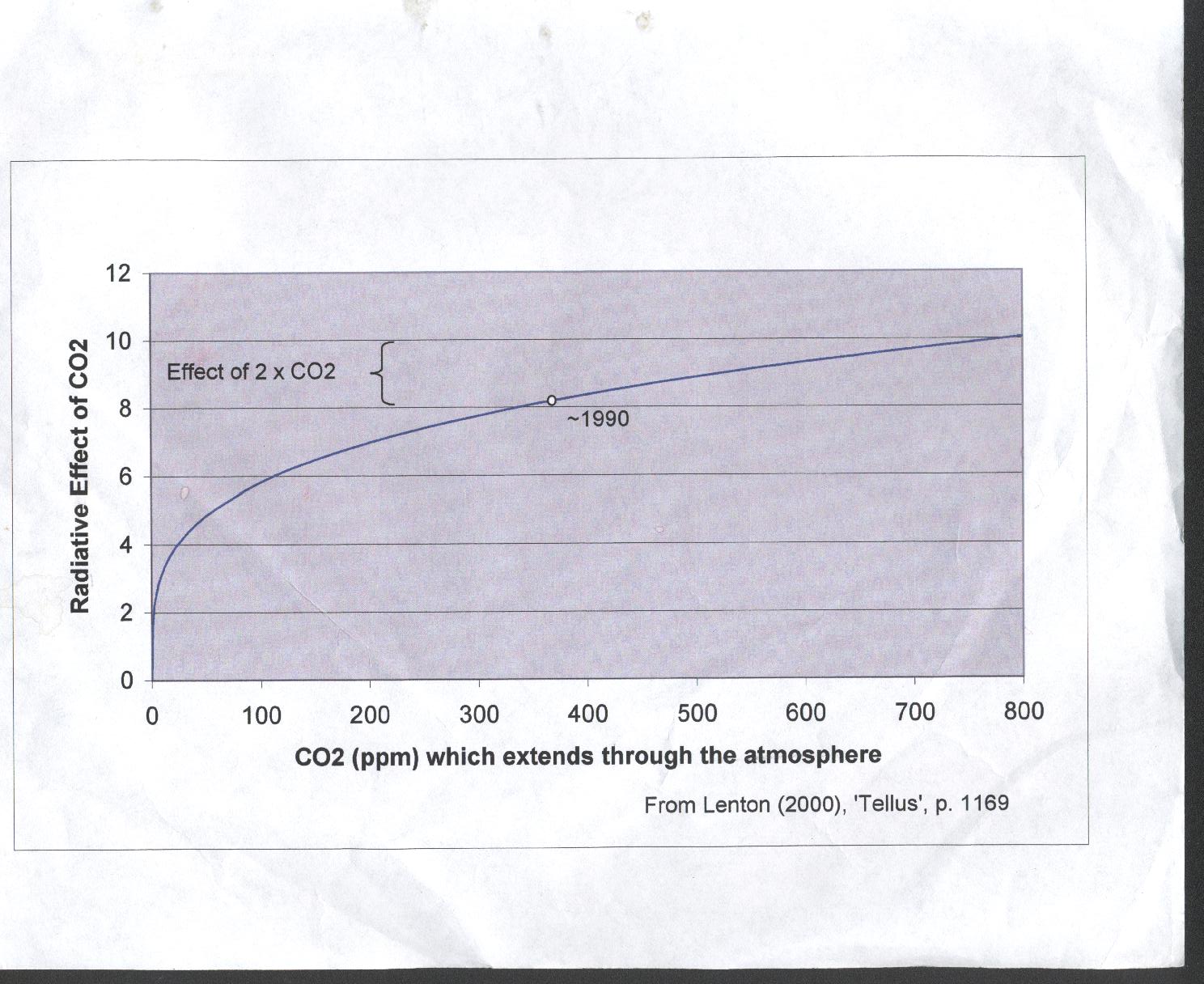
And you will notice, on the range from 400 to 800, the curve is basically linear. *The curvature is small. *It is negligable for 300 to 400.
The effect is only significant if the change in x is appreciable. *300 to 380 isn't double. So the specific point is mute. And as I'm not interested in creating a climate model, I don't need to care.
I though to add that, on the time domain side, because CO2 has gone up exponentially, it comes out linear, the two cancel each other out. *At the exponential rate of increase, that is the historic precidence, the increase can be expected to continue to be linear with time. *The scatter plot will finally shoe a log relationship, as the qualtity increase is no longer a small increment but gives a nicer range of 300 to 800. *
Question is, over the range of CO2 and time, does the Keeling curve have an exponential fit?
Without doing the regression, it kind looks exponential. *And why shouldn't it be, population has been a bit exponential, as well goes things like energy usage.
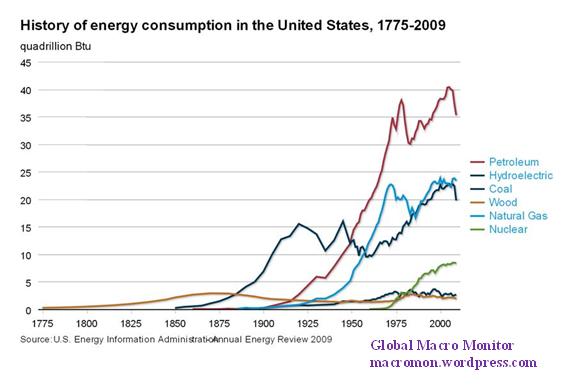
We could look at energy consumption and find it to be exponential.
Kinda. It would be nice to see that added together and a reason the Keeling curve is so smooth by comparison. There is one for the conspiracy theory crowd.
We can examine it graphically. The linearity for small changes is most apparent there. *We can examime it algebraicly, the insignificance of the scaling is more apparent there. *The rate of change of temp is log related to CO2. *The CO2 is exponentially related to time because it is directly related to energy usage and population. *Both of those are exponential in time. *They have been, at least. *And unless something changes, they continue to be. *
If nature forces the change, with us ignorant, we are always behind the eight ball. *And it is unpleasant. *If we predict that the changes will occur, we can be ahead of those changes, the pain of which is typically lessened. It doesn't take an exagerated effort, it's not a "freaking out" problem. *
All I care about is whether the evidence reasonably supports anthropogenic warming. *From there I can simply correlate denier statements against that and use them as a negatively correlated proxy. They do the advanced reading, and if they disagree with the IPCC, I know the IPCC is right because deniers are demonatratably wrong. *It makes my work much easier.*
It also sets up the null hypothesis, if I should want to verify something. *Their statement is the null hypothesis.

Here are a couple of items on GHG absorbtion, that starts to bridge the gap between the general and simplified presentation and the s=dT(ln(2)/ln(2C/C))
"Saturation, Nonlinearity and Overlap
in the Radiative Efficiencies of Greenhouse Gases"
"In order to properly understand the greenhouse effect one must take into account the nonlinearity of the effect of increased concentration of greenhouse gases. One must also take into account that different greenhouse gases may have different spectra for the absorption of thermal radiation.
First consider the matter of the nonlinearity. According to the Beer-Lambert Law the proportion of radiation absorbed upon passing through a distance x of a medium is
** * *1 − e(−ax)
where a is a parameter that reflects the concentration of the absorber and its radiative efficiency. The parameter a is the product of two terms. One is the concentration ρ of the absorber and the other is a characteristic of the absorber α, called its radiative efficiency."
And there is the ubiquitous *1 − e(−ax) form.
"where a is a parameter that reflects the concentration of the absorber and its radiative efficiency. The parameter a is the product of two terms. One is the concentration ρ of the absorber and the other is a characteristic of the absorber α, called its radiative efficiency.
When there are more than one greenhouse gas the value of a is
a = Σ αiρi*
*
where αi and ρi are the radiative efficiency and linear density of constituent i."
We get that the radiative efficiency goes as*
1 − e(−ax)*
The two htmls, listed below, distinguish between radiative efficiency and radiative forcing.
This paper, *http://www.atmos-chem-phys.net/9/5539/2009/acp-9-5539-2009.pdf has "radiative forcing is, to a reasonable approximation, a logarithmic function of CO2
RF=beta*ln(CO2/CO2_ref)
Which gets us closer to the*
This Lenton (2000) chart uses the term "radiative effect", * not "efficiency" or "forcing", so I am reluctant to jump to the conclusion it is*
"RF=beta*ln(CO2/CO2_ref)"
And it's not
1 − e(−ax)*
I'm not getting a solid connection between effect, efficiency and forcing.
But, defining things as "when it doubles, then "RF=beta*ln(CO2/CO2_ref)" becomes*"RF=beta*ln(2*CO2_ref/CO2_ref)/ln(2)" which begins to take on the appearance of*s = dT(ln2/ln(2C/C))=dT, refered to as climate sensitivity.
And climate sensitivity is given by
"The two concepts of radiative forcing and global warming potential (GWP) should not be confused with radiative efficiency. Radiative forcing is the change in the energy input to the Earth's climate system over some period of time due to some external change. It is measured in watts per square meter (W/m²). It is a useful concept and leads to the definition of the climate sensitivity parameter λ, i.e.,
λ = ΔTs/ΔF*
*
where ΔTs is the change in the Earth's global mean surface temperature and ΔF is the radiative forcing."
Radiative forcing was given as*"RF=beta*ln(2*CO2_ref/CO2_ref)/ln(2)"
so*
λ = ΔTs/ΔF
*= ΔTs/(beta*ln(2*CO2_ref/CO2_ref)/ln(2))
s = ΔTs*ln(2)/(beta*ln(2*CO2_ref/CO2_ref))
So *ΔTs=ΔF*s
Where s is defined as*
s = ΔTs*ln(2)/(beta*ln(2*CO2_ref/CO2_ref))
Clearly tautological, still, the connection is clear, that the effect is related to the typical natural exponent/ramp function where a quantity rate of change is dependent on it's level. It begins with the ubiquitous 1 − e(−ax). It results in parameters that go as ln and 1/ln.
And within the range of 300 to 400, the effect is nearly linear. *With CO2 increasing exponentially with time, the temporal change in temperature is linear.
----
Saturation, Nonlinearity and Overlap in the Radiative Efficiencies of Greenhouse Gases
Saturation, Nonlinearity and Overlap in the Radiative Efficiencies of Greenhouse Gases
Searching under Lenton 2000 turns up*http://lgmacweb.env.uea.ac.uk/esmg/papers/Lenton2000.pdf which has some nice graphs on CO2 concentrations and emmissions, but sheds little light on forcing.
I suspect that the info is in the textbook world, not readily available on the net. It's almost like there is this conspiracy among academia. *The overly simplified and some ofnthe advanced material is on the net while the material connecting the two is not there. *I suspect it is the publishers. *It really sucks.

You'd be right if energy didn't need to be conserved. It doesn't stop existing because it has been "dispersed".
It doesn't matter either way. *The denialist point is that, as it is logarithmic, then the effect falls significantly as CO2 rises. *
The issue is that, this is true for large percentage changes. Over the range from 300 to 380 the effect is nearly linear, which is why
regresses out linearly.
The problem they have is scaling and a lack of familiarity with math in both graphic and algebraic form. *They read "logarithmic" and "doubles" and creates an image in their mind that is unrelated to the actual math or physical data shown above.
Logarithmic can refer to log10, ln, and, in the case of the convenient form for climate forcing, log2. *Log2 gives a nice linearity for doubling, because it is base 2. *Climate forcing is conveniently defined this way. *Log10 is linear for factors of ten. And ln is linear for factors of e. *Again, these are simply a form of scaling, for convenience.
I've got it as s = dT(ln2/ln(2C/C))=dT
I also have dT(tn)=(3/ln(2))*ln(C(tn)/C0), which was a chosen curve fit by a climate guy.
But, that is just as well written as
s = dT(ln(10)/ln(10C/C))=dT
Which would say, when it goes up a factor of ten.
The reality is that it is a natural process where the rate of change is proportional to thrle level. This yields the natural exponent y=e^x. *Alterntatively, as the temperature increases, the rate at which energy is absorbed decreases exponentially, yielding a form like Tn=T_max*(1-e^(-x))
It's this simple, consider taking a cup of water out of the fridge, and putting it on the counter. *At first, the temp increases rapidly. As the temp increases, it slow down the rate. You can do this with a standard kitchen thermometer. *As the temp gets closer and closer to the room temperature, it starts creeping up more slowly. It follows the curve*Tn=T_max*(1-e^(-t)).
The exact nature of this increase is a natural exponent,*y=e^x. *The inverse is x=ln(y). *If we want the difference between y and 2y, it is x2=ln(2*y) and x1=ln(y). *The difference is x2-x1= ln(2*y) - ln(y) = ln(2y/y). *The reciprocal is 1/(x2-x1)=1/ln(2y/y). And, for whatever reason, the guy who came up with radiative physics decided to go with ln(2)/(x2-x1)=ln(2)/ln(2y/y).
And, as with acoustics, the power scale is in dB=10log(2P/P), which give a measure of power that is linear for purposes as the responces to power tend to be exponentially damped. It is scale of convenience because the ear responds logarithmically or exponentially. log, ln, and log2 are simply different scaling of the same thing.
so we get this form of convenience.
*s = dT(ln2/ln(2C/C))=dT
Which is simply because it is a natural process. *And because it is a natural process which follows this*Tn=T_max*(1-e^(-t)) form, like that cup of water, with some futzing about we can derive the radiative physics form.
Basically, we'd start with the temp at some level due to a solar output and C (for CO2). *Then we'd double the C, or 2C. *Guided by this,
we'd subtract one from the other for delta-T, futz around, consider if there is an additional exponential function that results from volume changes, and rearrange so we have a nice ln(2C/C) form.
If its a matter of odds and volume, such that it is exponential, it would ln( 2v^3/v^3)/ln(2)= 3ln(2v/v)/ln(2) *which is the other form provided. *And, again, its just scaling.
The point simply being that nature produces the exponential forms. *The radiative equation conveniently chose "doubling" in defining s. *It could have been on 10, or whatever. *The defining as "double" is simple convenience..And if we really wanted to, we could get to a form s = dT(ln2/ln(2C/C))=dT
Regardless, it's nearly linear for small values. *
But we aren't trying to create a model, just understand what's going on. And because I'm not writing a textbook, this presentation is just as it comes to me. *Why reinvent the wheel?
And you will notice, on the range from 400 to 800, the curve is basically linear. *The curvature is small. *It is negligable for 300 to 400.
The effect is only significant if the change in x is appreciable. *300 to 380 isn't double. So the specific point is mute. And as I'm not interested in creating a climate model, I don't need to care.
I though to add that, on the time domain side, because CO2 has gone up exponentially, it comes out linear, the two cancel each other out. *At the exponential rate of increase, that is the historic precidence, the increase can be expected to continue to be linear with time. *The scatter plot will finally shoe a log relationship, as the qualtity increase is no longer a small increment but gives a nicer range of 300 to 800. *
Question is, over the range of CO2 and time, does the Keeling curve have an exponential fit?
Without doing the regression, it kind looks exponential. *And why shouldn't it be, population has been a bit exponential, as well goes things like energy usage.
We could look at energy consumption and find it to be exponential.
Kinda. It would be nice to see that added together and a reason the Keeling curve is so smooth by comparison. There is one for the conspiracy theory crowd.
We can examine it graphically. The linearity for small changes is most apparent there. *We can examime it algebraicly, the insignificance of the scaling is more apparent there. *The rate of change of temp is log related to CO2. *The CO2 is exponentially related to time because it is directly related to energy usage and population. *Both of those are exponential in time. *They have been, at least. *And unless something changes, they continue to be. *
If nature forces the change, with us ignorant, we are always behind the eight ball. *And it is unpleasant. *If we predict that the changes will occur, we can be ahead of those changes, the pain of which is typically lessened. It doesn't take an exagerated effort, it's not a "freaking out" problem. *
All I care about is whether the evidence reasonably supports anthropogenic warming. *From there I can simply correlate denier statements against that and use them as a negatively correlated proxy. They do the advanced reading, and if they disagree with the IPCC, I know the IPCC is right because deniers are demonatratably wrong. *It makes my work much easier.*
It also sets up the null hypothesis, if I should want to verify something. *Their statement is the null hypothesis.
I don't think you understand logarithmic...
Your understanding is lacking, and obviously no amount of charts; graphs, or data will help you here..
Your argument is a silly one...
The log of 10, where did you get that? The fact is the AGW theory hasn't been quantified to that level, and any claims regarding that factor are simply fiction. SO I ask you where did you get your log from?
You pulled it off of a web page somewhere or took pieces off a wiki article on logarithm. Nice now please explain how your BS is based on anything real regarding CO2?
LOL, again we see you trying to baffle with Bullshit...
Here are a couple of items on GHG absorbtion, that starts to bridge the gap between the general and simplified presentation and the s=dT(ln(2)/ln(2C/C))
"Saturation, Nonlinearity and Overlap
in the Radiative Efficiencies of Greenhouse Gases"
"In order to properly understand the greenhouse effect one must take into account the nonlinearity of the effect of increased concentration of greenhouse gases. One must also take into account that different greenhouse gases may have different spectra for the absorption of thermal radiation.
First consider the matter of the nonlinearity. According to the Beer-Lambert Law the proportion of radiation absorbed upon passing through a distance x of a medium is
** * *1 − e(−ax)
where a is a parameter that reflects the concentration of the absorber and its radiative efficiency. The parameter a is the product of two terms. One is the concentration ρ of the absorber and the other is a characteristic of the absorber α, called its radiative efficiency."
And there is the ubiquitous *1 − e(−ax) form.
"where a is a parameter that reflects the concentration of the absorber and its radiative efficiency. The parameter a is the product of two terms. One is the concentration ρ of the absorber and the other is a characteristic of the absorber α, called its radiative efficiency.
When there are more than one greenhouse gas the value of a is
a = Σ αiρi*
*
where αi and ρi are the radiative efficiency and linear density of constituent i."
We get that the radiative efficiency goes as*
1 − e(−ax)*
The two htmls, listed below, distinguish between radiative efficiency and radiative forcing.
This paper, *http://www.atmos-chem-phys.net/9/5539/2009/acp-9-5539-2009.pdf has "radiative forcing is, to a reasonable approximation, a logarithmic function of CO2
RF=beta*ln(CO2/CO2_ref)
Which gets us closer to the*
This Lenton (2000) chart uses the term "radiative effect", * not "efficiency" or "forcing", so I am reluctant to jump to the conclusion it is*
"RF=beta*ln(CO2/CO2_ref)"
And it's not
1 − e(−ax)*
I'm not getting a solid connection between effect, efficiency and forcing.
But, defining things as "when it doubles, then "RF=beta*ln(CO2/CO2_ref)" becomes*"RF=beta*ln(2*CO2_ref/CO2_ref)/ln(2)" which begins to take on the appearance of*s = dT(ln2/ln(2C/C))=dT, refered to as climate sensitivity.
And climate sensitivity is given by
"The two concepts of radiative forcing and global warming potential (GWP) should not be confused with radiative efficiency. Radiative forcing is the change in the energy input to the Earth's climate system over some period of time due to some external change. It is measured in watts per square meter (W/m²). It is a useful concept and leads to the definition of the climate sensitivity parameter λ, i.e.,
λ = ΔTs/ΔF*
*
where ΔTs is the change in the Earth's global mean surface temperature and ΔF is the radiative forcing."
Radiative forcing was given as*"RF=beta*ln(2*CO2_ref/CO2_ref)/ln(2)"
so*
λ = ΔTs/ΔF
*= ΔTs/(beta*ln(2*CO2_ref/CO2_ref)/ln(2))
s = ΔTs*ln(2)/(beta*ln(2*CO2_ref/CO2_ref))
So *ΔTs=ΔF*s
Where s is defined as*
s = ΔTs*ln(2)/(beta*ln(2*CO2_ref/CO2_ref))
Clearly tautological, still, the connection is clear, that the effect is related to the typical natural exponent/ramp function where a quantity rate of change is dependent on it's level. It begins with the ubiquitous 1 − e(−ax). It results in parameters that go as ln and 1/ln.
And within the range of 300 to 400, the effect is nearly linear. *With CO2 increasing exponentially with time, the temporal change in temperature is linear.
----
Saturation, Nonlinearity and Overlap in the Radiative Efficiencies of Greenhouse Gases
Saturation, Nonlinearity and Overlap in the Radiative Efficiencies of Greenhouse Gases
Searching under Lenton 2000 turns up*http://lgmacweb.env.uea.ac.uk/esmg/papers/Lenton2000.pdf which has some nice graphs on CO2 concentrations and emmissions, but sheds little light on forcing.
I suspect that the info is in the textbook world, not readily available on the net. It's almost like there is this conspiracy among academia. *The overly simplified and some ofnthe advanced material is on the net while the material connecting the two is not there. *I suspect it is the publishers. *It really sucks.
You're actually in theatre right? Prepping for a part *playing a scientist right? Trying to look confident and familiar with big math concepts and lingo..*
This cut and paste and THEFT of others intellectual property without credits is dishonest and probably illegal.. But moreover -- it looks like you are having a crack induced psychotic episode..*
Since I felt compassion for your lack of discipline and apparent penchant for wasting your time and the server storage at USMB -- I jotted out an Excel graph for you..*
You are certainly welcome to approximate log functions over "small changes" in the independent variable as linear. However, with a log function, "small" is not a fixed qty.. The chart shows the slope of the ln() function over several ranges. Note 8 to 16 is doubling and 32 to 64 is also a doubling. But the others are LESS than a doubling.*
Even for the spans LESS than a doubling, there is a significant change in the slope of the curve !! And that's at point considerably far out on the curve.
As for your ramblings about textbook conspiracies.. I have no f-ing idea what that's about.*
I think you're stuck at converting W/m2 radiative forcing to a surface temperature..*
No conspiracy..*
You calculate the CO2 forcing and that gets you to Watts/m2 additional power. Then to estimate Temp rise from that WITHOUT A CLIMATE MODEL --- it's a simple trip thru a "Gray" body approximately and the Stephan Boltzmann model. That gets you to what I told you WEEKS AGO.. That the surface temp rise from a doubling of CO2 (span is 1960 to about 2040?) from 280ppm to 560ppm is --- by pure physics ---- 1.1 degC.. Everybody involved knows this and accepts it..*
Everything else about 6DegC rises in the couple decades is pure speculation and fantasy...*
The IPCC models all use a "climate sensitivity" multiplier instead of the simple physics "grey body".. And that's probably justified ---- IF they had any f-ing idea how to assign ONE "climate sensitivity" for the ENTIRE GLOBE. The Arctic Clim. Sens. doesn't respond like the Tropical one. And climate sensitivity VARY not only by region but by SEASON.*
But ---- they (your AGW heroes) insist on blowing smoke up your ass and arguing whether this number is anywhere between 1.6 and 5.5 or so.. No joking -- that's the range of uncertainty. So when you throw us up a mess of yellow squiggly lines and call that a "model".. It means jack shit unless you know what the Clim. Sens. and 100 other variables were assumed to be..*
What else is bugging you bunky? Is it more serious than crack? How long you got before your show opens on Broadway?
You'd be right if energy didn't need to be conserved. It doesn't stop existing because it has been "dispersed".
It doesn't matter either way. *The denialist point is that, as it is logarithmic, then the effect falls significantly as CO2 rises. *
The issue is that, this is true for large percentage changes. Over the range from 300 to 380 the effect is nearly linear, which is why
regresses out linearly.
The problem they have is scaling and a lack of familiarity with math in both graphic and algebraic form. *They read "logarithmic" and "doubles" and creates an image in their mind that is unrelated to the actual math or physical data shown above.
Logarithmic can refer to log10, ln, and, in the case of the convenient form for climate forcing, log2. *Log2 gives a nice linearity for doubling, because it is base 2. *Climate forcing is conveniently defined this way. *Log10 is linear for factors of ten. And ln is linear for factors of e. *Again, these are simply a form of scaling, for convenience.
I've got it as s = dT(ln2/ln(2C/C))=dT
I also have dT(tn)=(3/ln(2))*ln(C(tn)/C0), which was a chosen curve fit by a climate guy.
But, that is just as well written as
s = dT(ln(10)/ln(10C/C))=dT
Which would say, when it goes up a factor of ten.
The reality is that it is a natural process where the rate of change is proportional to thrle level. This yields the natural exponent y=e^x. *Alterntatively, as the temperature increases, the rate at which energy is absorbed decreases exponentially, yielding a form like Tn=T_max*(1-e^(-x))
It's this simple, consider taking a cup of water out of the fridge, and putting it on the counter. *At first, the temp increases rapidly. As the temp increases, it slow down the rate. You can do this with a standard kitchen thermometer. *As the temp gets closer and closer to the room temperature, it starts creeping up more slowly. It follows the curve*Tn=T_max*(1-e^(-t)).
The exact nature of this increase is a natural exponent,*y=e^x. *The inverse is x=ln(y). *If we want the difference between y and 2y, it is x2=ln(2*y) and x1=ln(y). *The difference is x2-x1= ln(2*y) - ln(y) = ln(2y/y). *The reciprocal is 1/(x2-x1)=1/ln(2y/y). And, for whatever reason, the guy who came up with radiative physics decided to go with ln(2)/(x2-x1)=ln(2)/ln(2y/y).
And, as with acoustics, the power scale is in dB=10log(2P/P), which give a measure of power that is linear for purposes as the responces to power tend to be exponentially damped. It is scale of convenience because the ear responds logarithmically or exponentially. log, ln, and log2 are simply different scaling of the same thing.
so we get this form of convenience.
*s = dT(ln2/ln(2C/C))=dT
Which is simply because it is a natural process. *And because it is a natural process which follows this*Tn=T_max*(1-e^(-t)) form, like that cup of water, with some futzing about we can derive the radiative physics form.
Basically, we'd start with the temp at some level due to a solar output and C (for CO2). *Then we'd double the C, or 2C. *Guided by this,
we'd subtract one from the other for delta-T, futz around, consider if there is an additional exponential function that results from volume changes, and rearrange so we have a nice ln(2C/C) form.
If its a matter of odds and volume, such that it is exponential, it would ln( 2v^3/v^3)/ln(2)= 3ln(2v/v)/ln(2) *which is the other form provided. *And, again, its just scaling.
The point simply being that nature produces the exponential forms. *The radiative equation conveniently chose "doubling" in defining s. *It could have been on 10, or whatever. *The defining as "double" is simple convenience..And if we really wanted to, we could get to a form s = dT(ln2/ln(2C/C))=dT
Regardless, it's nearly linear for small values. *
But we aren't trying to create a model, just understand what's going on. And because I'm not writing a textbook, this presentation is just as it comes to me. *Why reinvent the wheel?
And you will notice, on the range from 400 to 800, the curve is basically linear. *The curvature is small. *It is negligable for 300 to 400.
The effect is only significant if the change in x is appreciable. *300 to 380 isn't double. So the specific point is mute. And as I'm not interested in creating a climate model, I don't need to care.
I though to add that, on the time domain side, because CO2 has gone up exponentially, it comes out linear, the two cancel each other out. *At the exponential rate of increase, that is the historic precidence, the increase can be expected to continue to be linear with time. *The scatter plot will finally shoe a log relationship, as the qualtity increase is no longer a small increment but gives a nicer range of 300 to 800. *
Question is, over the range of CO2 and time, does the Keeling curve have an exponential fit?
Without doing the regression, it kind looks exponential. *And why shouldn't it be, population has been a bit exponential, as well goes things like energy usage.
We could look at energy consumption and find it to be exponential.
Kinda. It would be nice to see that added together and a reason the Keeling curve is so smooth by comparison. There is one for the conspiracy theory crowd.
We can examine it graphically. The linearity for small changes is most apparent there. *We can examime it algebraicly, the insignificance of the scaling is more apparent there. *The rate of change of temp is log related to CO2. *The CO2 is exponentially related to time because it is directly related to energy usage and population. *Both of those are exponential in time. *They have been, at least. *And unless something changes, they continue to be. *
If nature forces the change, with us ignorant, we are always behind the eight ball. *And it is unpleasant. *If we predict that the changes will occur, we can be ahead of those changes, the pain of which is typically lessened. It doesn't take an exagerated effort, it's not a "freaking out" problem. *
All I care about is whether the evidence reasonably supports anthropogenic warming. *From there I can simply correlate denier statements against that and use them as a negatively correlated proxy. They do the advanced reading, and if they disagree with the IPCC, I know the IPCC is right because deniers are demonatratably wrong. *It makes my work much easier.*
It also sets up the null hypothesis, if I should want to verify something. *Their statement is the null hypothesis.
I don't think you understand logarithmic...
Your understanding is lacking, and obviously no amount of charts; graphs, or data will help you here..
Your argument is a silly one...
The log of 10, where did you get that? The fact is the AGW theory hasn't been quantified to that level, and any claims regarding that factor are simply fiction. SO I ask you where did you get your log from?
You pulled it off of a web page somewhere or took pieces off a wiki article on logarithm. Nice now please explain how your BS is based on anything real regarding CO2?
LOL, again we see you trying to baffle with Bullshit...
Here are a couple of items on GHG absorbtion, that starts to bridge the gap between the general and simplified presentation and the s=dT(ln(2)/ln(2C/C))
"Saturation, Nonlinearity and Overlap
in the Radiative Efficiencies of Greenhouse Gases"
"In order to properly understand the greenhouse effect one must take into account the nonlinearity of the effect of increased concentration of greenhouse gases. One must also take into account that different greenhouse gases may have different spectra for the absorption of thermal radiation.
First consider the matter of the nonlinearity. According to the Beer-Lambert Law the proportion of radiation absorbed upon passing through a distance x of a medium is
** * *1 − e(−ax)
where a is a parameter that reflects the concentration of the absorber and its radiative efficiency. The parameter a is the product of two terms. One is the concentration ρ of the absorber and the other is a characteristic of the absorber α, called its radiative efficiency."
And there is the ubiquitous *1 − e(−ax) form.
"where a is a parameter that reflects the concentration of the absorber and its radiative efficiency. The parameter a is the product of two terms. One is the concentration ρ of the absorber and the other is a characteristic of the absorber α, called its radiative efficiency.
When there are more than one greenhouse gas the value of a is
a = Σ αiρi*
*
where αi and ρi are the radiative efficiency and linear density of constituent i."
We get that the radiative efficiency goes as*
1 − e(−ax)*
The two htmls, listed below, distinguish between radiative efficiency and radiative forcing.
This paper, *http://www.atmos-chem-phys.net/9/5539/2009/acp-9-5539-2009.pdf has "radiative forcing is, to a reasonable approximation, a logarithmic function of CO2
RF=beta*ln(CO2/CO2_ref)
Which gets us closer to the*
This Lenton (2000) chart uses the term "radiative effect", * not "efficiency" or "forcing", so I am reluctant to jump to the conclusion it is*
"RF=beta*ln(CO2/CO2_ref)"
And it's not
1 − e(−ax)*
I'm not getting a solid connection between effect, efficiency and forcing.
But, defining things as "when it doubles, then "RF=beta*ln(CO2/CO2_ref)" becomes*"RF=beta*ln(2*CO2_ref/CO2_ref)/ln(2)" which begins to take on the appearance of*s = dT(ln2/ln(2C/C))=dT, refered to as climate sensitivity.
And climate sensitivity is given by
"The two concepts of radiative forcing and global warming potential (GWP) should not be confused with radiative efficiency. Radiative forcing is the change in the energy input to the Earth's climate system over some period of time due to some external change. It is measured in watts per square meter (W/m²). It is a useful concept and leads to the definition of the climate sensitivity parameter λ, i.e.,
λ = ΔTs/ΔF*
*
where ΔTs is the change in the Earth's global mean surface temperature and ΔF is the radiative forcing."
Radiative forcing was given as*"RF=beta*ln(2*CO2_ref/CO2_ref)/ln(2)"
so*
λ = ΔTs/ΔF
*= ΔTs/(beta*ln(2*CO2_ref/CO2_ref)/ln(2))
s = ΔTs*ln(2)/(beta*ln(2*CO2_ref/CO2_ref))
So *ΔTs=ΔF*s
Where s is defined as*
s = ΔTs*ln(2)/(beta*ln(2*CO2_ref/CO2_ref))
Clearly tautological, still, the connection is clear, that the effect is related to the typical natural exponent/ramp function where a quantity rate of change is dependent on it's level. It begins with the ubiquitous 1 − e(−ax). It results in parameters that go as ln and 1/ln.
And within the range of 300 to 400, the effect is nearly linear. *With CO2 increasing exponentially with time, the temporal change in temperature is linear.
----
Saturation, Nonlinearity and Overlap in the Radiative Efficiencies of Greenhouse Gases
Saturation, Nonlinearity and Overlap in the Radiative Efficiencies of Greenhouse Gases
Searching under Lenton 2000 turns up*http://lgmacweb.env.uea.ac.uk/esmg/papers/Lenton2000.pdf which has some nice graphs on CO2 concentrations and emmissions, but sheds little light on forcing.
I suspect that the info is in the textbook world, not readily available on the net. It's almost like there is this conspiracy among academia. *The overly simplified and some ofnthe advanced material is on the net while the material connecting the two is not there. *I suspect it is the publishers. *It really sucks.
You're actually in theatre right? Prepping for a part *playing a scientist right? Trying to look confident and familiar with big math concepts and lingo..*
Since I felt compassion for your lack of discipline and apparent penchant for wasting your time and the server storage at USMB -- I jotted out an Excel graph for you..*
You are certainly welcome to approximate log functions over "small changes" in the independent variable as linear. However, with a log function, "small" is not a fixed qty.. The chart shows the slope of the ln() function over several ranges. Note 8 to 16 is doubling and 32 to 64 is also a doubling. But the others are LESS than a doubling.*
Even for the spans LESS than a doubling, there is a significant change in the slope of the curve !! And that's at point considerably far out on the curve.
As for your ramblings about textbook conspiracies.. I have no f-ing idea what that's about.*
I think you're stuck at converting W/m2 radiative forcing to a surface temperature..*
No conspiracy..*
You calculate the CO2 forcing and that gets you to Watts/m2 additional power. Then to estimate Temp rise from that WITHOUT A CLIMATE MODEL --- it's a simple trip thru a "Gray" body approximately and the Stephan Boltzmann model. That gets you to what I told you WEEKS AGO.. That the surface temp rise from a doubling of CO2 (span is 1960 to about 2040?) from 280ppm to 560ppm is --- by pure physics ---- 1.1 degC.. Everybody involved knows this and accepts it..*
Everything else about 6DegC rises in the couple decades is pure speculation and fantasy...*
The IPCC models all use a "climate sensitivity" multiplier instead of the simple physics "grey body".. And that's probably justified ---- IF they had any f-ing idea how to assign ONE "climate sensitivity" for the ENTIRE GLOBE. The Arctic Clim. Sens. doesn't respond like the Tropical one. And climate sensitivity VARY not only by region but by SEASON.*
But ---- they (your AGW heroes) insist on blowing smoke up your ass and arguing whether this number is anywhere between 1.6 and 5.5 or so.. No joking -- that's the range of uncertainty. So when you throw us up a mess of yellow squiggly lines and call that a "model".. It means jack shit unless you know what the Clim. Sens. and 100 other variables were assumed to be..*
What else is bugging you bunky? Is it more serious than crack? How long you got before your show opens on Broadway?
flatulance said:"Even for the spans LESS than a doubling, there is a significant change in the slope of the curve !! And that's at point considerably far out on the curve."
flatulance said:"Even for the spans LESS than a doubling, there is a significant change in the slope of the curve !! And that's at point considerably far out on the curve."
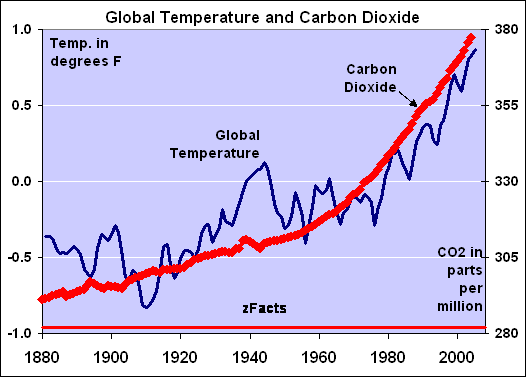
Well gosh darn, then how come the real measure of temp v CO2 concentration regresses out to a higher R^2 for a+bx than for a+bln(x)? *What's up with that?
Why is it that the history of temp increase, from 1880 to 1950 and from 1960 to the present are clearly both linear *How much you wanna bet that if you regress those two time frames, you'll get better fits to linear than to some ln function? And how come, over the entire range, you'll get a better fit to e^t than linear or ln?
Can't explain, just complain, eh! And if reality gets in the way, just skip that. Complaining is so more important.
flatulance said:Since I felt comp lack of discipline and apparent penchant for wasting your time and the server storage at USMB
flatulance said:"Even for the spans LESS than a doubling, there is a significant change in the slope of the curve !! And that's at point considerably far out on the curve."
Well gosh darn, then how come the real measure of temp v CO2 concentration regresses out to a higher R^2 for a+bx than for a+bln(x)? *What's up with that?
Why is it that the history of temp increase, from 1880 to 1950 and from 1960 to the present are clearly both linear *How much you wanna bet that if you regress those two time frames, you'll get better fits to linear than to some ln function? And how come, over the entire range, you'll get a better fit to e^t than linear or ln?
Can't explain, just complain, eh! *And if reality gets in the way, just skip that. *Complaining is so more important.
It's called a coincidence. *That's why now that the temps hav'nt followed the increase in CO2 the "theory" of AGW is collapsing. *That's why the scientific axiom "correlation does not equal causation" was coined. *Sadly for you, you guys ignored that very basic axiom and are being educated quickly because of that fact.
Well gosh darn, then how come the real measure of temp v CO2 concentration regresses out to a higher R^2 for a+bx than for a+bln(x)? *What's up with that?
Why is it that the history of temp increase, from 1880 to 1950 and from 1960 to the present are clearly both linear *How much you wanna bet that if you regress those two time frames, you'll get better fits to linear than to some ln function? And how come, over the entire range, you'll get a better fit to e^t than linear or ln?
Can't explain, just complain, eh! *And if reality gets in the way, just skip that. *Complaining is so more important.
It's called a coincidence. *That's why now that the temps hav'nt followed the increase in CO2 the "theory" of AGW is collapsing. *That's why the scientific axiom "correlation does not equal causation" was coined. *Sadly for you, you guys ignored that very basic axiom and are being educated quickly because of that fact.
Wrong.
Do you think that objects falling is just coincidence? *After all, feathers fall slowly and rocks fall quickly.
Correlation plus a physical mechanism is causation.
Sadly, you have no fundamental education in physics or statistics. *


