Executive Summary Of AGW, climate change.
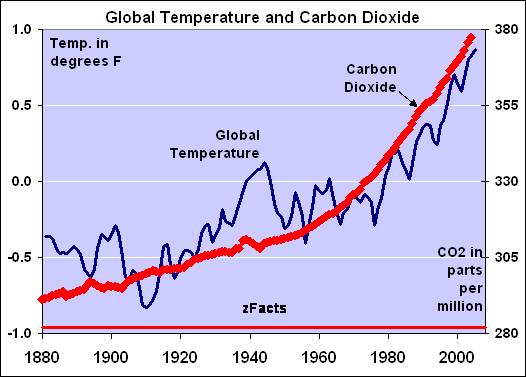
AGW is that CO2 and temperature have increased together, it is empirical. And the temperature change is driven by the CO2.
This is the history is increasing temp and CO2.
That CO2 absorbs infared radiation is the basis for the fact that the correlation is causal. It is a testable, empirical fact. In the laboratory, IR radiation can be demonstrated as absorbed by CO2.
CO2 is the same everywhere, that is why it has been identified as being a unique molecule. *If it changed, it would be something else. So, in the atmosphere, it acts just like in the laboratory.
Empirical correlation plus empirical demonstration equals causality. CO2 plus temperature equals global warming.
It's really just that simple.
Now, since 1880, temperature has gone up.
If something has happened repeatedly, in the past, then it is expected to happen in the future. Most people learn this as a child. When you hit your head against something and it hurts, you learn that hitting your head in the future will hurt again. *It's empirical.
Alternatively graph is shown here;
This gives two parametric equations, CO2 and temperature as functions of time. *Of course, time doesn't cause things. Time is simply a property of reality that measures change.
To get the correlation accurately and precisely, we plot temperature anomoly as a function of CO2.
Now, we can determine how the temperature anomoly is related to CO2.
The chi square for the ln fit is 0.459 and the chi square for the linear fit is 0.453. So the linear fit is slightly better, but probably within the measurement errors. The climate sensitivity searched to 2.29 away from 3. The linear parameters searched to -3.176 and 0.009468.
An alternate regeression may be found at;
Temp v CO2 Correlation
This regression analysis, is based on this data
Which yields
"The data points covered the period from 1880 to 2007 inclusive, so there were N = 128 data points. The regression line I found was:
Anom = -1876.715416 * + 325.8718284 ln CO2
The numbers in parentheses are "t-statistics," and they measure how significant the numbers above them are. The coefficient of the CO2 term is significant at p < 2.4483 x 10-41. That means the chances against the relationship being coincidental are less than 1 in about 4 x 1040.
The correlation coefficient is about 0.874, which means 76.4% of the variance is accounted for. Every other factor that affected temperature during this time span, then, accounted for 23.6%."
Now here we have a nice ln fit of
"Anom = -1876.715416 * + 325.8718284 ln CO2" where CO2 is ranging from 290.7 to 383.6. *lnCO2 ranges from 5.6723 to 5.9495."
Or we can go with either; anom=-3.176 + CO2 * 0.009468 for the more precise data or; anom=-3.08 + CO2 * 0.00922 for the full data.
A line fit or a log fit works as well. Basically, in atmosphere, over the range of CO2 and temp anomoly, the two are indistinguishable, within the bounds of variability due to other factors. *These are accurate. *
As the CO2 is coming from fossil fuel use and accounts for the increase in temperature, the conclusion is easy. It isn't complicated. *
And it accounts for all but 23.6% of the variability when just examining CO2. *The rest comes from other factors.
We may do the same with the solar variation
This is solar irradiance against temperature anomoly
which is also included in
Which also contains;
And if you do the linear regression on solar irradiation, that huge divergence guarantees that the R^2 will be less than for CO2.*
Obviously, CO2 is the gas responsible for holding the *suns heat in. So a regression against CO2 yields a higher R^2 because it accounts for the majority suns heat. If there were no sun, CO2 would yield nothing. *If there were no CO2, the Earth would be substantially colder. *CO2 and the sun yields multiple times more temperature. The CO2 multiplies the suns influence. *
The Solar Cycle and Global Warming ? Starts With A Bang
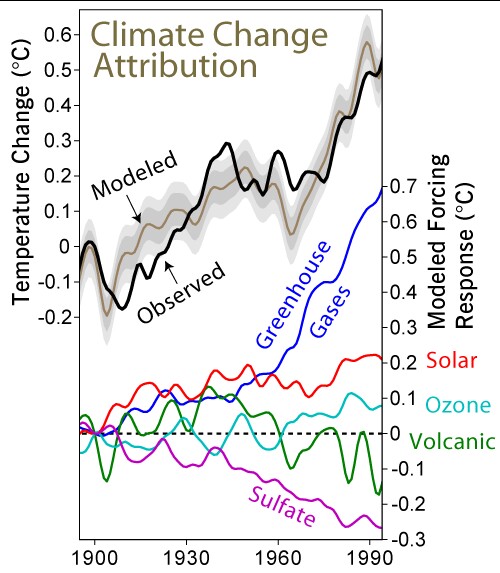
A more refined, and precise, regression analysis of CO2, solar activity, volcanic eruptions, El Nino, etc., yields
When all relevant factors are calculated, that is "added", using a number of methods, the combined results are
And, when different future scenarios are considered, the predicted future temperature is;
The science, in it's details, is far more complex than this overview. *It involves the work climatologists, geologists, oceanographers, and biologists. *Each of these broad categories has specialists, scientists that focus on very specific details of their field, much like there are different medical doctors; surgeons, pediatricians, and podiatrists. *
As the study progresses, the regression becomes more refined. *
Like Einstien refined Kepler, Kepler refined Newton, Newton refined Galileo, Galileo refined Copernicus, and Copernicus refined Pythagorus, the science keeps refining the prediction. *Pythagorus was right, Copernicus, Galileo, Newton, Kepler, and Einstein were all right.*
CO2 is correct, and solar, volcanos, ozone, and sulfates were added, to get closer and closer. *What was accurate is now even more precise.
These changes will not be exactly the same, everywhere. *AGW causes climate change. Climate change causes changing weather patterns.
There will be increased drought, sea level rise, flooding, changes in precipitation, longer summer seasons, movement of *mobile species, extinction of others, increased forest fires, and other effects. *And, worst of all, it will strain our mature agrigultural industries in providing for the current populations as crop yield falls as a result of droughts and changing precipitation patterns.
Most people are smart enough to not try to reinvent science. *If you are among those, you can now move forward because you have the mind of an executive. *
zFacts on Controversial Topics
Index of /pub/data/cmb/images/indicators
JMF:itfitzme