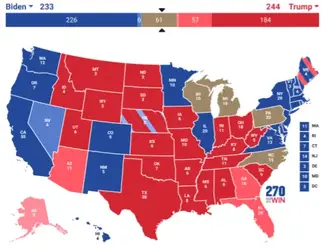
E - none of the above.
The several states will certify their results in the next few weeks and name their electors, those electors will vote on December 14, and that will be that. Same as any other election.
Rump of course will fire off petulant twits about how the Electoral College is "a disaster for a democracy" and they're all "losers" and proceed to melt into a corner sucking his thumb, rocking and making moaning noises for the next month. With any luck it will be live-streamed.
What makes you think republican [sic] state legislatures wont choose different electors?
The two party system has no real power under law
They can't. So says existing state laws.
It ain't a question of "the two party system". It's how the states handle the election, by their state's OWN LAW.
You're actually suggesting they're going to convene next week and try to change those laws??

Oh yeah that'll go over bigly.
The supreme court can overturn any law deemed not lawful or that interfered with constitutional rights.
The Constitution (of the US) doesn't even *REQUIRE* an election, Dumbass.
The issue of
voting rights in the United States, specifically the
enfranchisement and disenfranchisement of different groups, has been contested throughout
United States history.
Eligibility to vote in the United States is established both through the
United States Constitution and by state law. Several constitutional amendments (the
Fifteenth,
Nineteenth, and
Twenty-sixth specifically) require that voting rights of U.S. citizens cannot be abridged on account of race, color, previous condition of servitude, sex, or age for those above 18; the constitution as originally written did not establish any such rights during 1787–1870, except that if a state permitted a person to vote for the "most numerous branch" of its state legislature, it was required to permit that person to vote in elections for members of the United States House of Representatives.
[1] In the absence of a specific federal law or constitutional provision, each state is given considerable discretion to establish qualifications for suffrage and candidacy within its own respective jurisdiction; in addition, states and lower level jurisdictions establish election systems, such as
at-large or
single member district elections for county councils or school boards. Beyond qualifications for suffrage, rules and regulations concerning voting (such as the
poll tax) have been contested since the advent of
Jim Crow laws and related provisions that indirectly disenfranchised racial minorities.
A historic turning point arrived when the
Supreme Court under
Chief Justice Earl Warren ruled in 1964 that both houses of all state legislatures had to be based on election districts that were relatively equal in population size, under the "
one man, one vote" principle.
[2][3][4] The
Warren Court's decisions on two previous landmark cases—
Baker v. Carr (1962) and
Wesberry v. Sanders (1964)—also played a fundamental role in establishing the nationwide "one man, one vote"
electoral system.
[5][6] Since the
Voting Rights Act of 1965, the
Twenty-fourth Amendment, and related laws, voting rights have been legally considered an issue related to election systems. In 1972, the
Burger Court ruled that state legislatures had to redistrict every ten years based on census results; at that point, many had not redistricted for decades, often leading to a rural bias.
In other cases,[
which?] particularly for county or municipal elections,
at-large voting has been repeatedly challenged when found to dilute the voting power of significant minorities in violation of the Voting Rights Act. In the early 20th century, numerous cities established small commission forms of government in the belief that "better government" could result from the suppression of ward politics. Commissioners were elected by the majority of voters, excluding candidates who could not afford large campaigns or who appealed to a minority. Generally the solution to such violations has been to adopt
single-member districts (SMDs), but alternative election systems, such as
limited voting or
cumulative voting, have also been used since the late 20th century to correct for dilution of voting power and enable minorities to elect candidates of their choice.
The
District of Columbia and five major
territories of the United States have
one non-voting member each (in the
U.S. House of Representatives) and no representation in the
U.S. Senate. People in the U.S. territories cannot vote for
president of the United States.
[7] People in the District of Columbia can vote for the president because of the
Twenty-third Amendment.