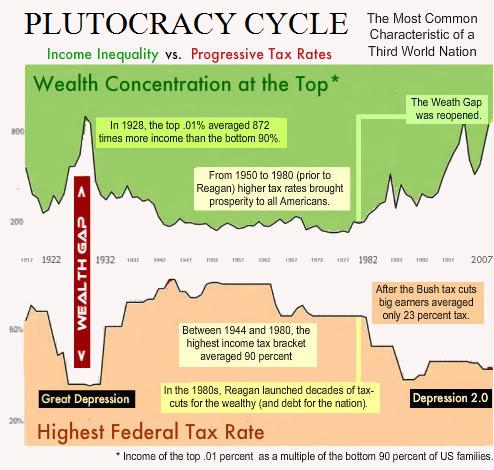
Uh -- we're not in 1956 anymore.. Nobody cares what FDR did for his recession because it's nothing like the world economical shrinkage we're seeing now.
And with what Obama has repeatedly said and done to orchestrate his class warfare act puts him WAAAAY to the left of even Truman or Kennedy.. It's NOT that Dem party anymore chump.. Even MAINSTREAM Dems are embarrassed over this blatant attack on economic freedom and Capitalism..
I KNOW my 1950--->1970 history. Don't need it respun..
BTW: Does anyone have a comment about the OP and how the engine has been ripped out of the car that Bush drove into the ditch and Obama is attempting to dismantle for scrap value?
Those who don't know history are destined to repeat it.
Edmund Burke
What NEVER works is what Herbert Hoover and Andrew Mellon did to bring on the Great Depression...liquidate, and austerity. They listened to the 'Austrian' school. Unless you also believe Medieval blood letting save lives?
Economic Policy Under Hoover
Throughout this declinewhich carried real GNP per worker down to a level 40 percent below that which it had attained in 1929, and which saw the unemployment rise to take in more than a quarter of the labor forcethe government did not try to prop up aggregate demand. The only expansionary fiscal policy action undertaken was the Veterans Bonus, passed over President Hoovers veto. That aside, the full employment budget surplus did not fall over 192933.
The Federal Reserve did not use open market operations to keep the nominal money supply from falling. Instead, its only significant systematic use of open market operations was in the other direction: to raise interest rates and discourage gold outflows after the United Kingdom abandoned the gold standard in the fall of 1931.
This inaction did not come about because they did not understand the tools of monetary policy. This inaction did not come about because the Federal Reserve was constrained by the necessity of defending the gold standard. The Federal Reserve knew what it was doing: it was letting the private sector handle the Depression in its own fashion. It saw the private sectors task as the liquidation of the American economy. It feared that expansionary monetary policy would impede the necessary private-sector process of readjustment.
Contemplating in retrospect the wreck of his countrys economy and his own presidency, Herbert Hoover wrote bitterly in his memoirs about those who had advised inaction during the downslide:
The leave-it-alone liquidationists headed by Secretary of the Treasury Mellon
felt that government must keep its hands off and let the slump liquidate itself. Mr. Mellon had only one formula: Liquidate labor, liquidate stocks, liquidate the farmers, liquidate real estate.
He held that even panic was not altogether a bad thing. He said: It will purge the rottenness out of the system. High costs of living and high living will come down. People will work harder, live a more moral life. Values will be adjusted, and enterprising people will pick up the wrecks from less competent people.
The Federal Reserve took almost no steps to halt the slide into the Great Depression over 192933. Instead, the Federal Reserve acted as if appropriate policy was not to try to avoid the oncoming Great Depression, but to allow it to run its course and liquidate the unprofitable portions of the private economy.
In adopting such liquidationist policies, the Federal Reserve was merely following the recommendations provided by an economic theory of depressions that was in fact common before the Keynesian Revolution and was held by economists like Friedrich Hayek, Lionel Robbins, and Joseph Schumpeter.
--------------------------------------------------------------------------------------------------
Mere parsimony (frugality, stinginess) is not economy. Expense, and great expense, may be an essential part in true economy.
Edmund Burke
300 Economists Warn Congress: Don't Kill Growth And Jobs In The Name Of Deficit Reduction
A small army of economists warned Congress on Thursday not to focus on deficit reduction instead of job creation or else risk a 1937-style double-dip recession.
"History suggests that a tenuous recovery is no time to practice austerity," says a statement signed by more than 300 economists and policy experts. "In the Great Depression, Franklin Roosevelt's New Deal generated growth and reduced the unemployment rate from 25 percent in 1932 to less than 10 percent in 1937. However, the deficit hawks of that era persuaded President Roosevelt to reverse course prematurely and move toward budget balance. The result was a severe recession that caused the economy to contract sharply and sent the unemployment rate soaring."
Democrats in Congress have had 1937 in mind since March 2009. "We're not going to let it happen again," vowed House Speaker Nancy Pelosi (D-Calif.) at the time.
Nevertheless, deficit hawks dominated the debate in Congress this summer as Democratic leaders struggled to reauthorize a series of programs created by the 2009 stimulus bill. Pelosi and her counterparts in the Senate have had seemingly little choice other than to sacrifice things like COBRA health insurance subsidies and enhanced unemployment benefits to win the support of deficit-hawkish Democrats and moderate Republicans.
"This is about a high road to recovery versus a low road to fiscal balance," said Bob Kuttner of the American Prospect and co-author of the statement, along with the Center for Economic and Policy Research's Dean Baker and the Robert Borosage and Roger Hickey from the Institute for America's Future. "The proper sequencing is: You get the recovery first, that requires increased public investment. And then the road to fiscal balance is much less arduous because people are working, businesses are investing, and tax revenues go up because you're back in recovery.
"There is also a low road to fiscal balance, where you have austerity and you get the budget balanced at the cost of whacking the real economy."
Click
HERE to download a PDF of the report.