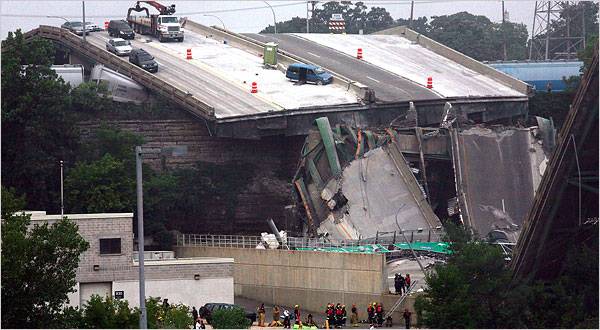
Im often struck by how much of our language has become metaphorical: A few years ago, a Fleet Street colleague accidentally booked himself into a conference on building bridges assuming it would be some multiculti community outreach yakfest. It turned out to be a panel of engineers discussing bridge construction. Yet in an important sense the ability to build real bridges is indeed an attribute of community. A friend of mine is a New Hampshire selectman, one of those municipal offices Tocqueville found so admirable. In 2003, a state highway inspector rode through and condemned one of the towns bridges, on a dirt road that serves maybe a dozen houses. Thats the bad news. The good news was the 80/20 state/town funding plan, under which, if you applied to Concord for a new bridge, the state would pay 80 percent of the cost, the town 20. So they did. The state estimated the cost at $320,000, so the towns share would be $64,000. Great. So the town threw up a temporary bridge just down river from the condemned one, and waited for the state to get going. Six years later, the temporary bridge has worn out, and the latest revised estimate is $655,000, such that the towns share would be $131,000.
Thats the bad news. The good news is that, under the stimulus bill, they can put in for the 60/40 federal/state bridge funding plan, under which the feds pay 60 percent, and the state pays 40, and thus the town would be on the hook for 20 percent of the 40 percent, if you follow. If they applied for the program now, the bridge might be built by, oh, 2015, 2020, and itll only be $1.2 million, or $4 million, or $12 million, or whatever the estimatell be by then.
But who knows? By 2015, there might be some 70/30 UN/federal bridge plan, under which the UN pays 70 percent, and the feds pay 30, and thus the town would only be liable for 20 percent of the states 40 percent of the feds 30 percent. And the estimate for the bridge will be a mere $2.7 billion. While the Select Board was pondering this, another bridge was condemned. The states estimate was $415,000, and, given that the previous bridge had been on the to-do list for six years, they werent ready to pencil this second one in on the schedule just yet. So instead the town put in a new bridge from a local contractor. Cost: $30,000. Dont worry; its all up to codeand a lot safer than the worn-out temporary bridge still waiting for the 80/20/60/40/70/30 deal to kick in. As my friend said at the meeting: Screw the state. Lets do it ourselves.
Screw the state is not a Tocquevillian formulation, but he would have certainly agreed with the latter sentiment. When something goes wrong, a European demands to know what the governments going to do about it. An American does it himself. Or he used toin the Jacksonian America a farsighted Frenchman understood so well. Human dignity, writes Professor Rahe, is bound up with taking responsibility for conducting ones own affairs. When the state annexes that responsibility, the citizenry are indeed mere sheep to the government shepherd. Paul Rahe concludes his brisk and trenchant examination of republican staying power with specific proposals to reclaim state and local power from Washington, and with a choice: We can be what once we were, or we can settle for a gradual, gentle descent into servitude. I wish I were more sanguine about how that vote would go.


 This administration is currently under investigation for the Fast and Furious program--now the Solyndra bankruptcy--that is looking like Obama pressured the Energy department to loan 1/2 billion in taxpayer dollars out of the stimulus bill--WITHOUT going through proper procedures and KNOWING that this company was not financially viable to loan this money too in the 1st place--along with 4 other green energy companies. And we have the e-mails to PROVE IT. And now we have another scandel regarding testimony from a 4 star general--that this administration pressured him to change his testimony.