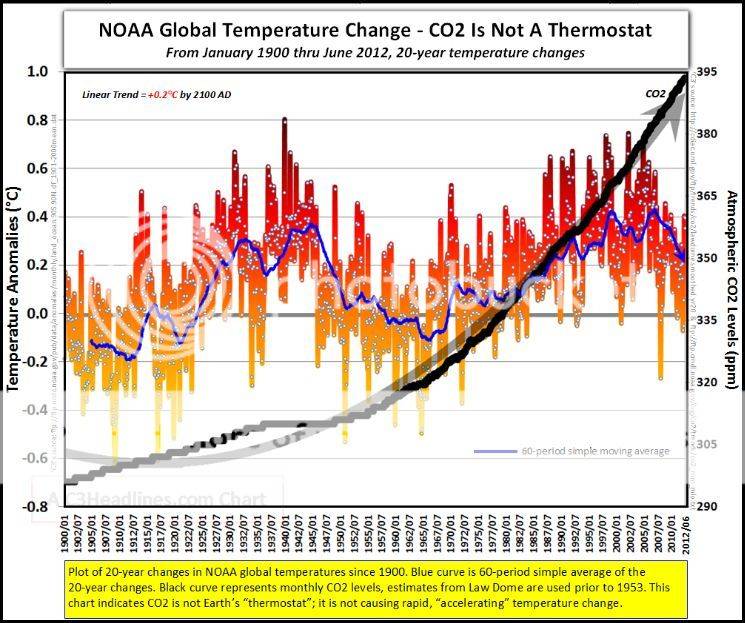
Regarding CO2;
The hypothesis is formed from a closed cylinder containing Argon gas and CO2 in varying concentrations. (argon does no interfere with down-welling high frequency solar radiation) They then passed sun light through the cylinder and measured the reflected amount of heat returning to the green surface below the cylinder. ( they measured original pass then placed the green screen and measured the heat reflection.) it resulted in this graph:
View attachment 31627
The problem comes when they take this graph and apply it in a non-linear atmosphere. Water vapor can render the gases traits null. when you consider that the gas can reflect high frequency energy it should cause some warming. The flip side of this coin is Black Body or long wave IR radiation. CO2 thins the water vapor so at night LWIR escapes easily in higher concentrations.
The offset is almost a 1-1 ratio. But then we add clouds, wind, oceans, etc and that warming effect is essentially gone.
The hypothesis is formed in the lab but in the functioning ecosystem of earth it is laid irrelevant. As I showed in the second post of this thread there is no coupling of temperature rise with CO2 levels. CO2 always lags temp by 200 years or so. We will be well into a cooling cycle before CO2 drops significantly.
IF you follow the X and Y axis notations you will see Degrees of temp rise Vs. Level of CO2 in PPM. From about O ppm to 270 ppm is 90% of the heat reflecting capability of this trace gas. above 270 to our current level of 398ppm we see just 0.4 deg C of potential warming. From our point today out to above 1000ppm we will see roughly 0.4 deg C potential from this trace gas.
The so called Sensitivity is how water vapor responds to this trace gas and as empirical evidence has shown, they are decoupled and may even be a Negative factor allowing greater cooling at the poles due to extended darkness. Just the opposite of what the alarmists have been stating.