The release of methane from the Arctic is in itself a contributor to global warming as a result of polar amplification. Recent observations in the Siberian arctic show increased rates of methane release from the Arctic seabed.[4] Land-based permafrost, also in the Siberian arctic, was also recently observed to be releasing large amounts of methane, estimated at over 4 million tons significantly above previous estimates.[11]
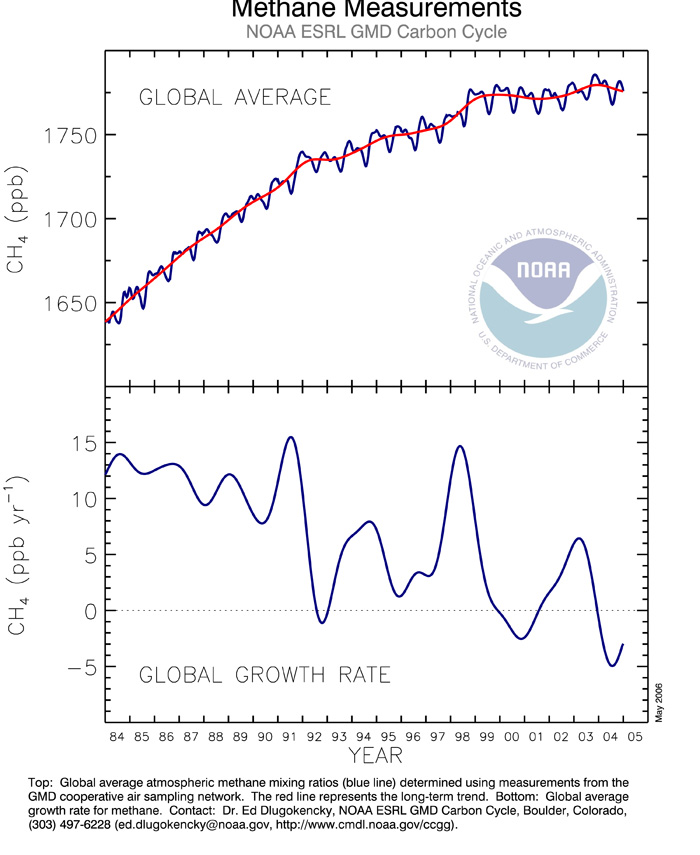
In the plot showing the global atmospheric methane concentration (the significant measure from the viewpoint of global warming and radiative forcing), however, the rate of the increase in atmospheric methane has been slowing until 2004, indicating that the contribution from Arctic release is currently not the dominant factor in the global picture.
Current methane release has previously been estimated at 0.5 Mt per year.[12] Shakhova et al. (2008) estimate that not less than 1,400 Gt of Carbon is presently locked up as methane and methane hydrates under the Arctic submarine permafrost, and 5-10% of that area is subject to puncturing by open taliks. They conclude that "release of up to 50 Gt of predicted amount of hydrate storage [is] highly possible for abrupt release at any time". That would increase the methane content of the planet's atmosphere by a factor of twelve.[13]
In 2008 the United States Department of Energy National Laboratory system[14] identified potential clathrate destabilization in the Arctic as one the most serious scenarios for abrupt climate change, which have been singled out for priority research. The U.S. Climate Change Science Program released a report in late December 2008 estimating the gravity of the risk of clathrate destabilization, alongside three other credible abrupt climate change scenarios.[15]
4. ^ a b c Shakhova, Natalia (2005). "The distribution of methane on the Siberian Arctic shelves: Implications for the marine methane cycle". Geophysical Research Letters 32 (9): L09601. Bibcode:2005GeoRL..3209601S. doi:10.1029/2005GL022751.
5. ^ a b c Shakhova, Natalia; Semiletov, Igor (2007). "Methane release and coastal environment in the East Siberian Arctic shelf". Journal of Marine Systems 66 (14): 227243. Bibcode:2007JMS....66..227S. doi:10.1016/j.jmarsys.2006.06.006
6. ^ Climate Change 2001: The Scientific Basis (Cambridge Univ. Press, Cambridge, 2001)
7. ^ N. E. Shakhova, I. P. Semiletov, A. N. Salyuk, N. N. Belcheva, and D. A. Kosmach, (2007). "Methane Anomalies in the Near-Water Atmospheric Layer above the Shelf of East Siberian Arctic Shelf". Doklady Earth Sciences 415 (5): 764768. Bibcode:2007DokES.415..764S. doi:10.1134/S1028334X07050236.
8. ^ Torn, M.; Chapiniii, F. (1993). "Environmental and biotic controls over methane flux from Arctic tundra". Chemosphere 26: 357. doi:10.1016/0045-6535(93)90431-4. edit
9. ^ Whalen, S. C.; Reeburgh, W. S. (1990). "Consumption of atmospheric methane by tundra soils". Nature 346 (6280): 160. Bibcode:1990Natur.346..160W. doi:10.1038/346160a0. edit
10. ^ Kerr, R. A. (2010). "'Arctic Armageddon' Needs More Science, Less Hype". Science 329 (5992): 620621. doi:10.1126/science.329.5992.620. PMID 20688993. edit: Transcript of related podcast "Science Podcast". Science 329 (5992): 697691. 2010. doi:10.1126/science.329.5992.697-b. edit
11. ^ Walter, Km; Zimov, Sa; Chanton, Jp; Verbyla, D; Chapin, Fs, 3Rd (Sep 2006). "Methane bubbling from Siberian thaw lakes as a positive feedback to climate warming". Nature 443 (7107): 715. Bibcode:2006Natur.443...71W. doi:10.1038/nature05040. ISSN 0028-0836. PMID 16957728.
12. ^ Shakhova N., Semiletov I., Salyuk A., Kosmach D., Bel'cheva N. (2007). "Methane release on the Arctic East Siberian shelf". Geophysical Research Abstracts 9: 01071.
13. ^ N. Shakhova, I. Semiletov, A. Salyuk, D. Kosmach (2008), Anomalies of methane in the atmosphere over the East Siberian shelf: Is there any sign of methane leakage from shallow shelf hydrates?, EGU General Assembly 2008, Geophysical Research Abstracts, 10, EGU2008-A-01526
14. ^ IMPACTS: On the Threshold of Abrupt Climate Changes, Lawrence Berkeley National Laboratory News Center, 17 September 2008
15. ^ CCSP, 2008: Abrupt Climate Change. A report by the U.S. Climate Change Science Program and the Subcommittee on Global Change Research (Clark, P.U., A.J. Weaver (coordinating lead authors), E. Brook, E.R. Cook, T.L. Delworth, and K. Steffen (chapter lead authors)). U.S. Geological Survey, Reston, VA, 459 pp.