We have an interesting Ukrainian view on the elections.
The future government of Germany: with an alternative, but without an "Alternative"
Although the German conservatives are winning the battle for electoral preferences, they cannot avoid a coalition. The only question is whether it will be two- or three-party. It is known for sure that the xenophobic, pro-Kremlin Alternative for Germany (AfD), despite its growing popularity, will not be included in the next government.
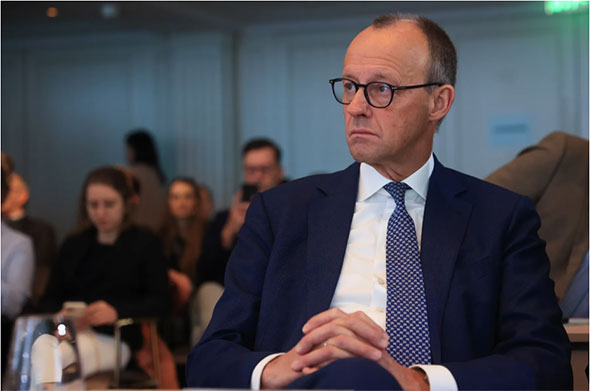
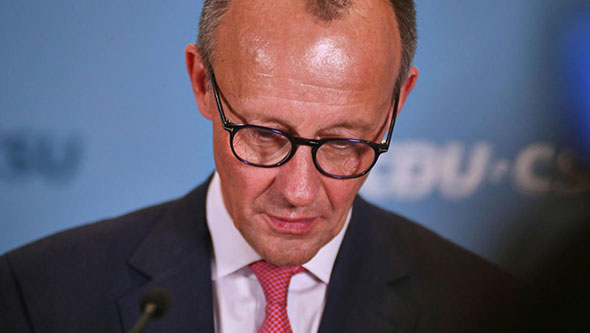
The center-right alliance - the Christian Democratic Union and its Bavarian sister party Christian Social Union - under the leadership of Friedrich Merz, according to a recent sociology, wins around 30 percent of the vote. That is, he remains the uncontested leader of electoral sympathies. Therefore, the question now is not who will be the next chancellor of Germany, but with which of their political opponents the Hadecks will form a government.
And now, all parliamentary parties in Germany are to one degree or another opponents of the CDU/CSU, even the Union 90/Greens, with which the conservatives have very close approaches to the important issue of military aid to Ukraine. However, on such an irritating issue for Germans as the migration policy, the conservatives and the Greens have diametrically opposite approaches.
The opponents are liberals from the Free Democratic Party (FDP), even though they have been natural accomplices of the CDU/CSU since the partition of Germany and in the 1990s.
The eternal opponent of the CDU/CSU is the Social Democratic Party of Germany, although both political forces have repeatedly had to create a "grand coalition".
Tough opponents are the Left Party and the even more left-wing Sarah Wagenknecht Union. And the most annoying opponent is the already mentioned AfN, because it is so drawn to trample on the electoral field of the Hadeks.
So while the overall winner of the February 23 election looks boringly predictable, although we are almost certain that the chancellor's chair has been reserved for Friedrich Merz, the composition of the coalition still hangs firmly in the air. Therefore, elections are only the beginning of history.
So what exactly does sociology predict for us? For example, according to the results of an opinion poll conducted this week by the demographic institute
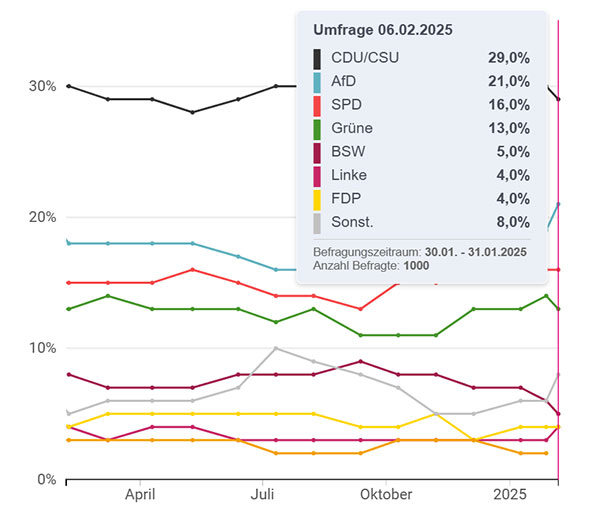
Ipsos, if the elections to the Bundestag were held this Sunday, the CDU/CSU bloc would gain 29%. Despite a slight drop (-1%) over the past week, the Hadecks are still significantly ahead of all other parties. In second place, unfortunately, with 21 percent is the far-right Alternative for Germany (AfD). The current ruling SPD is expected to gain the support of only 16 percent of the population. The coalition partner of the Social Democrats – the Greens – can count on 13%. The rest of the parties are on the verge of overcoming the electoral barrier of five percent.
According to politicians from Merz's party, the least favorable election result for them would be a situation where a three-party coalition would have to be formed. The experience of the past four years has clearly shown how limited the government is in its actions at that time, what violent inter-party strife can arise due to many issues of domestic and foreign policy. An unstable three-party alliance would be an echo of the problems that plagued the last SPD-led government in alliance with the liberal FDP and the Greens, whose December collapse led to these snap elections.
What are the possible configurations of the future coalition alliance. At the moment, only one thing can be said for sure: there will be no place for AfN in it. All other parties stated in advance that they categorically reject the possibility of working with "alternatives" in one coalition.
In all other eventual scenarios, much will depend on what share of votes each party receives compared to the others. Let's try to play this game.
If the center-right and center-left, i.e. the CDU/CSU and the SPD (these two parties were once called "people's" precisely because of their strong electoral support for both political forces) successfully hold elections, then the likelihood of the formation of the so-called "Grand Coalition" (
Große Koalition or
GroKo for short) will increase. This configuration of power in Germany, despite its political unnaturalness, has already become quite common in recent years. Since 1949, Germany has been ruled by
GroKo four times. And three of them were during the time of former Bundeschancellor Angela Merkel, that is, already in the XXI century.
However, since Friedrich Merz led the conservatives, they have shifted significantly to the right. This is how they had to respond to migration problems in the country and to the growing popularity of the AfD, which successfully instrumentalized these problems. This circumstance makes future compromises with the center-left more difficult, but by no means hopeless.
"It won't be easy after the election," Merz said this week. The question of whether he would prefer to cooperate with the SPD, or try his luck with another party, at least with the same "greens", he left open.
In this context, it is interesting to recall the case of the leader of the CDU of the state of Hesse, Boris Rein. He is currently the current prime minister of this land, although after the 2023 regional elections, his premiership hung in the balance. However, Rein managed to quarrel between the SPD and the Greens through subtle intrigues. When the deed was done, he persuaded the SPD to cooperate as a junior partner.
Merz often spoke of Hesse as a role model. At the national level, the SPD is also expected to be more flexible, especially when it comes to tackling illegal migration, which is a key promise of Merz.
If the "Grand Coalition" becomes a reality, and most political analysts are inclined to this, then the current Bundeschancellor Olaf Scholz will not participate in the government. He has previously stated that he categorically rejects his participation in such a cabinet with conservatives. But which of the Social Democrats will gain weight for
GroKo is the current Minister of Defense Boris Pistorius. By the way, many among the SPD advocated that Pistorius should become the party candidate for chancellor. However, it didn't work out - Scholz remained.
The coalition of conservatives and greens also has its chance of success, although not as big as
GroKo. Such a coalition is jokingly called "Kiwi" (after the black and green party colors, which are also present in this fruit). Currently, three of Germany's 16 states are under the rule of the Kiwi coalition. But such an alliance would be a novelty at the national level.
From a political point of view, there are many points of contact in matters of foreign policy and defense spending. It is worth recalling that both parties sharply criticized Scholz for his indecision in supporting Kyiv. Therefore, such an alliance would be very desirable for Ukraine, because, as already mentioned, both of these parties are in favor of strengthening military assistance to the Armed Forces of Ukraine. The chances that we would finally receive the long-awaited
TAURUS missiles for the Kiwi would increase significantly.
But their positions on migration differ significantly: Merz promised to close Germany's borders on the very first day of his tenure, and the Greens consider such plans illegal. This split on the migration issue deepened last week when Merz, pushing through his initiatives to limit migration, did not even disdain to ask the AfD for support. And such an extravagant step significantly weakened Germany's so-called firewall against the far right and sparked a fierce election debate about the country's post-war identity. In this way, Merz tried to appeal to voters who are constantly struggling because of migration problems. However, everything turned out exactly the opposite: the CDU/CSU lost one percentage point of electoral support, and the AfD, on the contrary, gained.
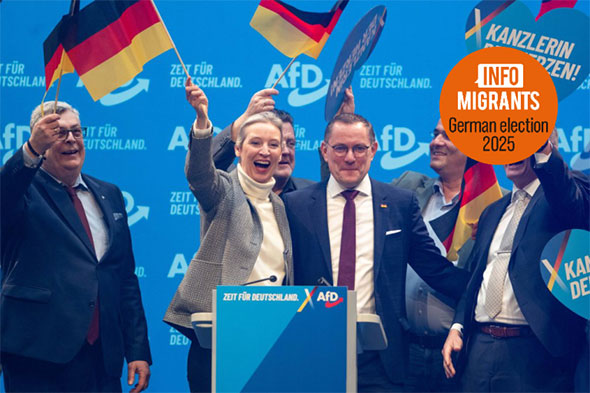
But, as already mentioned, a three-party coalition is also possible. It is worth recalling right away that post-war Germany does not have a large and even more positive experience of coalitions of more than two parties. The triad of incumbent Chancellor Olaf Scholz, which was formed after the 2021 elections, was the first not very successful tripartite alliance in more than six decades of Germany's political history. Although the current political fragmentation and the end of traditional bipartisan dominance may make such arrangements the new normal.
In fact, a tripartite alliance could be difficult to avoid if two of the three small parties – the Union 90/Greens, the FDP and the Left Party – that are currently in parliament re-enter the Bundestag.
In this case, the most likely options will be the so-called "German" coalition consisting of the CDU/CSU, SPD and FDP. She received the nickname "German" again for the party colors, which miraculously fold into the national flag of Germany - black, red, yellow.
Less likely is the "Kenyan" coalition – the CDU/CSU, SPD and the Greens. Here, the colors of the parties correspond to the already black-red-green flag of Kenya.
Analysts believe that such a scenario leading to a three-party coalition is highly undesirable, since sharp disagreements between coalition partners will lead to the fact that the next government will be no more quarrelsome than the previous one. And then the risk of another early election will increase significantly.
07.02.2025
Німецькі консерватори хоч і виграють бій за електоральні преференції, але коаліції їм не уникнути. Питання лише в тому: буде вона дво- чи трипартійною.

zbruc.eu