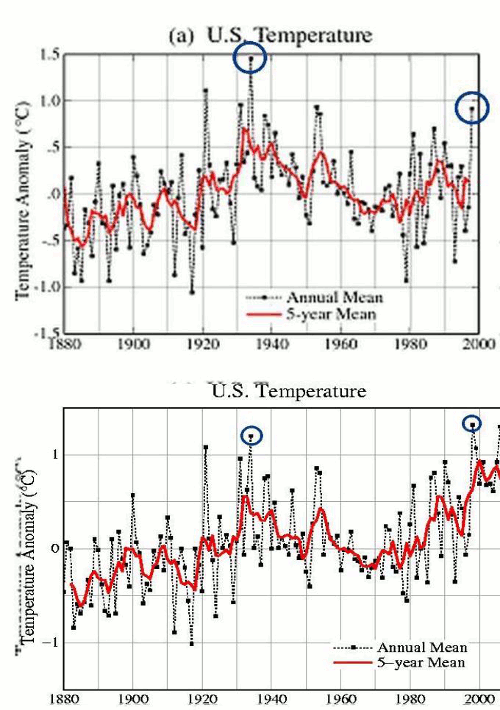
We are ******* up this planet beyond recognition. Warning signs everywhere on not just climate change but on environmental degradation.
Do not vote for anyone that denies climate change. Do not vote for anyone that favors gutting our environmental laws. Future generations depend on it.
'We've never seen this': massive Canadian glaciers shrinking rapidly
Here's the science that you DONT know..
Ice is a very poor thermometer. It's the WORST indicator of GW. It melts only above 0degC, not including insolation and re-freeze effects. You can melt the same volume of ice with a one day temperature of 2degC as you will with a 100 day anomaly of 0.02DegC.. So it's sensitive to WEATHER effects..
It's also in the glaciers VERY susceptible to "blackening" from pollution swept in from as far away as China. So it's hard to separate GW effects from CO2 from carbon blackening.
If you look at an actually science paper (which I doubt you ever do) the most OBVIOUS FACT is that these numbers that the media flings around are very subjective and soft. That 22% quoted by lay press is the HIGH estimate of numbers that have a "confidence bound" almost as large as the number itself. So in REALITY -- that 22% could become 12% +/- 10% --- with LOW END OF THE ESTIMATE for loss since 1958 being as low as 2%.
WHY are the numbers THAT UNCERTAIN? Because in the science papers, they are filled with what the scientists DONT KNOW. And they really don't try to hide it. Except when they issue the press release, the know-nothing media will ALWAYS PICK -- the highest scariest numbers.
Force yourself to READ some of the science. Stop pissing you pants and learn how little is actually known..
https://agupubs.onlinelibrary.wiley.com/doi/full/10.1029/2009GL042030
[1] Glaciers in the Yukon, NW Canada, lost 22% of their surface area during the 50 years following the 1957–58 International Geophysical Year, coincident with increases in average winter and summer air temperatures and decreases in winter precipitation. Scaling these results to ice volume change, we obtain a total mass loss of 406 ± 177 Gt, which accounts for 1.12 ± 0.49 mm of global sea‐level rise. Yukon glaciers thinned by 0.78 ± 0.34 m yr−1 water equivalent, a regional thinning rate exceeded only by mountain glaciers in Patagonia and Alaska. Our scaling analysis suggests the remaining glaciers have the capacity to contribute a further 5.02 mm to global sea‐level rise.
1. Introduction
[2] The response of glaciers and ice caps (GIC) to climate change is an issue of significant public and scientific concern because of its implications for global sea‐level rise (SLR). In addition to ocean thermal expansion, the present day sea‐level budget attributes ∼half of observed SLR to the ice sheets and ∼half to mass losses from GIC [Cazenave et al., 2009]. The GIC contribution to SLR has accelerated over the past decade [Meier et al., 2007], yet the errors associated with estimates of this contribution are often large. Reducing them requires comprehensive studies of regional‐scale glacier changes, particularly from undersampled areas that have experienced substantial climate change in recent decades.
[3] Although ∼10,000 km2 of the Yukon, NW Canada, is glacier covered (Figure 1), very little is known about the health of these glaciers due to an absence of field measurements and the difficulty of estimating regional‐scale volume changes. NW North America has experienced significant climate change over the past half century, with increases in average winter (October‐April, 2.0 ± 0.8°C) and summer (May‐September, 1.0 ± 0.4°C) air temperatures and a small increase in precipitation (albeit significant at just 17% of sites) recorded at 67 National Oceanic and Atmospheric Administration (NOAA) and Environment Canada weather stations [Arendt et al., 2009]. Of these stations, the 14 located within the Yukon record similar summer warming (0.99°C), yet a reduction in winter precipitation (on average, −22 mm). Regional climate warming, reduction in winter precipitation and increases in freezing level heights (FLHs) [Arendt et al., 2009] suggest that both the maritime (St. Elias (Figure 1b)) and interior (Mackenzie (Figure 1c)) glacier populations of the Yukon may have experienced large losses during the past 50 years.
Let me focus some of that for you.. The 2degC +/- 0.8degC in the WINTER -- is not the source of ice melt. But the LACK OF PRECIPT in the winter IS.. And AGAIN, the summer temp anomaly has an "error bar" nearly as large as the mean value.
Note -- how little is KNOWN and how it's EMPHASIZED. If you want credibility on the topic, divest yourself of the "science is settled" bullshit -- even if it requires daily enemas for a month. It's NO WHERE NEAR "settled"...