
Pretty damned good article on the hows and why's of the Fordow hit. Long but very excellent article explains the logistics of relocating the Iranium to another locale and what was seen by satellite. Long article but full of well informed information.
The story begins with satellite imagery. On June 19 and 20, sixteen large dump trucks were observed at Fordow. They were not empty, nor discreet. These were trucks of a kind suited to hauling construction materials, cement, earth-moving equipment, steel sheeting. Analysts who reviewed the imagery noted bulldozers actively placing cement covers over air shafts. These shafts are the known weak points in any deeply buried complex, where pressure and airflow must meet engineering limits, but where adversaries might also insert precision-guided munitions. To harden these vulnerabilities is to reinforce the very purpose of Fordow: to endure.
Crucially, none of the observed trucks were the type required to transport nuclear material. Not one matched the profile of the secure, shielded 18-wheelers required by nuclear handling protocols. Nor did they appear to be departing the facility. Most were simply repositioned about a kilometer northwest of the core site, well outside the blast radius, but still within operational range. One truck stood near the main entrance, but again, not the kind of vehicle suited to carry fissile material. There is no visual evidence of loading, no convoy, no escort vehicles, no attempt to obscure or evade. In short, there is no movement that even faintly resembles a uranium exfiltration.
To understand the impossibility of the uranium having been removed, one must first understand what moving enriched uranium entails. Iran is believed to have had approximately 900 kilograms of uranium enriched to 60 percent at Fordow. That quantity, in powder form, must be stabilized into uranium oxide and then sealed into thirty separate Type B(U) containers. Each container stands four feet tall, nearly two feet wide, and weighs between 1,100 and 1,760 pounds. These are not tossed in the back of a truck like crates of fruit. They require fixed cradles, meticulous spacing of at least three to four feet to avoid criticality risks, and strict handling by trained nuclear engineers and radiation safety officers. Criticality risk arises when excessive fissile material, like enriched uranium, is placed too closely together under certain configurations, such that it could support a self-sustaining nuclear chain reaction. Even though each container is subcritical on its own, improper spacing or environmental conditions could elevate the risk. Therefore, these containers must be spaced deliberately and isolated by materials designed to absorb or block neutrons, ensuring absolute containment and safety.
____________________
So what explains the disinformation? Likely, it is a classic tactic: inject doubt into the aftermath. Suggest that the uranium may still be intact. Foster fear, uncertainty, and doubt. The acronym is apt: FUD. And FUD is a tool of both state propaganda and media opportunism. By seeding the idea that the strike failed to eliminate the core threat, Iran preserves psychological deterrence. It invites domestic pride, foreign caution, and diplomatic ambiguity. But propaganda is not proof. Narratives are not facts. Trucks moving cement are not trucks moving uranium.
__________________
The simplest explanation is the correct one. The uranium remained in place. The reinforcements observed on June 19 and 20 were desperate attempts to patch weak points, to survive the coming assault. Fordow did not empty, it braced. And when the bunker-busters landed, they hit their mark.
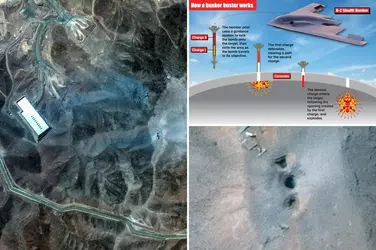
The story begins with satellite imagery. On June 19 and 20, sixteen large dump trucks were observed at Fordow. They were not empty, nor discreet. These were trucks of a kind suited to hauling construction materials, cement, earth-moving equipment, steel sheeting. Analysts who reviewed the imagery noted bulldozers actively placing cement covers over air shafts. These shafts are the known weak points in any deeply buried complex, where pressure and airflow must meet engineering limits, but where adversaries might also insert precision-guided munitions. To harden these vulnerabilities is to reinforce the very purpose of Fordow: to endure.
Crucially, none of the observed trucks were the type required to transport nuclear material. Not one matched the profile of the secure, shielded 18-wheelers required by nuclear handling protocols. Nor did they appear to be departing the facility. Most were simply repositioned about a kilometer northwest of the core site, well outside the blast radius, but still within operational range. One truck stood near the main entrance, but again, not the kind of vehicle suited to carry fissile material. There is no visual evidence of loading, no convoy, no escort vehicles, no attempt to obscure or evade. In short, there is no movement that even faintly resembles a uranium exfiltration.
To understand the impossibility of the uranium having been removed, one must first understand what moving enriched uranium entails. Iran is believed to have had approximately 900 kilograms of uranium enriched to 60 percent at Fordow. That quantity, in powder form, must be stabilized into uranium oxide and then sealed into thirty separate Type B(U) containers. Each container stands four feet tall, nearly two feet wide, and weighs between 1,100 and 1,760 pounds. These are not tossed in the back of a truck like crates of fruit. They require fixed cradles, meticulous spacing of at least three to four feet to avoid criticality risks, and strict handling by trained nuclear engineers and radiation safety officers. Criticality risk arises when excessive fissile material, like enriched uranium, is placed too closely together under certain configurations, such that it could support a self-sustaining nuclear chain reaction. Even though each container is subcritical on its own, improper spacing or environmental conditions could elevate the risk. Therefore, these containers must be spaced deliberately and isolated by materials designed to absorb or block neutrons, ensuring absolute containment and safety.
____________________
So what explains the disinformation? Likely, it is a classic tactic: inject doubt into the aftermath. Suggest that the uranium may still be intact. Foster fear, uncertainty, and doubt. The acronym is apt: FUD. And FUD is a tool of both state propaganda and media opportunism. By seeding the idea that the strike failed to eliminate the core threat, Iran preserves psychological deterrence. It invites domestic pride, foreign caution, and diplomatic ambiguity. But propaganda is not proof. Narratives are not facts. Trucks moving cement are not trucks moving uranium.
__________________
The simplest explanation is the correct one. The uranium remained in place. The reinforcements observed on June 19 and 20 were desperate attempts to patch weak points, to survive the coming assault. Fordow did not empty, it braced. And when the bunker-busters landed, they hit their mark.
Last edited:


 Conclusion:


